What Is a Briquetting Machine and Why Southeast Asian Factories Need One
A briquetting machine compacts loose metal chips, turnings, and swarf into dense, solid briquettes using high hydraulic pressure. For factories in Vietnam, Indonesia, Thailand, Malaysia, and the Philippines that generate metal waste from machining, casting, or fabrication operations, this equipment addresses three persistent problems: low bulk density that drives up transport and storage costs, cutting fluid residue that complicates handling, and reduced resale value when selling loose contaminated chips to foundries.
Tiangong's product line includes the TG-BriqPress 250, a standalone hydraulic briquetting machine that processes steel, cast iron, aluminum, copper, and brass chips. It raises bulk density from 0.2–0.5 t/m³ (loose chips) to approximately 2.0–2.5 t/m³ (compact briquettes), a 5–8x improvement that directly reduces logistics costs and increases foundry resale value.
Types of Briquetting Machines
Standalone Hydraulic Briquetting Press
The standalone configuration is the most common choice for machining facilities with a single dominant chip type. The TG-BriqPress 250 fits this category: a self-contained hydraulic press that accepts loose chips through a hopper, compacts them in a cylindrical chamber, and discharges finished briquettes. It is suited for facilities where the chip stream is relatively clean and homogeneous-steel turnings from a lathe shop, or aluminum swarf from an extrusion plant.
Key advantages of the standalone press:
- Simpler installation and lower capital cost than a full line
- Flexible placement-can be positioned near the machining area
- Handles multiple metal types with chamber and pressure adjustments
- Cutting fluid drains during compaction and can be collected for recycling
Integrated Recycling Line with Briquetting Press
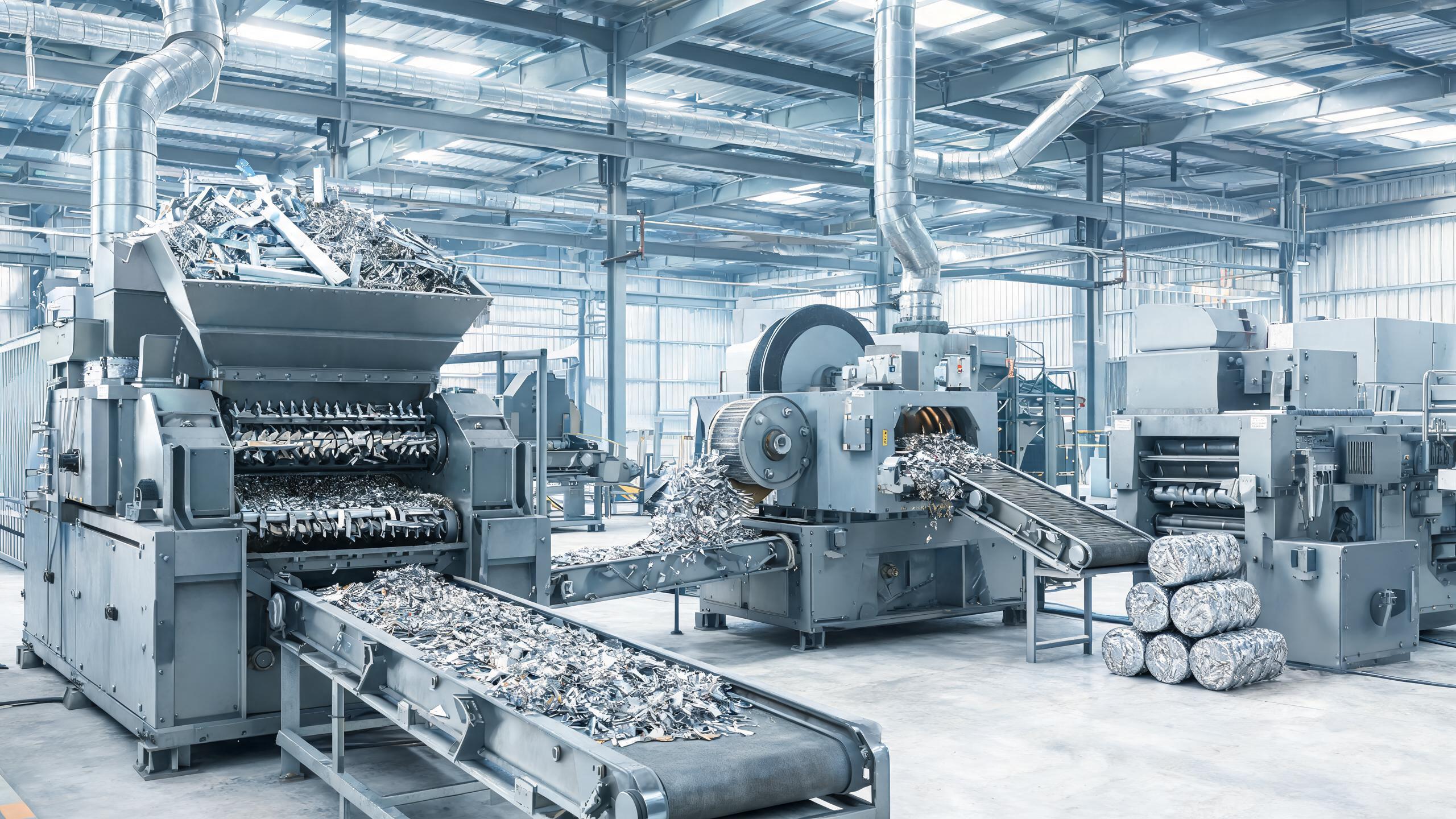
When the feed stream is mixed, contaminated, or varies significantly in size, a standalone press may not be sufficient. Integrated lines combine shredding, separation, and briquetting into a continuous process. Two Tiangong products illustrate this approach:
TG-AluLine 200 Aluminum Scrap Recycling Processing Line: A four-stage system combining a twin-shaft shredder, magnetic contaminant removal, eddy current separator, and hydraulic briquetting press. It is designed for aluminum machining facilities processing 3 to 15 tonnes per day of turnings with cutting fluid residue, extrusion offcuts, and sheet scrap. The unified PLC control system manages stage sequencing and interlocks-if the eddy current separator pauses, upstream feeding automatically stops to prevent material spillage.
TG-ScrapLine 150 Integrated Scrap Processing System: A turnkey 15 t/h scrap processing line for mixed ferrous scrap, combining a twin-shaft shredder, overband magnetic separator, and hydraulic briquetting press. The briquetting press raises bulk density above 4.0 t/m³ for ferrous briquettes, maximizing per-tonne sale value. It is CE certified and manufactured under ISO 9001 quality management.
Working Principle of a Hydraulic Briquetting Machine
Understanding how a briquetting machine works helps buyers evaluate specifications and maintenance requirements. The process follows four stages:
- Feeding: Loose metal chips are loaded into the hopper, either manually, by conveyor, or by an automated feed system. The hopper design must prevent bridging of stringy turnings.
- Compaction: A hydraulic ram pushes the chips into a cylindrical compaction chamber at high pressure. The pressure forces chips into intimate contact, causing mechanical interlocking and plastic deformation of the metal particles.
- Fluid extraction: During compaction, residual cutting fluid and coolant are squeezed out of the chip matrix. Drain points collect this fluid for recycling or disposal.
- Discharge: The finished briquette is ejected from the chamber as a dense, cylindrical block-typically 50–80 mm in diameter depending on the machine configuration. The cycle repeats automatically.
The hydraulic system is the core of the machine. Consistent hydraulic pressure across cycles determines briquette density and quality. The TG-BriqPress 250 uses a dedicated hydraulic power pack with its own oil reservoir and filtration system-maintaining oil quality and filter condition is essential for consistent performance.
Cost Savings and Return on Investment
| Cost Factor | Without Briquetting | With Briquetting Machine |
|---|---|---|
| Transport cost per tonne | High (low-density payload) | 5–8x reduction in volume |
| Cutting fluid loss | Fluid lost with chips | Fluid recovered during compaction |
| Foundry/scrap dealer price | Lower (contaminated, loose) | Higher (clean, dense, furnace-ready) |
| Storage space | Bins or piles occupying floor area | Compact briquette stacks |
| Environmental compliance | Fluid-contaminated chips harder to dispose | Cleaner waste stream, recoverable fluid |
The return on investment period depends on daily chip volume, material type, and current disposal costs. Facilities generating 3+ tonnes of metal chips per day typically see faster payback due to the volume of transport savings and cutting fluid recovery. Higher-value metals like copper and brass generate the quickest ROI, as the density improvement and cleanliness premium are proportionally greater.
Southeast Asian Application Scenarios
Vietnam: Precision Machining Workshops
Vietnam's manufacturing sector has expanded rapidly, with many facilities in the north (Bac Ninh, Hai Phong) and south (Binh Duong, Dong Nai) producing metal components for electronics, automotive, and consumer goods. These workshops generate steel and aluminum chips that currently go to scrap dealers at low prices. A briquetting machine lets them sell furnace-ready briquettes directly to foundries at higher rates while reducing workshop clutter.
Indonesia: Aluminum and Copper Processing
Indonesia's metals industry spans Java, Sumatra, and Kalimantan, with significant aluminum and copper processing. Long transport distances between islands make bulk density critical-briquetting aluminum swarf from 0.3 t/m³ to 2.0+ t/m³ dramatically reduces inter-island shipping costs. The TG-AluLine 200's integrated shredding and magnetic separation addresses the contamination common in Indonesian scrap streams.
Thailand: Automotive Parts Manufacturing
Thailand's automotive supply chain generates large volumes of steel and aluminum machining chips. Facilities serving Japanese and Western OEMs operate under strict quality and environmental standards. Briquetting machines support both cost management and environmental compliance by producing clean, transportable briquettes and recovering cutting fluid.
Malaysia and Philippines: Electronics and Non-Ferrous
Electronics manufacturing in Penang and Cebu generates copper, brass, and aluminum swarf. These higher-value metals offer strong briquetting ROI-the density improvement and cleanliness premium are proportionally greater than for steel. The TG-BriqPress 250 handles all these materials.
Specifications to Confirm at Inquiry
- Dominant and secondary chip material types
- Daily chip generation volume (average and peak)
- Cutting fluid or coolant type and whether recovery is needed
- Target briquette density and diameter
- Site power supply (voltage and frequency, 50 Hz or 60 Hz)
- Available floor space and overhead clearance
- Whether feed material requires pre-shredding (stringy turnings, large pieces)
- Whether magnetic separation or eddy current separation is needed for contaminated feed
Tiangong operates a 12,000 m² production facility founded in 2008, manufacturing under ISO 9001 quality management. Every briquetting machine ships with installation supervision, operator training, a 12-month warranty, and a spare-parts kit. Standard lead time for replacement wear parts is under 45 days. The engineering team configures compaction chamber dimensions, hydraulic pressure settings, and hopper design to match each buyer's specific chip characteristics and processing volume.