Why Southeast Asian Scrap Yards Need the Right Metal Recycling Equipment
Across Southeast Asia, scrap metal volumes are rising fast. Indonesia's nickel pig iron sector generates slag and stainless steel scrap as a byproduct. Thailand's automotive dismantling industry produces thousands of tons of vehicle hulks monthly. In Malaysia, electronics manufacturing creates e-waste rich in copper and aluminum. Each of these feedstocks requires different metal recycling equipment—and choosing the wrong machine type leads to stalled rotors, excessive wear, and throughput that never reaches nameplate capacity.
This guide maps the major equipment categories to Southeast Asian scrap feedstocks, so facility managers and procurement teams can match machine specifications to actual material characteristics before investing.
Core Equipment Categories in Metal Recycling
1. Twin-Shaft Shredders
Twin-shaft shredders use two counter-rotating shafts with cutting discs to shear and tear material. They are the workhorse for mixed, irregular scrap where feed geometry varies unpredictably—automobile bodies, light sheet steel, white goods, and mixed light iron. The low-speed, high-torque action (typically 14–38 RPM) minimizes spark generation, which matters when processing material that may carry residual contaminants.
Best fit in Southeast Asia: Auto dismantling yards in Thailand processing vehicle hulks; general scrap yards in the Philippines handling mixed household metal collections.
2. Hammer Crushers
Hammer crushers use a high-speed rotor with manganese steel hammers to fragment material by impact force, often paired with a hydraulic compression ram that pushes bulky stock into the hammer path. They handle dense ferrous scrap—cast iron engine blocks, thick-walled pipe, steel billets—that would stall a shear-type shredder.
Best fit in Southeast Asia: Indonesian facilities processing nickel pig iron slag and dense stainless steel scrap; Thai foundries reducing cast iron components to furnace-charge size.
3. Jaw Crushers
Jaw crushers apply compressive force between a fixed and a movable manganese steel jaw plate. They are primary-stage machines for hard, brittle ferrous material—castings, railway components, thick structural sections—that exceed the torque rating of shredders. The eccentric shaft drives the movable jaw in an elliptical motion, and fragmented pieces fall by gravity through the discharge opening.
Best fit in Southeast Asia: Heavy industrial scrap yards processing oversized castings and thick sections before secondary shredding or shearing.
4. Impact Crushers
Horizontal shaft impact (HSI) crushers use a high-speed rotor with blow bars to strike material against adjustable impact curtains. They serve as secondary crushers, fragmenting pre-shredded scrap to uniform size. The differential response of brittle metals (which shatter) versus ductile metals (which deform) helps separate mixed streams downstream.
Best fit in Southeast Asia: Multi-stage recycling lines where uniform fragment size improves downstream magnetic and eddy-current separation efficiency.
5. Briquetting Presses
Hydraulic briquetting presses compact loose metal chips, turnings, and swarf into dense cylindrical briquettes. For aluminum, briquetting raises bulk density from approximately 0.2–0.5 t/m³ for loose chips to 2.0–2.5 t/m³—a 5–8x improvement. For ferrous scrap, briquettes reach 4.0 t/m³ or higher. This reduces transport cost per tonne and commands a higher price from foundries and steel mills.
Best fit in Southeast Asia: Facilities exporting densified scrap to regional steel mills or foundries, where transport distance makes bulk density a cost factor.
6. Integrated Processing Lines
Integrated lines combine shredding, magnetic separation, optional eddy-current separation, and briquetting into a continuous process with unified PLC control. Rather than sourcing each unit from different manufacturers and managing throughput matching, buyers get a pre-engineered line with matched capacities and a single commissioning timeline.
Best fit in Southeast Asia: Medium-capacity yards (80–120 tonnes per day) that need continuous, single-operator processing without integration risk.
Matching Equipment to Southeast Asian Feedstocks
| Feedstock Type | Primary Machine | Secondary Stage | Key Consideration |
|---|---|---|---|
| Auto hulks (Thailand) | Twin-shaft shredder or hammer crusher | Magnetic separator + eddy current | Vehicles must be depolluted (fluids drained, battery removed) before processing |
| Nickel pig iron slag (Indonesia) | Jaw crusher (primary) | Impact crusher (secondary) | Slag abrasiveness affects wear part selection—confirm material hardness at inquiry |
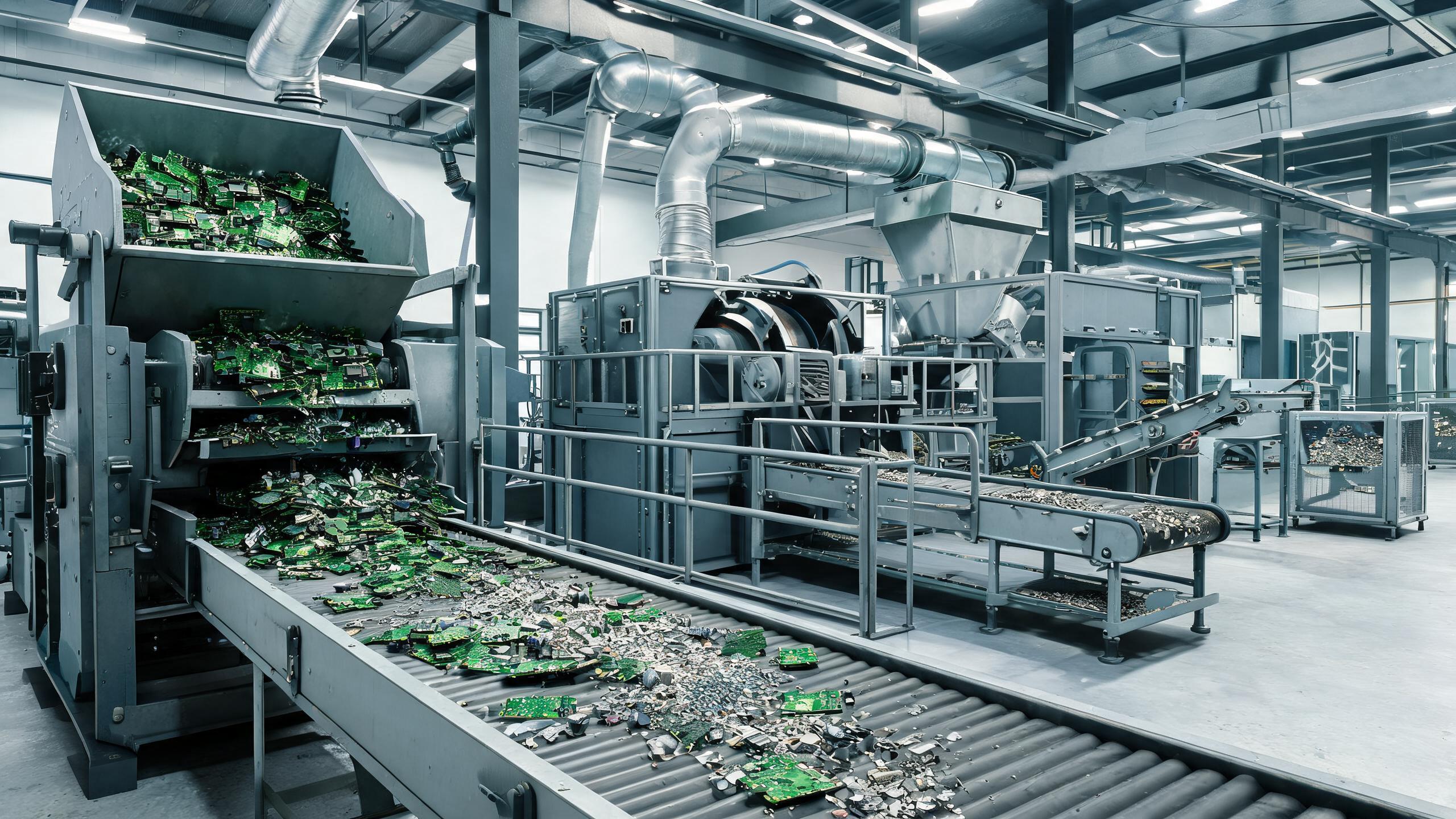
| E-waste / PCB scrap (Malaysia) | Four-shaft shredder with screen | Granulator + magnetic + eddy current | Batteries and capacitors must be removed upstream; controlled particle size needed |
| Aluminum turnings (Vietnam) | Aluminum swarf shredder | Magnetic separator + briquetting press | Stringy turnings require hook-style cutting discs; coolant drainage needed |
| Mixed light ferrous (Philippines) | Twin-shaft shredder | Magnetic separator + briquetting press | Contamination level (dirt, sand, plastic) affects hammer and disc wear life |
Capacity Matching: Getting Throughput Right
The most common selection error is buying equipment rated for a throughput tier that does not match actual daily volume. Here is how capacity tiers map to facility size:
- Light-duty (2–8 t/h): Fabrication shops, small recyclers, HVAC manufacturers processing sheet offcuts and light profiles. Motors in the 15–37 kW range. Standard industrial three-phase power is sufficient.
- Medium-capacity (15 t/h): Yards processing 80–120 tonnes per day across one to two shifts. A turnkey line with twin-shaft shredder, magnetic separator, and briquetting press in one package.
- Heavy-duty (40–60 t/h): Large-scale operations running continuous shifts on mixed ferrous scrap. Motors in the 750 kW range with hydraulic compression systems rated at 500+ tons of force.
Practical tip: Confirm expected capacity against your typical feed mix, not the top-end nameplate figure alone. Denser inputs like bundled structural sections run toward the lower end of the throughput range because each cycle takes longer to complete fragmentation.
Wear Parts and Maintenance Planning
Wear part availability is a critical factor for Southeast Asian buyers, where international shipping can add weeks to replacement cycles. Key considerations:
- Cutting discs and hammers: These are the fastest-wearing components. Order a spare set at commissioning. Track tonnage per set rather than waiting for visible performance drop-off.
- Jaw plates: Available in Mn13 (standard for mixed ferrous) and Mn18 (for harder, more abrasive feed like cast iron). Both grades are reversible—use both sides before replacement.
- Blow bars: Martensitic steel is the standard choice for mixed ferrous. Hardened alloy steel suits more abrasive feed. Composite bars with ceramic inserts offer maximum wear resistance but require effective tramp iron protection.
- Screens and grates: Available in multiple perforation sizes (10–60 mm). Changing the screen changes output fraction without replacing cutting tools.
Standard lead time for replacement wear parts from the manufacturer is under 45 days. Each machine ships with a spare-parts kit, and installation supervision with operator training is included with commissioning.
Power Supply and Electrical Configuration
Most industrial recycling equipment is configurable for 50 Hz or 60 Hz operation. Southeast Asian countries typically use 50 Hz supply, matching the standard configuration. Confirm your site voltage and transformer capacity during inquiry, as heavier machines (750 kW hammer crushers, for example) may require transformer upgrades or dedicated substations.
CE-marked frames and control panels are standard, with technical construction files and declarations provided. For Southeast Asian buyers, CE documentation supports local safety authority reviews, though specific national electrical codes may still apply.
Frequently Asked Questions
Next Steps: Matching Equipment to Your Facility
Selecting metal recycling equipment starts with understanding your feedstock—material types, maximum piece size, daily volume, and contamination level. Tiangong Technology manufactures twin-shaft and four-shaft shredders, hammer and jaw crushers, impact crushers, briquetting presses, and integrated processing lines from a 12,000 m² facility established in 2008. Equipment is CE-marked with ISO 9001 quality management, and the engineering team configures rotor profiles, screen sizes, and hopper dimensions to match each buyer's input material.
To request a configured proposal, include your typical feed material types and sizes, target throughput, site power supply (voltage and frequency), and whether you need a standalone machine or an integrated line. Mention any specific certification or regulatory requirements for your country.