How to Choose Scrap Processing Equipment for Your Metal Recycling Facility
Setting up or expanding a metal recycling facility means making equipment decisions that affect throughput, operating costs, and product quality for years. The right scrap processing equipment matches your feedstock characteristics, target output specifications, and local regulatory requirements - not just the highest-capacity machine available. This guide walks through the key equipment categories, capacity sizing principles, and compliance considerations that buyers in Southeast Asia should evaluate before placing an order.
Understanding the Core Equipment Categories
Metal recycling relies on three primary types of scrap processing equipment, each operating on a different mechanical principle and suited to different feedstock profiles:
Shredders: Shear Cutting for Mixed and Light-Gauge Scrap
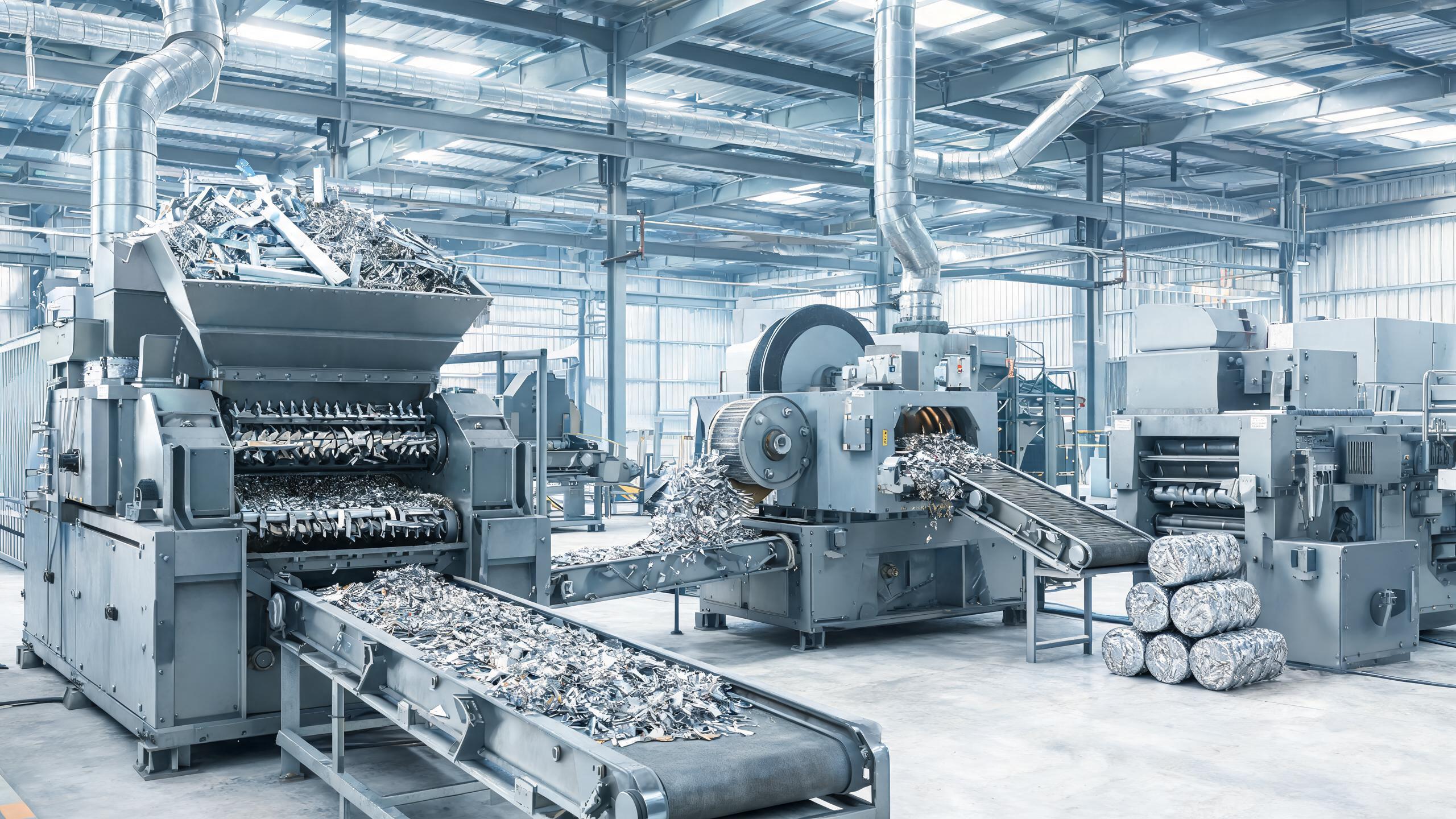
Twin-shaft and four-shaft shredders use counter-rotating cutting discs to shear material into uniform fragments. They excel at processing mixed light-gauge scrap - automobile bodies, sheet metal, drums, and aluminum profiles - where the material is too varied or too light for compression crushers. A twin-shaft shredder like the TG-2200 Twin-Shaft Metal Shredder handles automobile scrap and mixed ferrous without pre-sorting, making it a workhorse for general-purpose recycling yards.
For operations requiring finer output and better control over fragment size, a four-shaft configuration adds a screening drum that recirculates oversized pieces for a second pass. Single-shaft shredders offer precise particle size control for homogeneous feed streams like aluminum swarf.
Crushers: Impact and Compression for Dense, Hard Material
When feedstock includes cast iron engine blocks, thick-walled steel pipe, or hardened steel components, shredders stall or suffer accelerated wear. Compression crushers - jaw crushers - fracture hard metal between manganese steel plates. The TG-Jaw 600, with its 600 × 900 mm feed opening, handles large castings that would damage a shredder.
For secondary reduction, hammer crushers like the TG-Hammer 800 Heavy-Duty Metal Crusher deliver 40 to 60 tons per hour throughput using high-inertia manganese hammers. Impact crushers use blow bars on a horizontal rotor to fragment pre-sized scrap, producing uniform fragments that improve downstream magnetic and eddy-current separation efficiency.
Briquetting Presses: Densification for Higher Sale Value
Loose metal chips and turnings have a bulk density of 0.2–0.5 t/m³, making transport expensive and furnace charging inefficient. A hydraulic briquetting press compacts clean chips to 2.0–4.0 t/m³, raising the per-tonne sale value and reducing logistics costs. The TG-BriqPress 250 Metal Briquetting System integrates into both ferrous and non-ferrous processing lines.
Sizing Equipment to Your Throughput Requirements
Equipment capacity should match your actual and projected feedstock volume, not an aspirational maximum. Oversizing wastes capital and increases per-tonne operating costs; undersizing creates bottlenecks that limit plant utilization.
Key sizing factors include:
- Feedstock volume: Daily tonnage of incoming scrap, accounting for seasonal variation and growth projections over 3–5 years.
- Material density and composition: Dense cast iron processes differently from light-gauge sheet steel. Mixed feed requires equipment that can handle the full range without pre-sorting.
- Target discharge size: Finer output requires more energy and slower feed rates. Specify the downstream requirement (furnace charge size, separation feed size) before selecting screen mesh or grate bar openings.
- Operating hours: Single-shift vs. continuous operation affects equipment specification and wear-part inventory planning.
For medium-capacity yards processing 10–20 tonnes per hour, an integrated system like the TG-ScrapLine 150 Integrated Scrap Processing System combines shredding, magnetic separation, and briquetting in a single 15 t/h line with a 250 kW main drive. This eliminates the risk of throughput mismatch between separately sourced units.
Compliance Requirements for Southeast Asian Markets
Buyers in Vietnam, Indonesia, Thailand, Malaysia, and Philippines face varying import regulations and environmental standards. While requirements differ by country, several compliance factors apply across the region:
CE Marking
CE marking demonstrates that equipment meets European safety, health, and environmental protection directives. While Southeast Asian countries do not uniformly require CE marking, many importers use it as a quality benchmark and a prerequisite for facility permitting. All Tiangong equipment is CE-marked, with technical files and declarations of conformity available for facility inspection and customs clearance.
ISO 9001 Quality Management
ISO 9001 certification of the manufacturing facility provides assurance that production processes, quality control, and documentation meet internationally recognized standards. This matters for buyers evaluating supplier reliability, particularly when ordering custom-configured equipment.
Electrical Standards
Most Southeast Asian countries operate on 50 Hz power supply, but voltage standards vary (220V, 380V, 415V). Confirm that equipment electrical panels match your site power supply. Tiangong offers 50 Hz and 60 Hz configurations, and electrical panels can be specified to local voltage requirements at inquiry.
Environmental and Noise Regulations
Urban recycling facilities in Southeast Asia increasingly face noise and emissions regulations. Equipment with interlocked safety guards, PLC-controlled stage sequencing, and enclosed processing chambers helps meet local environmental permit conditions. Discuss site-specific requirements with the equipment supplier before finalizing specifications.
Evaluating Equipment Suppliers
Beyond the machine itself, the supplier's engineering capability and after-sale support determine long-term operating success. When evaluating scrap processing equipment suppliers, consider:
- Engineering customization: Can the supplier configure rotor knife profiles, screen mesh openings, and hopper dimensions to match your specific feedstock?
- Spare parts availability: What is the standard lead time for replacement wear parts? Does each machine ship with a spare-parts kit?
- Installation and training: Is installation supervision and operator training included with commissioning?
- Warranty coverage: What warranty period is offered, and what does it cover?
- Production facility: Does the manufacturer operate its own machining, welding, and electrical assembly facility, or does it outsource critical components?
Tiangong operates a 12,000 m² production facility with in-house machining, welding, and electrical assembly. Key components - hard-faced rotor shafts, gearboxes, and hydraulic systems - are manufactured or sourced domestically to maintain lead times under 45 days for standard models. Each machine ships with a spare-parts kit, and installation supervision, operator training, and a 12-month warranty are included with commissioning.
Matching Equipment to Your Facility: A Practical Framework
Use this decision framework to narrow your equipment selection:
- Light mixed scrap (auto bodies, sheet metal, drums): Start with a twin-shaft shredder. Add magnetic separation and briquetting for a complete line.
- Hard, dense scrap (cast iron, thick sections): Use a jaw crusher for primary reduction, followed by a hammer or impact crusher for secondary sizing.
- Aluminum scrap (turnings, profiles, sheet): A dedicated aluminum recycling line with shredder, magnetic separation, eddy current separation, and briquetting produces furnace-ready briquettes.
- Multi-material yard: An integrated scrap processing system with PLC-controlled stage sequencing handles mixed feed without pre-sorting.
Next Steps: Request a Configuration Proposal
Selecting scrap processing equipment is a multi-stage decision that benefits from supplier engineering input. To prepare an accurate equipment proposal, gather the following information before contacting a supplier:
- Typical feed material types, sizes, and composition
- Daily or monthly processing volume
- Target output fragment size and downstream separation requirements
- Site power supply (voltage and frequency)
- Available floor space and any height restrictions
- Local certification or permitting requirements
With these details, Tiangong's engineering team can configure rotor profiles, screen openings, and hopper dimensions to match your specific recycling operation. Contact us to discuss your facility requirements and receive a detailed equipment configuration and quotation.