
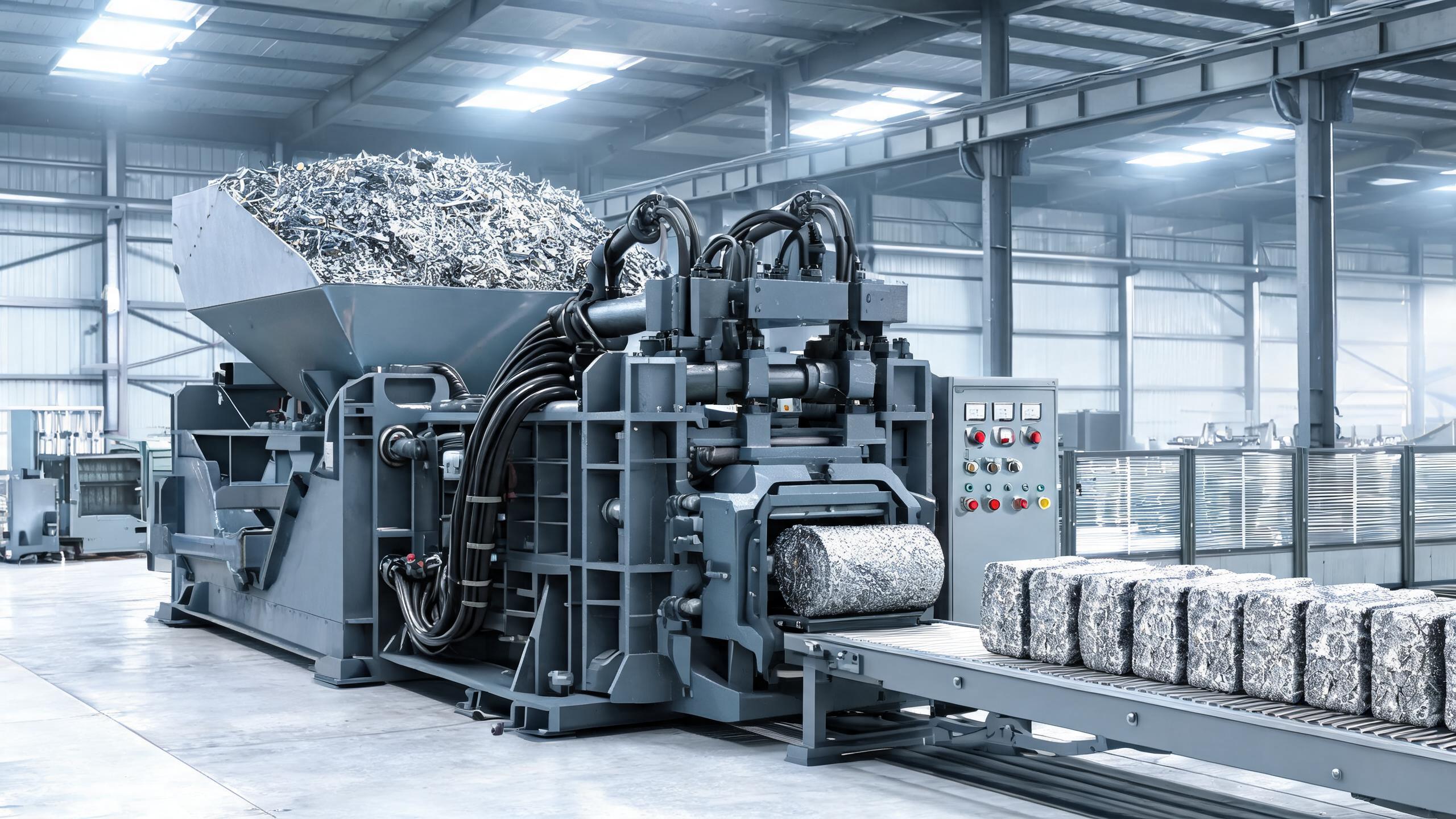
Your Machining Chips Are Worth More Than You Are Being Paid For Them
For machine shops and foundries across Southeast Asia, the pile of aluminum and steel chips growing beside the CNC machines is usually treated as an inevitable cost of doing business. But loose chips are bulky, wet with coolant, and heavily discounted by scrap buyers — or hauled away at your expense. The metal itself is perfectly good; the problem is density and moisture. A metal briquetting press fixes both at the source, and for many operations it is one of the fastest-payback equipment investments available.
This guide explains the economics of briquetting, how a hydraulic press works, and how to choose the right machine for your chip stream. The reference machine throughout is the TG-BriqPress 250 metal briquetting system, a standalone hydraulic press for steel, cast iron, aluminum, copper and brass chips.
The Core Problem: Loose Chips Are a Logistics and Value Problem
Loose machining swarf has a bulk density of roughly 0.2–0.5 t/m³. That means when you sell loose chips, you are paying to transport air and coolant along with the metal. Scrap buyers discount heavily for moisture and contamination, storage consumes floor space, and furnace charging is inefficient — loose chips oxidize rapidly and can even be blown out of the furnace by combustion air, increasing metal loss.
What a Metal Briquetting Press Actually Does
A hydraulic briquetting press compresses loose chips under high pressure into solid, uniform cylindrical briquettes. Three things happen in one cycle:
- Density increases 5–10x. Briquette bulk density reaches roughly 2.0–5.0 t/m³ depending on material and compaction pressure — more metal per truckload or container, directly reducing transport cost per tonne.
- Coolant is recovered. Residual cutting fluid is squeezed out during compaction and collected through a drain point. Filtered and returned to the machining process, this reduces your fluid purchase costs — a benefit many buyers overlook when calculating payback.
- Furnace-ready form. Dense briquettes stay in the furnace and melt more efficiently, reducing oxidation loss compared with loose chips.
How Hydraulic Briquetting Works
Chips are fed into the infeed hopper, where an auger or hydraulic ram conveys them into the compaction chamber. The main hydraulic cylinder compresses the chips against a die that shapes the briquette, which is ejected onto a discharge conveyor. The cycle repeats automatically under PLC control, allowing continuous operation with consistent briquette quality.
Hydraulic pressure determines briquette density, and it is adjustable by material: aluminum chips compact at lower pressure than steel because aluminum is more ductile. Higher pressure produces denser, harder briquettes that resist breakage during handling and transport.
Choosing the Right Press: Five Selection Criteria
1. Material type and chip form
Confirm the press handles your metals — steel, cast iron, aluminum, copper and brass chips and turnings are the standard range. Critically, the feed must already be in chip or turning form: a briquetting press is not a crusher. If your stream includes solid pieces, sheet offcuts or large castings, position a shredder upstream — for aluminum swarf specifically, a dedicated aluminum swarf shredder is the correct pre-stage.
2. Daily volume
Size the press for your peak chip output, not your average. An undersized press becomes a bottleneck; an oversized one wastes capital. Give the supplier your estimated daily volume and chip type so compaction pressure and die dimensions can be configured to match.
3. Coolant recovery integration
If you machine with flood coolant, coolant recovery is a major economic driver, not a minor add-on. Confirm the press has a proper drain point and collection interface, and that the recovered fluid is compatible with your filtration setup.
4. Automation and control
A PLC-controlled auto-cycle allows continuous, largely unattended operation with consistent briquette quality. Check that the hydraulic power pack includes filtration and cooling, and that safety circuits (pressure relief, emergency stop) meet the standards your plant insurer expects.
5. Wear parts and support
Die components, hydraulic seals and auger parts are consumables. Ask for the standard wear-parts lead time (under 45 days is a reasonable benchmark from a China-based manufacturer shipping to Southeast Asia), whether a spare-parts kit ships with the machine, and whether installation supervision, operator training and a 12-month warranty are included.
Material Boundaries: What a Briquetting Press Cannot Do
A briquetting press handles chips, turnings and borings — not solid billets, large castings or thick-walled pipe sections. Mixed metal chips can be processed if consistent within a batch. If you briquette non-ferrous chips for foundry charging, the material must be free of tramp ferrous; fit a magnetic separator upstream if your feed may contain steel contaminants from mixed machining.
Quick Answers for Buyers
Can one machine briquette both aluminum and steel? Yes — hydraulic presses handle both, with pressure adjusted per material. Confirm material compatibility and die configuration with the supplier before ordering.
How much coolant can be recovered? Most of the residual cutting fluid in the chips is squeezed out during compaction and collected at the drain point. The exact recovery rate depends on chip type and moisture content — confirm with a test on your own chips.
Do briquettes sell at a premium? Most smelters and foundries prefer briquettes because they are denser, drier and easier to handle and charge. Confirm pricing with your local buyers — but the transport and storage savings alone are independent of the selling price.
What information should I send for a quotation? Chip type (steel, aluminum, copper, brass or mixed), estimated daily volume, moisture/coolant content, target briquette density or size, site power supply (50 or 60 Hz), and whether you need a shredder upstream or coolant recovery integration.
Next Step: Test Your Chips, Then Decide
Start by auditing your current scrap stream: monthly chip volume, moisture content, and what you are actually paid today. Then send us your chip specifications — our engineering team will recommend the right press configuration, compaction pressure and die size, and confirm what briquette density you can expect from your material.