Scrap Metal Recycling Machine: A Complete Selection and Purchasing Guide
Investing in a scrap metal recycling machine is one of the most consequential capital decisions a recycling yard owner can make. The wrong choice locks you into years of high operating costs, frequent downtime, and missed throughput targets. This guide helps buyers in Vietnam, Indonesia, Thailand, Malaysia, and Philippines navigate the equipment landscape - from machine types and throughput matching to maintenance cost analysis and supplier evaluation - so you can make a purchasing decision grounded in technical facts rather than marketing claims.
Types of Scrap Metal Recycling Machines
Every recycling operation processes different feedstock, and each material category calls for a specific machine type. Understanding the mechanical principles behind each type is the first step to a sound purchase.
Metal Shredders: Primary Size Reduction
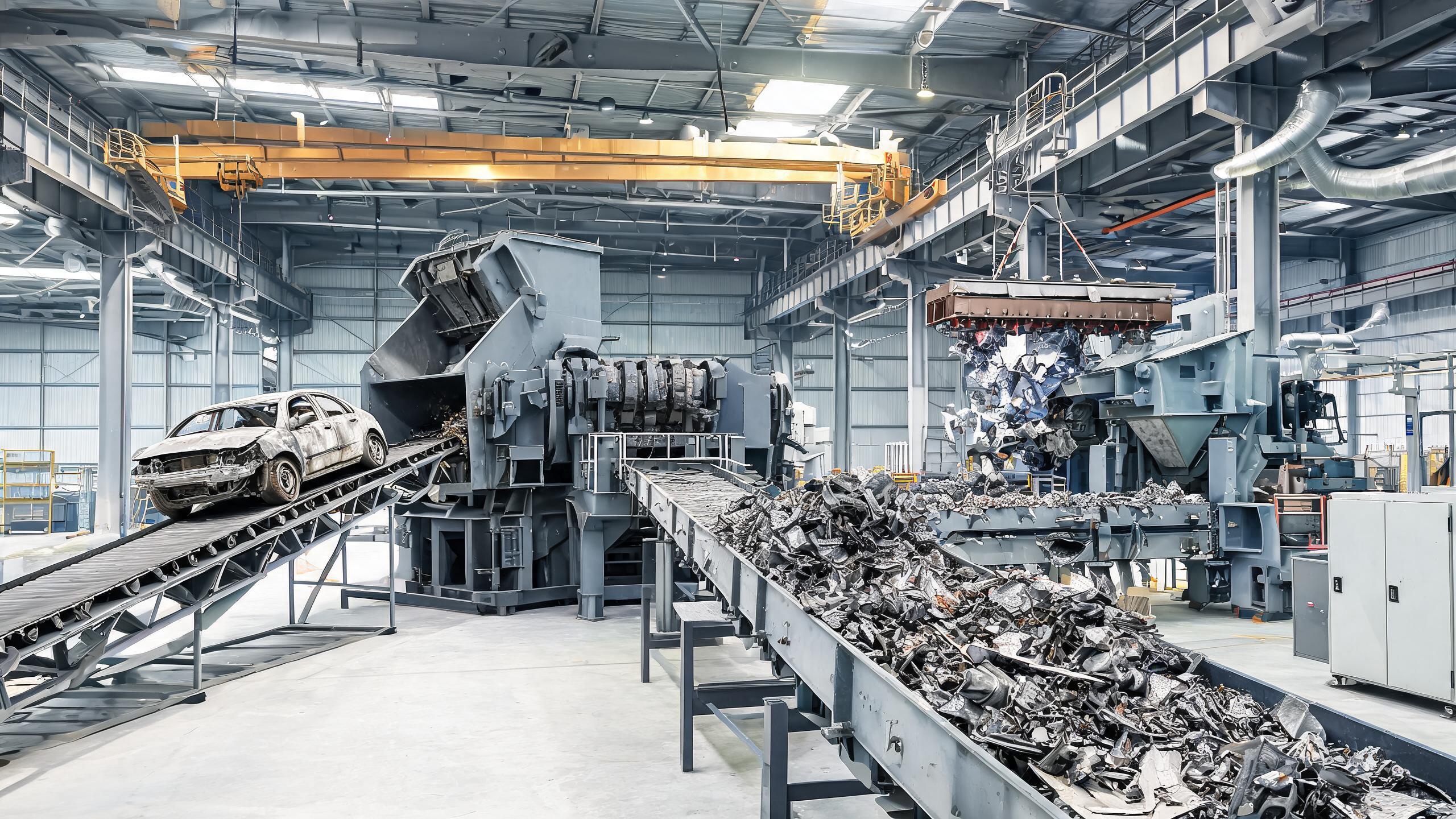
Shredders use shear force from counter-rotating cutting shafts to reduce scrap metal. They are the primary processing stage for most recycling yards:
- Twin-shaft shredders: The industry standard for mixed ferrous scrap. Low-speed, high-torque counter-rotating hexagonal blade shafts deliver precise shear cuts. The TG-2200 Twin-Shaft Metal Shredder handles automobile scrap, light steel, and mixed ferrous without pre-sorting - a critical advantage for Southeast Asian yards where incoming scrap is often unsorted.
- Four-shaft shredders: Add a screening drum that recirculates oversized fragments for a second pass. Better for operations requiring consistent output size. The TG-FourShaft 400 provides this precision for applications where downstream separation depends on uniform particle size.
- Single-shaft shredders: Best for homogeneous feed streams like aluminum swarf or cable, where precise particle size control matters more than raw throughput.
- Light-duty shredders: For smaller yards or specialized applications, the TG-LightMetal 80 Light-Duty Metal Shredder offers a lower entry cost while maintaining the same shearing principle.
Metal Crushers: Fragmentation by Impact and Compression
When feedstock is too hard or too dense for shredders, crushers take over. They operate on two principles:
- Compression (jaw crushers): Manganese steel jaw plates squeeze hard castings until they fracture. The TG-Jaw 600, with its 600 × 900 mm feed opening, is designed for cast iron engine blocks, thick-walled steel pipe, and large machinery castings that would stall a shredder.
- Impact (hammer crushers): High-speed rotating hammers fracture metal through kinetic energy transfer. The TG-Hammer 800 Heavy-Duty Metal Crusher delivers 40 to 60 tons per hour with a 750 kW motor and 500-ton hydraulic compression ram. Its reversible manganese steel hammers extend service intervals, and its CE-marked frame includes a technical file and declaration of conformity.
Briquetting Machines: Densification for Value Recovery
Loose metal chips and turnings have extremely low bulk density (0.2–0.5 t/m³), making them expensive to transport and inefficient to charge into furnaces. A hydraulic briquetting press compacts these chips into dense briquettes at 2.0–4.0 t/m³. The TG-BriqPress 250 Metal Briquetting System squeezes residual cutting fluid from chips during compaction, producing cleaner briquettes and enabling coolant recovery.
Integrated Recycling Lines: Complete Processing Systems
For yards that need end-to-end processing, an integrated line eliminates the risk of throughput mismatch between separately sourced machines. The TG-ScrapLine 150 Integrated Scrap Processing System combines a twin-shaft shredder, overband magnetic separator, and hydraulic briquetting press in a single 15 t/h line. A unified PLC control system manages stage sequencing and interlock safety across all stages - if one stage pauses, upstream feeding stops automatically to prevent material spillage.
Matching Throughput to Your Operation
The most common purchasing mistake is sizing equipment to peak aspirational volume rather than realistic daily throughput. Consider these factors:
- Incoming scrap volume: Track your actual daily and monthly tonnage over at least 3 months. Account for seasonal variation - many Southeast Asian yards see higher scrap inflows during dry season construction demolition.
- Material mix: A yard processing 80% light mixed scrap and 20% dense castings needs different equipment than one with the reverse ratio. The TG-Hammer 800 handles 40–60 t/h of mixed ferrous, while the TG-ScrapLine 150 is rated at 15 t/h for medium-capacity operations.
- Discharge specifications: Finer output requires more energy per tonne. Know what your downstream buyer (foundry, steel mill, exporter) requires before selecting screen mesh or grate bar openings.
- Operating schedule: A single-shift operation (8 hours) needs higher hourly throughput than a continuous three-shift operation (24 hours) to process the same daily volume. Equipment wear rates and maintenance windows differ accordingly.
Maintenance Cost Considerations
Purchase price is only the beginning. Over a 10-year operating life, maintenance and wear parts often exceed the initial capital cost. Evaluate these factors:
- Wear part material: Manganese steel (Mn13/Mn18) work-hardens under impact, extending service life. Hardened alloy steel and composite bars with ceramic inserts offer higher wear resistance but at higher cost and greater brittleness risk.
- Reversibility: Many wear parts - jaw plates, blow bars, shredder cutting discs - are reversible, effectively doubling service life before replacement.
- Spare parts lead time: Imported wear parts with long lead times cause extended downtime. Tiangong manufactures key components in-house and maintains lead times under 45 days for standard replacement parts. Each machine ships with a spare-parts kit for immediate commissioning.
- Service accessibility: Bolted wear parts that require no welding for replacement reduce maintenance downtime. Ask whether the supplier provides installation supervision and operator training as part of commissioning.
Southeast Asian Scrap Metal Recycling: Industry Characteristics
The scrap metal recycling landscape in Southeast Asia has distinct characteristics that should inform equipment selection:
Raw Material Structure
Southeast Asian yards typically process a mix of imported and domestically generated scrap. Auto hulks, light structural steel from demolition, and manufacturing offcuts dominate the feed stream. Aluminum scrap from extrusion plants and machining facilities is growing, particularly in Vietnam and Thailand. Equipment must handle this mixed feed without extensive pre-sorting labor.
Labor Cost Considerations
While labor costs in Southeast Asia are lower than in Europe or North America, automated equipment with PLC control systems reduces dependency on skilled operators. A unified PLC that manages stage sequencing and interlocks - like the system on the TG-ScrapLine 150 - allows a smaller operating crew to manage a multi-stage line safely.
Environmental Regulations
Environmental oversight is tightening across the region. Indonesia and Vietnam have introduced stricter waste processing permits, and Malaysia has increased enforcement of noise and emissions standards for industrial facilities. CE-marked equipment with interlocked safety guards, enclosed processing chambers, and documented technical files helps satisfy permit requirements and customs inspections.
Supplier Evaluation Checklist
Before committing to a purchase, evaluate potential suppliers against these criteria:
- Manufacturing capability: Does the supplier operate its own production facility with machining, welding, and electrical assembly? Tiangong operates a 12,000 m² facility with in-house manufacturing of hard-faced rotor shafts, gearboxes, and hydraulic systems.
- Engineering customization: Can rotor knife profiles, screen mesh openings, and hopper dimensions be configured to your specific feedstock? This is where a manufacturer with in-house engineering adds value beyond a trading company.
- Certification and documentation: Is the equipment CE-marked? Is the manufacturing facility ISO 9001 certified? Request technical files and declarations of conformity before purchasing.
- Warranty and after-sale support: What warranty is offered? Tiangong provides a 12-month warranty, installation supervision, and operator training with every machine.
- Spare parts supply: Does the supplier maintain a spare-parts kit with each machine? What is the standard lead time for replacement parts?
- Power supply compatibility: Can equipment be configured for 50 Hz (standard in Southeast Asia) or 60 Hz operation? Can electrical panels be specified to local voltage (220V, 380V, 415V)?
Making the Purchase Decision
Once you have evaluated machine types, throughput requirements, maintenance costs, and supplier capability, consolidate your findings into a purchase specification:
- Primary feedstock type(s) and approximate volume
- Required throughput (tonnes per hour or per shift)
- Target output fragment size
- Downstream separation or melting requirements
- Site power supply and floor space constraints
- Local certification and permitting requirements
- Budget range and expected payback period
Submit this specification to shortlisted suppliers and request detailed equipment proposals. Tiangong's engineering team reviews each inquiry and configures machine specifications - rotor profiles, screen openings, hopper dimensions, and electrical configuration - to match the buyer's specific recycling operation. Each proposal includes a technical specification sheet, CE documentation, and a quotation covering the machine, spare-parts kit, installation supervision, and operator training.
To start the conversation, prepare your feedstock details and throughput targets, and contact our engineering team for a configuration proposal tailored to your facility.