Scrap Recycling Equipment ROI Analysis: A Cost-Benefit Framework for B2B Buyers
When evaluating scrap recycling equipment, purchase price alone tells you nothing about profitability. A machine that costs 30% less upfront but consumes more energy, requires more frequent wear part replacement, and recovers less metal per tonne of feed can be far more expensive over its operating life. This analysis framework helps buyers in Vietnam, Indonesia, Thailand, Malaysia, and Philippines calculate true return on investment across three dimensions: capital acquisition cost, operating cost, and processing revenue.
Dimension 1: Equipment Acquisition Cost
The capital cost of scrap recycling equipment varies significantly by machine type, throughput capacity, and configuration. Understanding what drives cost helps you avoid paying for capacity you do not need - or underinvesting in capability you do.
Cost Drivers by Machine Type
- Standalone shredders: Twin-shaft shredders like the TG-2200 represent the entry point for most yards. Cost scales with motor power, shaft diameter, and cutting disc material. A light-duty model like the TG-LightMetal 80 offers a lower entry cost for smaller operations.
- Heavy-duty crushers: The TG-Hammer 800, with its 750 kW motor and 500-ton hydraulic compression ram, commands a higher price but delivers 40 to 60 tons per hour - the throughput needed to justify the investment in high-volume yards.
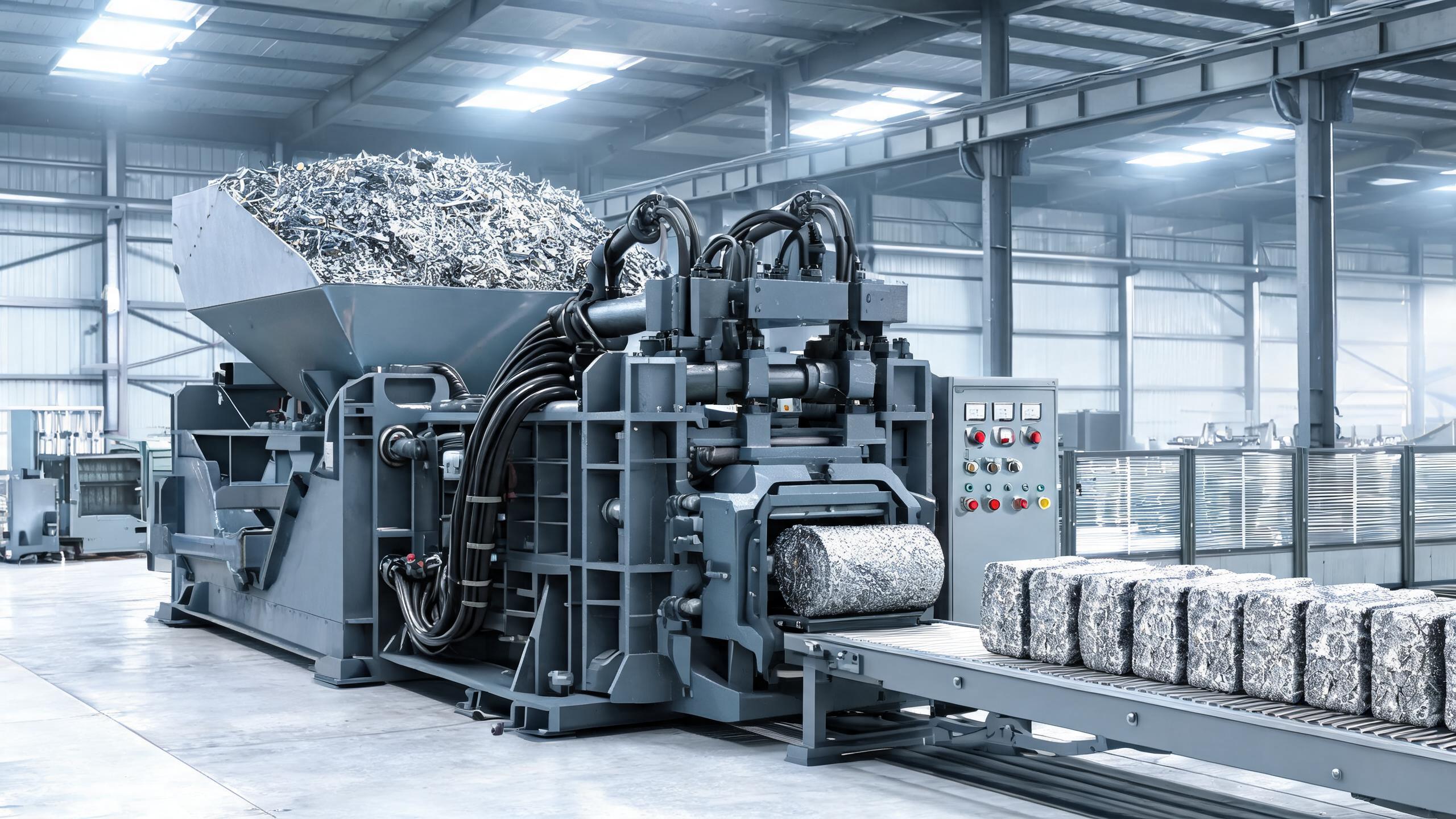
- Integrated processing lines: The TG-ScrapLine 150 bundles shredder, magnetic separator, and briquetting press into one system. While the upfront cost exceeds any single unit, it eliminates separately sourced equipment, inter-stage conveyors, and integration engineering - often reducing total project cost by 15 to 25%.
- Briquetting systems: The TG-BriqPress 250 is typically an add-on rather than a standalone investment. Its ROI comes from the price premium that dense briquettes command over loose chips.
What to Include in Capital Cost
Do not equate the machine price tag with total acquisition cost. A complete capital budget includes:
- Equipment purchase price
- Spare-parts kit (Tiangong includes one with every machine)
- Shipping and customs duties (varies by Southeast Asian destination port)
- Installation supervision and commissioning (included with Tiangong equipment)
- Operator training (included with Tiangong equipment)
- Site preparation - foundation, electrical supply, ventilation
- Initial wear parts inventory beyond the shipped kit
Tiangong maintains lead times under 45 days for standard models by manufacturing key components - hard-faced rotor shafts, gearboxes, and hydraulic systems - in-house at its 12,000 m² facility. This reduces project timeline risk, which is itself a cost: every week of delay is a week of foregone processing revenue.
Dimension 2: Operating Cost
Operating cost determines whether your equipment generates cash or consumes it. Three sub-categories drive the operating cost of scrap recycling equipment:
Energy Consumption
Motor power is the single largest ongoing operating expense. The TG-Hammer 800 draws 750 kW at full load; the TG-ScrapLine 150's main shredder drive is 250 kW. To estimate annual energy cost:
- Calculate rated power (kW) × operating hours per year × electricity tariff (per kWh)
- Factor in partial-load efficiency: equipment rarely runs at 100% rated power continuously
- Compare 50 Hz vs. 60 Hz motor efficiency for your local power supply
In Southeast Asia, industrial electricity rates range widely - from approximately 7 US cents/kWh in Vietnam to over 10 US cents/kWh in the Philippines. A 250 kW shredder running 2,000 hours per year at 8 cents/kWh costs roughly $40,000 annually in electricity alone. Lower-efficiency equipment or oversized motors inflate this figure substantially.
Labor Cost
Equipment with unified PLC control - like the TG-ScrapLine 150 - requires fewer operators per shift than manually controlled multi-machine setups. In Southeast Asia, where minimum wages are rising (Vietnam's regional minimum wages increased annually over the past five years), reducing headcount through automation directly improves ROI. A PLC-interlocked line that stops upstream feeding when a downstream stage pauses also reduces the need for constant operator intervention, lowering both labor cost and accident risk.
Maintenance and Wear Parts
Wear parts are the most variable operating cost component. Key factors:
- Wear part material: Manganese steel (Mn13/Mn18) work-hardens under impact, extending service intervals. Reversible jaw plates, blow bars, and cutting discs double wear life before replacement.
- Replacement lead time: Tiangong maintains under 45-day lead times for replacement wear parts and ships a spare-parts kit with every machine. Extended lead times from other suppliers can mean weeks of downtime waiting for parts.
- Bolted vs. welded wear parts: Bolted components require no welding for replacement, reducing maintenance time and skill requirements.
- Engineering configuration: Tiangong's engineering team configures rotor knife profiles, screen mesh openings, and hopper dimensions to match each buyer's feedstock, optimizing wear life for the specific material mix.
Dimension 3: Processing Revenue
Revenue from scrap recycling equipment depends on two factors: how much metal you recover, and how much that recovered metal is worth.
Metal Recovery Rate
Recovery rate - the percentage of input feedstock that becomes saleable metal output - is where equipment quality directly drives revenue. Key contributors:
- Magnetic separation: Overband or drum magnetic separators on integrated lines like the TG-ScrapLine 150 separate clean ferrous from non-magnetic residue, maximizing recoverable ferrous output.
- Eddy current separation: On non-ferrous lines like the TG-AluLine 200, eddy current separators recover aluminum from plastic and rubber contamination that manual sorting misses.
- Fragment uniformity: Impact crushers produce more uniform fragment sizes than compression crushers alone, improving downstream separation efficiency and recovery rates.
- Liberation: Impact force fractures brittle metals while ductile metals deform, enabling separation of mixed metal streams that would otherwise be sold as lower-grade mixed scrap.
Output Value Enhancement
The same tonne of scrap metal can be worth significantly more depending on how it is processed:
- Briquetting premium: Loose aluminum chips at 0.2–0.5 t/m³ bulk density command lower prices than dense briquettes at 2.0–2.5 t/m³. Foundries and remelters pay more for briquettes because they charge more efficiently and contain less oxidation surface area. The TG-BriqPress 250 and the briquetting stage in the TG-AluLine 200 both deliver this density upgrade.
- Contaminant removal: Magnetic separation removes tramp ferrous from aluminum scrap, preventing iron pickup in the alloy and maintaining higher-grade pricing.
- Coolant recovery: Briquetting presses squeeze residual cutting fluid from chips during compaction. In machining-intensive operations, recovered coolant has its own value and reduces waste disposal costs.
Calculating ROI: A Practical Example
Consider a Southeast Asian yard processing 15 tonnes per hour of mixed ferrous scrap, 2,000 hours per year (30,000 tonnes annually). Compare two scenarios:
Scenario A: Standalone Shredder Only
- Shredder processes scrap to loose fragment output
- No magnetic separation - mixed output sold at lower-grade pricing
- No briquetting - low bulk density increases transport cost per tonne
- Lower capital cost, but lower revenue per tonne and higher logistics cost
Scenario B: Integrated Line (TG-ScrapLine 150 Equivalent)
- Shredder + magnetic separator + briquetting press in one PLC-controlled line
- Clean ferrous separated from non-magnetic residue - higher-grade output
- Briquetting raises bulk density above 4.0 t/m³ - higher per-tonne sale value and lower transport cost
- Higher capital cost, but higher revenue per tonne and lower per-tonne operating cost
Scenario B's higher capital cost is recovered through: (1) higher metal recovery rate from magnetic separation, (2) price premium from briquetted output, and (3) lower transport cost per tonne due to higher bulk density. The exact payback period depends on local scrap metal prices, electricity tariffs, and labor rates - but for yards processing over 10,000 tonnes annually, integrated processing typically delivers a shorter payback period despite the higher initial investment.
Tiangong's Value Proposition in Southeast Asia
Several factors specific to Tiangong's equipment offering improve ROI for Southeast Asian buyers:
- CE-marked equipment with ISO 9001 manufacturing: Reduces permitting risk and demonstrates quality assurance to facility inspectors and financing partners.
- In-house manufacturing: 12,000 m² facility with machining, welding, and electrical assembly under one roof reduces lead time to under 45 days and controls component quality.
- Engineering customization: Rotor profiles, screen openings, and hopper dimensions configured to each buyer's feedstock optimize both throughput and wear life - directly improving both revenue and operating cost.
- 12-month warranty with spare-parts kit: Reduces first-year operating risk. Installation supervision and operator training included with commissioning reduce startup delays.
- 50 Hz / 60 Hz configurability: Equipment matches Southeast Asian power supply without retrofit costs.
Next Steps: Build Your ROI Model
To calculate ROI for your specific operation, gather the following data and request a configuration proposal:
- Annual scrap processing volume (tonnes) and material composition
- Current output pricing per tonne by metal grade
- Local electricity tariff (per kWh) and labor cost per operator
- Current transport cost per tonne for loose vs. densified output
- Target recovery rate improvement and output grade
- Available capital budget and expected equipment life
With these inputs, Tiangong's engineering team can configure equipment specifications and provide a quotation that includes throughput estimates, power consumption data, and wear part projections. Contact us to discuss your facility's requirements and receive a detailed equipment proposal tailored to your ROI targets.