What Southeast Asian Metal Processors Need from Scrap Machinery
Metal processing plants across Southeast Asia face a common challenge: selecting scrap machinery that matches their specific feedstock, throughput requirements, and downstream buyer specifications. Malaysia's electronics manufacturing sector generates e-waste rich in copper, aluminum, and precious metals. The Philippines collects mixed scrap metal from households, construction sites, and small workshops. Both markets need machines that can handle diverse material streams efficiently-and the wrong equipment choice leads to jammed rotors, excessive wear costs, and output that fails to meet mill or foundry specifications.
This article compares the main categories of scrap machinery, maps them to Southeast Asian processing scenarios, and provides selection criteria that go beyond nameplate specifications.
Scrap Machinery Categories: A Comparative Overview
Twin-Shaft Metal Shredders
The most versatile scrap machinery type. Two counter-rotating shafts with hardened cutting discs shear and tear material at low speed (14–38 RPM) with high torque. The shearing action handles mixed, irregular scrap where feed geometry varies unpredictably. Low-speed operation minimizes spark generation, which is critical when processing material that may carry residual contaminants.
Typical drive power: 30 kW (light-duty) to 250 kW (industrial). Best for: Mixed light ferrous, auto scrap, sheet offcuts, white goods.
Four-Shaft Metal Shredders
Two pairs of counter-rotating shafts work in sequence: the upper pair grabs and pre-cuts, while the lower pair performs final shearing through a screen basket (20–60 mm perforation). Material stays in the chamber until it passes through the screen, producing a narrower particle size distribution than twin-shaft designs.
Typical drive power: 2 × 75 kW (150 kW total). Best for: Applications requiring controlled particle size-aluminum profiles, copper wire bundles, e-waste after battery removal, mixed non-ferrous turnings.
Single-Shaft Metal Shredders
A horizontal rotor with bolted cutting knives rotates against a fixed bed knife, with a hydraulic ram pushing material into the cutting zone. A screen beneath the rotor controls discharge size (10–40 mm). The advantage over twin-shaft is particle size consistency, which matters when feeding briquetting presses, granulators, or smelting furnaces.
Typical drive power: 55 kW. Best for: Relatively homogeneous non-ferrous streams-aluminum extrusion offcuts, copper wire bundles, brass turnings.
Hammer Crushers
A high-speed rotor with manganese steel hammers fragments material by impact, paired with a hydraulic compression ram (up to 500 tons) that pushes bulky stock into the hammer path. Reversible hammers and replaceable grate bars in multiple slot sizes allow output size adjustment without changing the main rotor.
Typical drive power: 750 kW. Best for: Dense ferrous scrap-cast iron engine blocks, thick-walled pipe, automobile bodies, mixed ferrous at 40–60 t/h.
Jaw Crushers
Compressive force between fixed and movable manganese steel jaw plates (Mn13 or Mn18). Primary-stage machine for hard, brittle ferrous material that exceeds shredder torque ratings. Hydraulic wedge adjustment allows output size changes without manual shimming.
Typical feed opening: 600 × 900 mm. Best for: Cast iron, thick structural sections, railway components, large steel castings.
Briquetting Systems
Hydraulic presses that compact loose metal chips and turnings into dense cylindrical briquettes. For aluminum: 0.2–0.5 t/m³ loose chips become 2.0–2.5 t/m³ briquettes. For ferrous scrap: loose shred at 0.8 t/m³ becomes 4.0+ t/m³ briquettes. Residual cutting fluid is squeezed out during compaction and can be collected for recycling.
Best for: Any facility transporting scrap to distant mills or foundries, where bulk density directly affects transport cost and per-tonne sale price.
Equipment Comparison Table
| Machine Type | Mechanism | Drive Power | Key Advantage | Ideal Feedstock |
|---|---|---|---|---|
| Twin-shaft shredder | Shear (low-speed, high-torque) | 30–250 kW | Handles mixed, irregular scrap | Auto scrap, light steel, mixed ferrous |
| Four-shaft shredder | Shear + screen control | 150 kW | Controlled particle size output | E-waste, non-ferrous, aluminum profiles |
| Single-shaft shredder | Shear + screen + hydraulic ram | 55 kW | Uniform output for homogeneous streams | Aluminum, copper, brass turnings |
| Hammer crusher | Impact + hydraulic compression | 750 kW | High throughput on dense ferrous | Cast iron, auto bodies, structural steel |
| Jaw crusher | Compression | Varies | Handles oversized hard castings | Cast iron, thick sections, railway rail |
| Briquetting press | Hydraulic compaction | Varies | 5–8x bulk density improvement | Loose chips, turnings, swarf |
Southeast Asian Application Scenarios
Malaysia: E-Waste Metal Recovery
Malaysia's electronics manufacturing sector generates significant volumes of discarded PCBs, computer housings, and electronic assemblies rich in copper, aluminum, and precious metals. Processing this feedstock requires:
- Primary shredding: A four-shaft shredder with screen basket (20–30 mm) provides controlled particle size. The upper shafts grip irregularly shaped electronic assemblies, while the lower pair performs final shearing.
- Downstream separation: Magnetic separator removes ferrous components (steel frames, screws). Eddy-current separator recovers aluminum. Granulator further reduces PCB material for metal recovery.
- Critical safety note: Batteries and capacitors must be removed upstream before shredding. The machine is not designed for material containing free mercury switches or undrained batteries.
Philippines: Mixed Scrap Metal Recovery
Scrap collection in the Philippines spans household metal, construction debris, bicycle frames, aluminum window frames, and small workshop offcuts. This mixed feedstock varies widely in material type and geometry, making versatility the primary selection criterion:
- Light mixed scrap: A compact twin-shaft shredder (2 × 15 kW) handles steel sheet up to 3 mm and aluminum up to 5 mm. The wide, low-profile feed hopper accepts sheet stock and profile offcuts that tend to bridge in narrower hoppers.
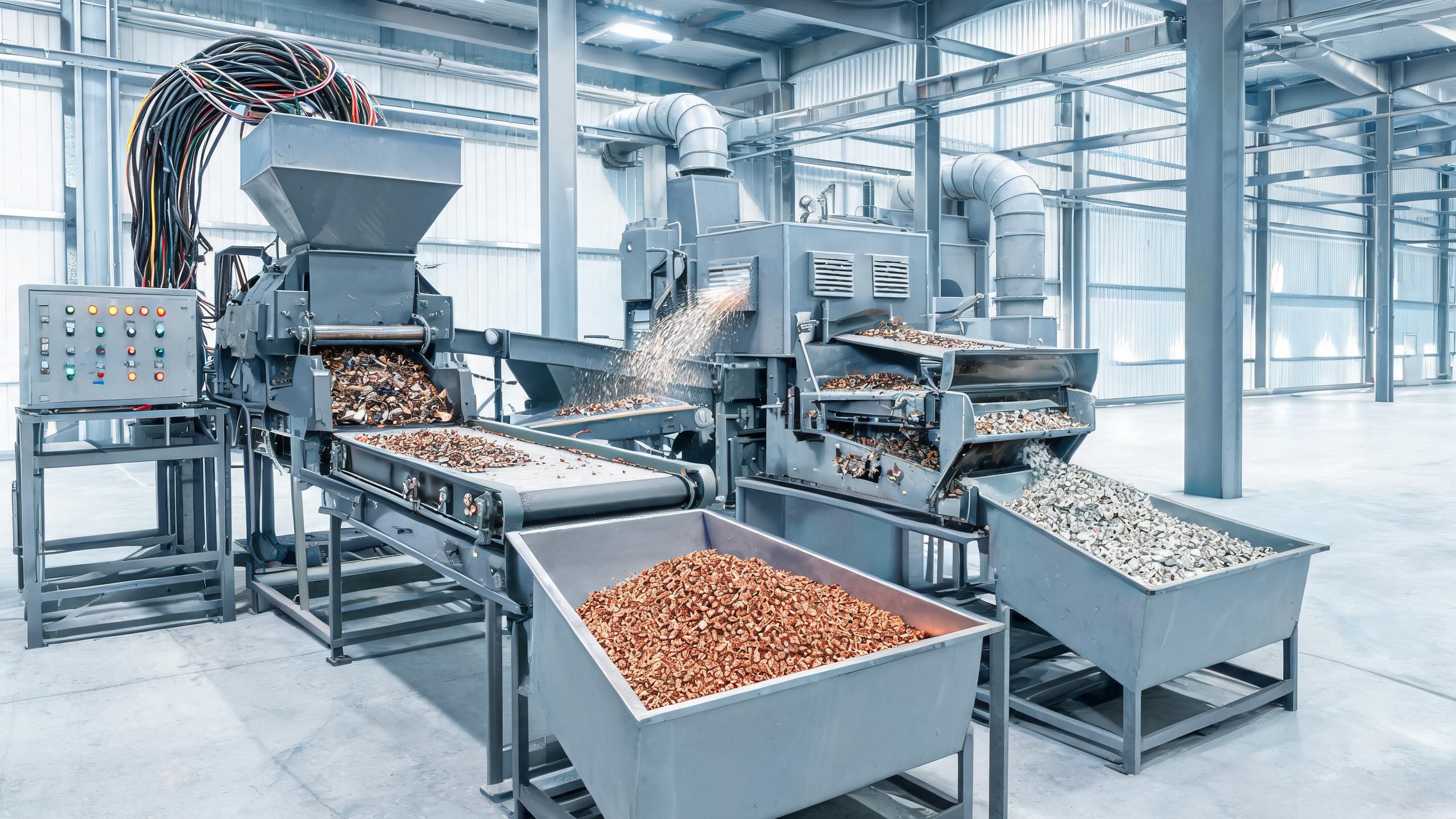
- Medium-volume yards: An integrated processing line at 15 t/h combines twin-shaft shredder, magnetic separator, and briquetting press. The PLC system manages stage sequencing across all stages, so an overload downstream automatically pauses upstream feeding.
- Dense ferrous: For cast iron and thick sections that exceed twin-shaft torque ratings, a jaw crusher as primary stage with Mn18 jaw plates handles abrasive feed. Output feeds a secondary impact crusher or shredder for final sizing.
Selection Criteria Beyond Specifications
Read this before comparing spec sheets: Nameplate throughput reflects ideal conditions with uniform feedstock. Real-world throughput depends on feed density, contamination level, and discharge size setting. Always confirm expected capacity against your actual feed mix.
When evaluating scrap machinery, look beyond the throughput number:
- Wear part standardization: Are cutting discs, hammers, jaw plates, and screens available as individual bolt-on replacements? Can they be changed without removing the shaft or rotor assembly? Reversible components (use both sides) double the service interval.
- Control system integration: Does the PLC manage stage sequencing and interlocks across connected equipment? A unified PLC that pauses upstream feeding when a downstream stage overloads prevents material spillage and conveyor damage.
- Power supply flexibility: Is the machine configurable for 50 Hz (standard in Southeast Asia) and 60 Hz? Heavy machines may require transformer capacity confirmation before ordering.
- Spare parts lead time: Standard lead time for replacement wear parts should be under 45 days. Each machine should ship with a spare-parts kit for the first operating period.
- Certification documentation: CE-marked frames with technical construction files and declarations support local safety authority reviews. ISO 9001 manufacturing quality management ensures process consistency.
Multi-Stage Line Configuration for Southeast Asian Plants
For plants processing diverse feedstock, a multi-stage approach provides flexibility. A typical configuration:
- Primary stage: Twin-shaft shredder for mixed light scrap, or jaw crusher for hard castings. Reduces oversized material to workable fragment size.
- Secondary stage: Impact crusher for uniform fragment size and metal liberation. Brittle metals shatter while ductile metals deform, aiding downstream separation.
- Separation stage: Overband magnetic separator for ferrous removal. Optional eddy-current separator for non-ferrous recovery (aluminum, copper).
- Densification stage: Hydraulic briquetting press compacts separated metal into dense briquettes for transport and furnace charging.
This staged approach lets a plant process both ferrous and non-ferrous streams through the same primary equipment, with separation and densification as downstream stages. The 12,000 m² manufacturing facility at Tiangong Technology produces every component in this chain, from shredders and crushers to separators and briquetting presses, with engineering support to configure the line for specific feedstock and capacity requirements.
Frequently Asked Questions
Working with Tiangong Technology
Tiangong Technology has manufactured scrap machinery since 2008 from a 12,000 m² facility with in-house machining, welding, and electrical assembly. The product range includes 18 machine models: twin-shaft, four-shaft, and single-shaft shredders; jaw, hammer, and impact crushers; cone and roll crushers; VSI crushers; briquetting systems; and integrated processing lines for aluminum scrap, cable recycling, e-waste recovery, and end-of-life vehicle processing.
All equipment is CE-marked and manufactured under ISO 9001 quality management. Key components such as hard-faced rotor shafts, gearboxes, and hydraulic systems are manufactured or sourced domestically to maintain lead times under 45 days for standard models. Installation supervision, operator training, and a 12-month warranty are included with every machine.
To discuss your specific processing requirements, include your feed material types, maximum piece size, daily volume, site power supply, and any country-specific regulatory requirements. The engineering team will configure rotor profiles, screen sizes, and hopper dimensions to match your feedstock and downstream separation needs.