
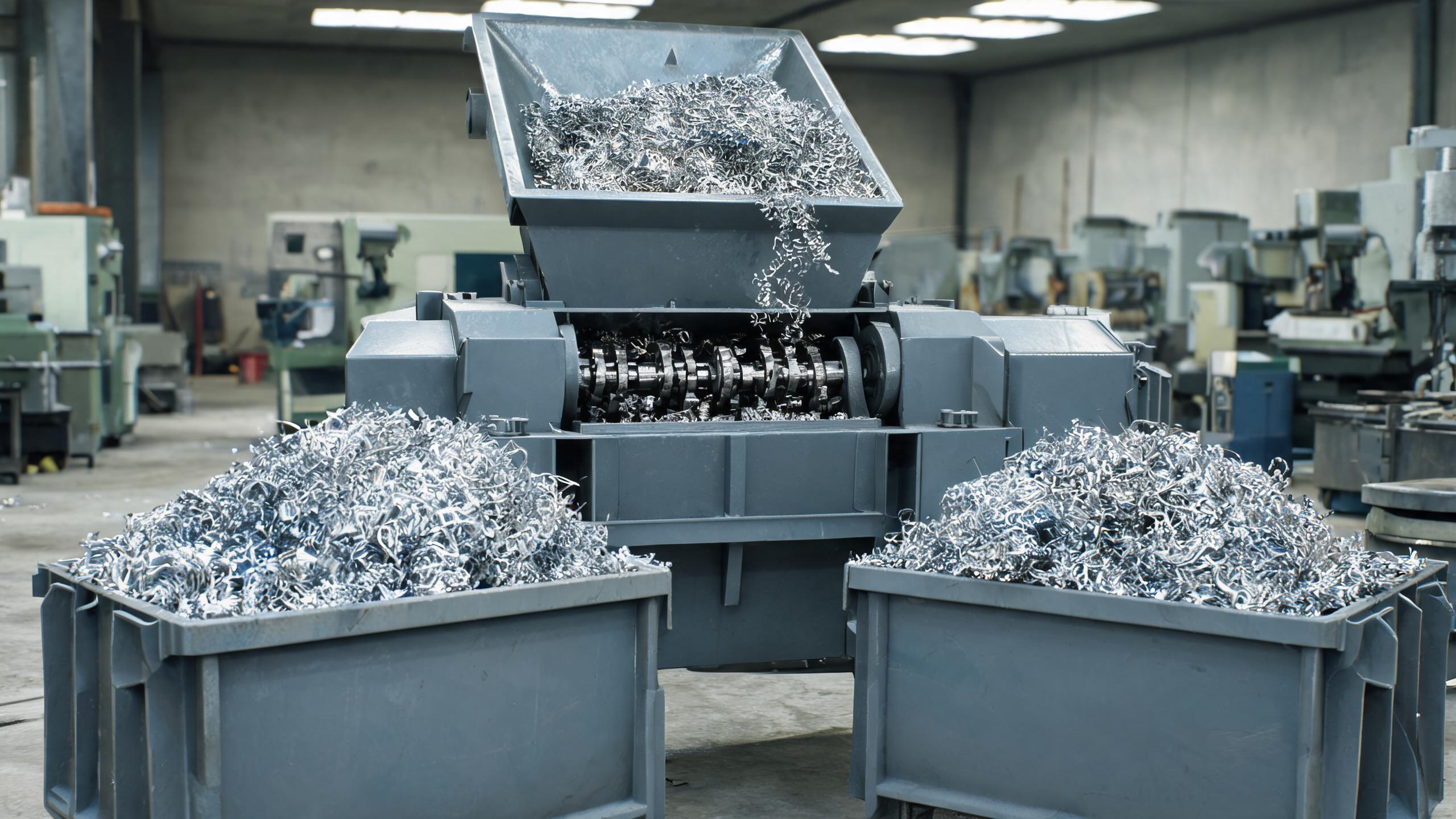
If you run a machining workshop or an aluminum recycling operation in Vietnam, Thailand, or Malaysia, you know that aluminum swarf and turnings are not just scrap — they are a revenue stream waiting to be managed properly. But handling stringy, springy turnings and fine chips is not the same as processing bulky scrap. You need a machine built for this specific material. This guide walks you through the key decisions: why aluminum swarf needs a purpose-built shredder, how to match capacity to your daily volume, what output size you should aim for, and what really drives the price. We'll keep it honest — no invented numbers, just the factors you need to compare quotes.
- Aluminum swarf requires low-speed shearing to prevent work-hardening and handle stringy turnings without jamming.
- Capacity selection starts with your daily swarf volume and operating hours — not the machine's theoretical maximum.
- Output size directly affects downstream value: smaller, uniform chips feed briquetting presses for furnace-ready density.
- Price is driven by drive power, shaft design, screen options, and automation — not just the brand name.
- Send your supplier a clear list of material details to get an accurate quote.
Why Aluminum Swarf Needs a Purpose-Built Shredder
Aluminum swarf is unlike other scrap. It comes in long, stringy turnings that can wrap around shafts, and fine chips that can pack tightly. If you feed this into a general-purpose shredder, you risk jamming, overheating, and poor output quality. Worse, aluminum can work-harden — meaning the more you crush it with high-impact forces, the harder and more abrasive it becomes. That damages blades and reduces the value of your output.
A purpose-built aluminum swarf shredder uses low-speed shearing. Instead of smashing the material, it cuts it with interlocking shafts at low speed. This prevents work-hardening, keeps the material's metallurgical properties intact, and handles both stringy turnings and loose chips without constant blockages. For example, the TG-AluShred 120 Aluminum Swarf Shredder is a twin-shaft machine designed specifically for this job. It features an inclined hopper for easier feeding of tangled turnings, sealed bearings to keep fine chips out of critical components, and a discharge screen to control output size. It's CE marked and runs on 50/60 Hz, so it suits power supplies across Southeast Asia.
Capacity Selection: Match the Machine to Your Daily Swarf Volume
The first question buyers ask is: "What size shredder do I need?" The answer depends on your daily swarf volume and how many hours you plan to run the machine. Here's a practical way to think about it:
- Estimate your daily output. How many kilograms of swarf do you generate per day? If you run CNC machines, weigh a week's worth of collected swarf to get a realistic average.
- Decide on operating hours. Are you running one shift or two? A smaller machine running longer can match a larger machine running shorter.
- Consider peak days. Production isn't uniform. If you have heavy machining days, you need a buffer — either a larger hopper or a slightly higher capacity than your average.
For smaller workshops with modest volume, a compact twin-shaft unit like the TG-LightMetal 80 Light-Duty Metal Shredder might be sufficient. It has a 2x15 kW drive, PLC auto-reverse to clear jams automatically, and is CE marked. It's designed for light-duty metal shredding, making it a sensible entry point for low-volume operations.
For larger recyclers processing high volumes, a dedicated aluminum line makes more sense. The TG-AluLine 200 Aluminum Scrap Recycling Processing Line integrates a twin-shaft shredder with downstream equipment — magnetic contaminant removal, an eddy current separator, and a hydraulic briquetting press. This transforms loose swarf, profiles, and sheet offcuts into dense, furnace-ready briquettes in one continuous process. If you're handling multiple forms of aluminum scrap, this is a system-level solution.
Output Size and Downstream Value
Why does output size matter? Because it determines what you can do with the shredded material — and how much it's worth. If you plan to sell the shreds directly, smaller, uniform chips fetch better prices. If you plan to briquette, the shredder must produce chips of a size that feeds the briquetting press efficiently.
Briquetting is the key to maximizing value. Loose swarf is bulky, difficult to transport, and has high oxidation losses in the furnace. Briquettes, on the other hand, are dense, easy to handle, and melt with less metal loss. The TG-AluLine 200's hydraulic briquetting press compresses the shredded material into dense briquettes that are ready for the furnace. This is the difference between selling low-grade loose swarf and selling a premium furnace-ready product.
To control output size, look for a shredder with a discharge screen. The TG-AluShred 120 includes this as a standard feature. You can choose a screen with larger or smaller openings depending on your downstream needs. The right size depends on your briquetting press and furnace specifications — always confirm the target chip size with your downstream equipment supplier before ordering screens.
Price Factors Explained Honestly
We won't quote prices here — they vary with configuration, shipping, and market conditions. But we can tell you what drives the cost, so you can compare quotes intelligently.
| Factor | Why It Matters | What to Look For |
|---|---|---|
| Drive power | Higher kW means more torque to cut tough material, but also higher energy consumption. | Match power to your material type and volume. Don't over-spec. |
| Shaft design | Twin-shaft vs. single-shaft; blade shape and material affect cutting efficiency and wear. | For aluminum swarf, twin-shaft low-speed shearing is the right choice. |
| Screen options | Interchangeable screens let you adjust output size without buying a new machine. | Check if screens are included and how easy they are to change. |
| Automation | PLC controls, auto-reverse, and sensors reduce downtime and operator error. | Auto-reverse is essential for handling stringy material that can jam. |
| Build quality | Sealed bearings, robust frame, and quality steel extend machine life in harsh conditions. | Sealed bearings are critical when processing fine chips that can penetrate. |
| Certifications | CE marking indicates compliance with EU safety standards, important for export. | Verify CE certification and ask for documentation. |
Remember: the cheapest machine is not always the most economical. A machine that jams frequently, wears out blades quickly, or produces poor output will cost you more in downtime and lost material value. Factor in maintenance, spare parts availability, and after-sales support when comparing prices.
Pre-Purchase Checklist and What to Send Suppliers
To get an accurate quote, you need to give suppliers complete information. Here's a checklist of what to prepare:
- Material type: Is it pure aluminum swarf, or does it contain steel, oil, or other contaminants? Magnetic removal may be needed.
- Material form: Stringy turnings, fine chips, or a mix? This affects hopper design and shaft configuration.
- Daily volume: In kilograms or tonnes per day, and how many hours you plan to run.
- Desired output: Do you want loose chips or briquettes? What size range?
- Power supply: Voltage and frequency (e.g., 380V/50Hz in Vietnam, 400V/50Hz in Thailand, 415V/50Hz in Malaysia).
- Space constraints: Floor area and ceiling height for the machine and any downstream equipment.
- Environmental requirements: Do you need noise control, dust collection, or oil separation?
When you contact a supplier like Tiangong Technology (founded in 2008, CE-marked equipment, 12-month warranty), include these details. A reputable supplier will ask clarifying questions if anything is unclear. That's a good sign — it means they're thinking about your specific application.
Frequently Asked Questions
Can I use a general metal shredder for aluminum swarf?
Technically yes, but it's not recommended. General shredders may use high-speed impact that work-hardens aluminum and causes jamming with stringy turnings. A purpose-built low-speed shear shredder is safer and more efficient.
What's the difference between a shredder and a granulator?
A shredder cuts material into coarse pieces, while a granulator further reduces it to fine granules. For briquetting, a shredder is usually sufficient. If you need very fine output, you may add a granulator downstream.
How do I know if I need a full processing line?
If you handle large volumes and want to produce furnace-ready briquettes, a line like the TG-AluLine 200 combines shredding, contamination removal, and briquetting in one system. For smaller operations, a standalone shredder plus external briquetting may be more cost-effective.
What maintenance does an aluminum swarf shredder require?
Regular checks include blade wear, bearing lubrication, and screen condition. Sealed bearings reduce maintenance frequency. Ask your supplier for a recommended maintenance schedule.
Next Steps
Choosing the right aluminum swarf shredder is a business decision, not just an equipment purchase. It affects your operating costs, material value, and compliance with environmental regulations. Start by gathering the information above, then reach out to suppliers with a clear brief. Tiangong Technology can help you match the right machine to your volume and output goals — whether that's the compact TG-LightMetal 80, the dedicated TG-AluShred 120, or the full TG-AluLine 200 processing line. Request a quote with your specific parameters, and you'll get a solution that pays for itself.