Choosing between a centrifugal (vertical shaft impact) crusher and a horizontal impact crusher is one of the first decisions you'll make when setting up or upgrading a metal recycling line. Get it right, and you reduce downtime, control operating cost per tonne, and hit your target output size. Get it wrong, and you're fighting wear parts, poor product shape, and a machine that struggles with your feed.
This guide compares the two technologies side by side — how each works, what materials each handles best, output shape and size control, wear and maintenance, and a practical decision checklist. We'll reference two specific machines from Tiangong Technology: the TG-VSI 200 Vertical Shaft Impact Crusher and the TG-Impact 500 Horizontal Impact Crusher. Both are CE-marked and built under ISO 9001 quality management.
- Centrifugal (VSI) crushers use rock-on-rock autogenous crushing — best for brittle metal chips and castings where you want low wear and consistent cubical shape.
- Horizontal impact crushers use blow bars and adjustable impact curtains — best for fragmenting pre-sized scrap where you need higher reduction ratios and flexibility in output size.
- Your choice depends on feed material, capacity (Tiangong typical throughput is 2–30 t/h depending on density and discharge size), and target output shape.
- Wear parts differ: VSI uses a self-renewing chamber lining; horizontal impact uses blow bars and curtains that need periodic replacement.
How Each Crusher Type Works
Centrifugal (Vertical Shaft Impact) Crusher
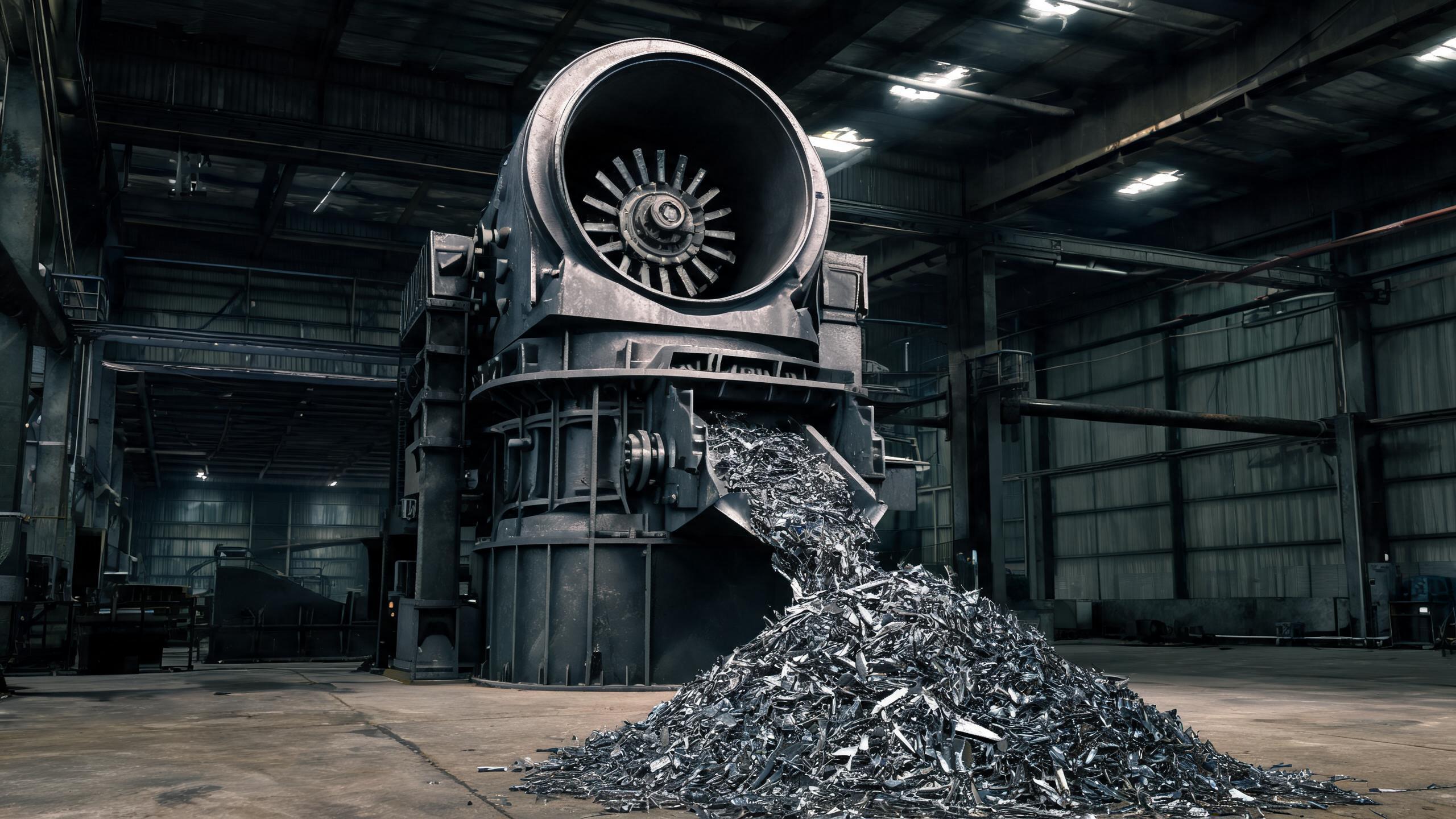
A centrifugal crusher — also called a vertical shaft impact (VSI) crusher — uses a vertical rotor with an impeller. Material is fed into the centre of the rotor, accelerated outward by centrifugal force, and thrown against a surrounding bed of material. This is called rock-on-rock autogenous crushing: the material crushes itself against other material, rather than against metal wear surfaces.
The TG-VSI 200 is built on this principle. It is designed for brittle metal chip and casting reduction. Because the crushing action is material-on-material, the machine's wear is concentrated in the rotor and the chamber lining — which in the TG-VSI 200 is a self-renewing chamber lining. This means the lining is formed by the material itself, reducing the frequency of replacement parts.
Horizontal Impact Crusher
A horizontal impact crusher uses a high-speed rotor fitted with blow bars. Material is fed into the rotor path, struck by the blow bars, and thrown against adjustable impact curtains mounted inside the crushing chamber. The combination of rotor impact and curtain rebound breaks the material down further.
The TG-Impact 500 is a secondary horizontal shaft impact crusher designed for fragmenting pre-sized metal scrap. It is a secondary unit — meaning it works best after primary reduction, not on raw, oversized scrap. Its adjustable impact curtains let you change the gap and thus influence the final product size.
Best-Fit Materials and Applications
Each technology suits a different feed profile. Matching the crusher to your material is the single most important step in avoiding premature wear and poor output.
| Parameter | Centrifugal (VSI) — TG-VSI 200 | Horizontal Impact — TG-Impact 500 |
|---|---|---|
| Crushing principle | Rock-on-rock autogenous (vertical rotor with impeller) | Blow bars striking material against impact curtains |
| Best for | Brittle metal chips, castings, and similar friable metal waste | Pre-sized metal scrap that needs secondary fragmentation |
| Feed size | Typically smaller, more uniform feed | Pre-sized scrap (not raw oversized material) |
| Output shape | Cubical, consistent — good for downstream sorting | More variable, but adjustable via curtains |
| Wear parts | Self-renewing chamber lining, rotor tips | Blow bars, impact curtains, liners |
Centrifugal crushers are ideal when your feed is brittle and you want low wear rates. The autogenous action means the material does the crushing, so you're not constantly replacing impact surfaces. This makes the TG-VSI 200 a strong candidate for metal chips from machining operations, or for reducing castings and other brittle metal parts before further processing.
Horizontal impact crushers shine when you need to fragment larger, pre-sized scrap into smaller pieces with a relatively high reduction ratio. The TG-Impact 500 is designed as a secondary unit — so it works best after a primary crusher or shredder has already reduced the material to a manageable size. Its adjustable curtains give you control over the final product size.
Output Shape and Size Control
For metal recycling, output shape matters more than many operators realise. A consistent, cubical product is easier to sort, denser to transport, and more valuable to downstream buyers.
Centrifugal crushers naturally produce a more cubical product because the rock-on-rock action breaks material along natural fracture lines. The TG-VSI 200's vertical rotor design promotes this. If your downstream process requires a uniform particle shape — for example, for separation or melting — a VSI is often the better choice.
Horizontal impact crushers produce a more elongated or flaky product in some materials, because the blow bar impact tends to crack along the path of least resistance. However, the TG-Impact 500's adjustable impact curtains allow you to fine-tune the crushing gap, which influences both size and shape. You can dial in a tighter gap for a finer product, or open it up for a coarser output.
Wear Parts and Maintenance Considerations
Wear is where operating costs can quietly spiral. Understanding what wears and how often is critical to budgeting and uptime.
Centrifugal (VSI) Wear
In a VSI, the main wear points are the rotor tips and the chamber lining. The TG-VSI 200 uses a self-renewing chamber lining — meaning the material builds up a protective layer on the chamber walls, which wears away and rebuilds during operation. This reduces the need for manual liner replacement and extends intervals between maintenance.
Rotor tips still need periodic inspection and replacement, but the overall wear cost per tonne is typically lower than a horizontal impact crusher when processing abrasive, brittle material.
Horizontal Impact Wear
In a horizontal impact crusher, the blow bars take the brunt of the wear. They strike the material at high speed and are subject to impact and abrasion. The impact curtains also wear, especially if the feed contains hard contaminants. Blow bars are reversible — the TG-Impact 500's design allows you to flip them to extend service life, but they will need replacement more frequently than a VSI's chamber lining.
Maintenance access is generally straightforward on horizontal impact crushers, but the frequency of blow bar changes can be higher, especially with harder feed materials. Factor this into your operating cost calculation, and ask your supplier for a recommended inspection and replacement schedule based on your actual feed material.
Decision Checklist: Feed Material, Capacity, Target Output
Use this checklist to make your choice. If you're still unsure, ask your supplier for a recommendation based on your specific material and throughput.
- Identify your feed material. Is it brittle metal chips and castings? → Centrifugal (VSI). Is it pre-sized scrap that needs secondary fragmentation? → Horizontal impact.
- Determine your feed size. Centrifugal crushers prefer smaller, more uniform feed. If your scrap is oversized, you'll need a primary crusher first — the TG-Hammer 800 is one option for heavy-duty primary reduction.
- Estimate your required capacity. Tiangong's typical throughput ranges from 2 to 30 t/h depending on material density and discharge size. Match the machine to your target tonnage.
- Define your target output shape. If you need cubical, consistent particles, lean toward a VSI. If size flexibility is more important, a horizontal impact with adjustable curtains gives you that control.
- Consider your maintenance budget. If you want lower wear part consumption, a VSI's self-renewing lining is an advantage. If you prefer simplicity and are prepared for more frequent blow bar changes, a horizontal impact is fine.
- Check your power availability. The TG-Hammer 800, for example, is a 750 kW machine with 500-ton hydraulic compression and 40–60 t/h throughput — a different class from the secondary crushers discussed here. Make sure your site can support the power draw.
Frequently Asked Questions
Can a centrifugal crusher handle wet or sticky material?
Centrifugal crushers generally handle dry, brittle material best. Wet or sticky feed can cause build-up in the rotor and chamber, reducing efficiency. For such material, a horizontal impact crusher may be more forgiving, but always test with your actual material.
Which crusher gives a better output shape for metal recycling?
Centrifugal (VSI) crushers typically produce a more cubical, consistent shape due to the rock-on-rock action. Horizontal impact crushers can produce more elongated particles, but adjustable curtains help mitigate this. For most metal recycling applications where shape matters, a VSI is preferred.
How often do blow bars need replacing in a horizontal impact crusher?
It depends on the feed material's abrasiveness and the crusher's operating conditions. There is no universal replacement interval — ask your supplier for a schedule based on your material, and inspect wear regularly. Reversible blow bars extend life, but plan for regular replacement.
Can I use a centrifugal crusher as a primary crusher?
Typically no. Centrifugal crushers work best on pre-sized, brittle feed. For primary reduction of large scrap, you'd need a heavy-duty crusher like the TG-Hammer 800, which handles larger feed with its 750 kW motor and 500-ton hydraulic compression.
Next Steps
Choosing the right crusher is about matching the machine to your material, your capacity, and your output goals. Both the TG-VSI 200 and the TG-Impact 500 are CE-marked and built under ISO 9001 quality management, so you can be confident in their compliance and build quality.
If you're still uncertain which technology fits your plant, contact Tiangong Technology. We can discuss your feed material, capacity requirements, and target output to recommend the right solution. Our typical throughput range is 2–30 t/h depending on material density and discharge size, so we can help you size the machine correctly.
Ready to talk? Send us your material specifications and we'll help you evaluate the options.