
BUYER GUIDE · SCRAP YARD OPERATIONS
What This Guide Covers
If you run a scrap yard in Vietnam, Thailand, Indonesia, Malaysia, or the Philippines, you already know the margin problem: buying scrap is getting more competitive, and selling it unprocessed leaves money on the table. The gap between selling loose scrap and selling densified, sorted material can be 15–30% depending on the metal and the mill's specifications.
This guide walks through the main categories of metal recycling equipment, what each machine actually does, how to size it for your throughput, and the questions you should ask a supplier before committing. We focus on practical selection criteria — not marketing language.
- Match machine capacity to your daily input tonnage, not your peak month — oversizing is the most common budget mistake.
- Balers and shears pay back fastest for mixed ferrous yards; granulators and separation lines suit non-ferrous processors.
- Power supply (three-phase vs. single-phase) and local emissions/noise rules determine which machines are viable at your site.
- Ask suppliers for reference installations in Southeast Asia — local voltage, humidity, and maintenance access matter more than brochure specs.
1. Start With Your Material Flow, Not the Machine
Before looking at any equipment, define what actually comes through your gate. A yard handling demolition scrap has a different problem than one buying e-waste or post-industrial offcuts. The equipment decision follows the material mix, not the other way around.
Answer these four questions first:
- Input: What are the main material types? (Light steel, heavy steel, mixed non-ferrous, cables, motors, aluminium cans, copper wire, e-waste boards)
- Volume: How many tonnes per day do you process today? What is realistic in 24 months?
- Output: Who buys your material, and what specification do they require? (Shredded to 100mm? Baled to 500kg? Sorted to 99% copper content?)
- Site constraints: Available footprint, power supply (voltage and phase), noise limits, and whether the site is indoors or covered.
Write these answers down. Every equipment supplier you contact will ask the same questions — and the ones who push back with counter-questions are the ones who understand your problem.
2. The Main Equipment Categories
Most scrap yards in Southeast Asia build their operation around one or two primary machines, then add supporting equipment as volumes grow. Here is what each category does, and where it fits.
2.1 Hydraulic Balers
Balers compress loose light scrap — sheet metal, tin cans, light steel offcuts, aluminium UBCs — into dense bales that are cheaper to transport and meet mill requirements. A typical vertical baler produces bales of 300–800 kg; horizontal balers run higher throughput for continuous operation.
Choose a baler when: your output buyer accepts bales, and your input is mostly light, bulky material that currently costs too much to truck.
2.2 Alligator Shears
Alligator shears cut long or oversized material — beams, pipes, rebar bundles, structural steel — down to charge-box length for furnaces or for further processing. They are simple, robust machines with low maintenance requirements, which is why they remain popular in smaller yards.
Choose a shear when: you handle long sections that cannot fit a shredder feed, or when a shredder is not yet justified by volume.
2.3 Metal Shredders
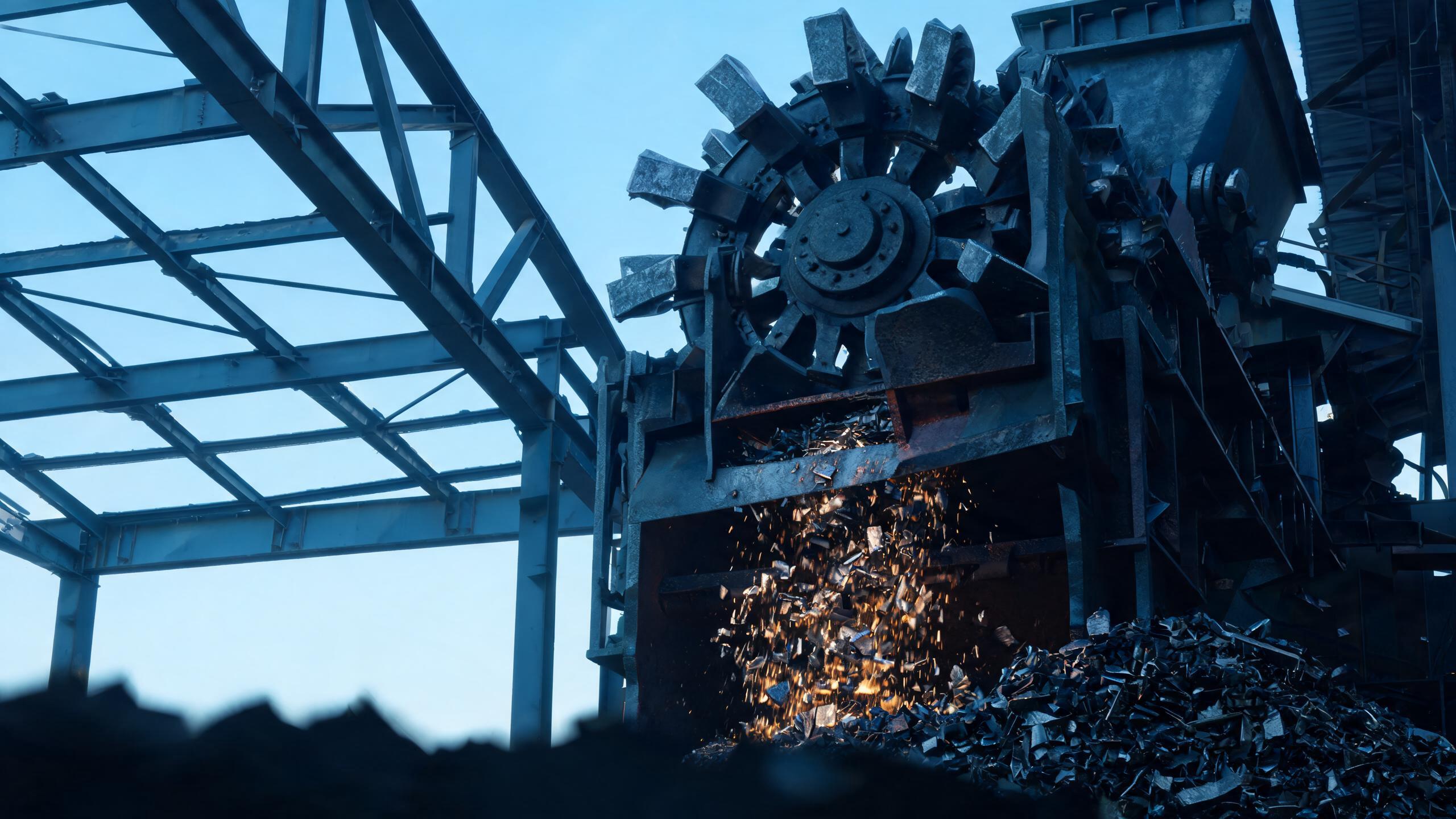
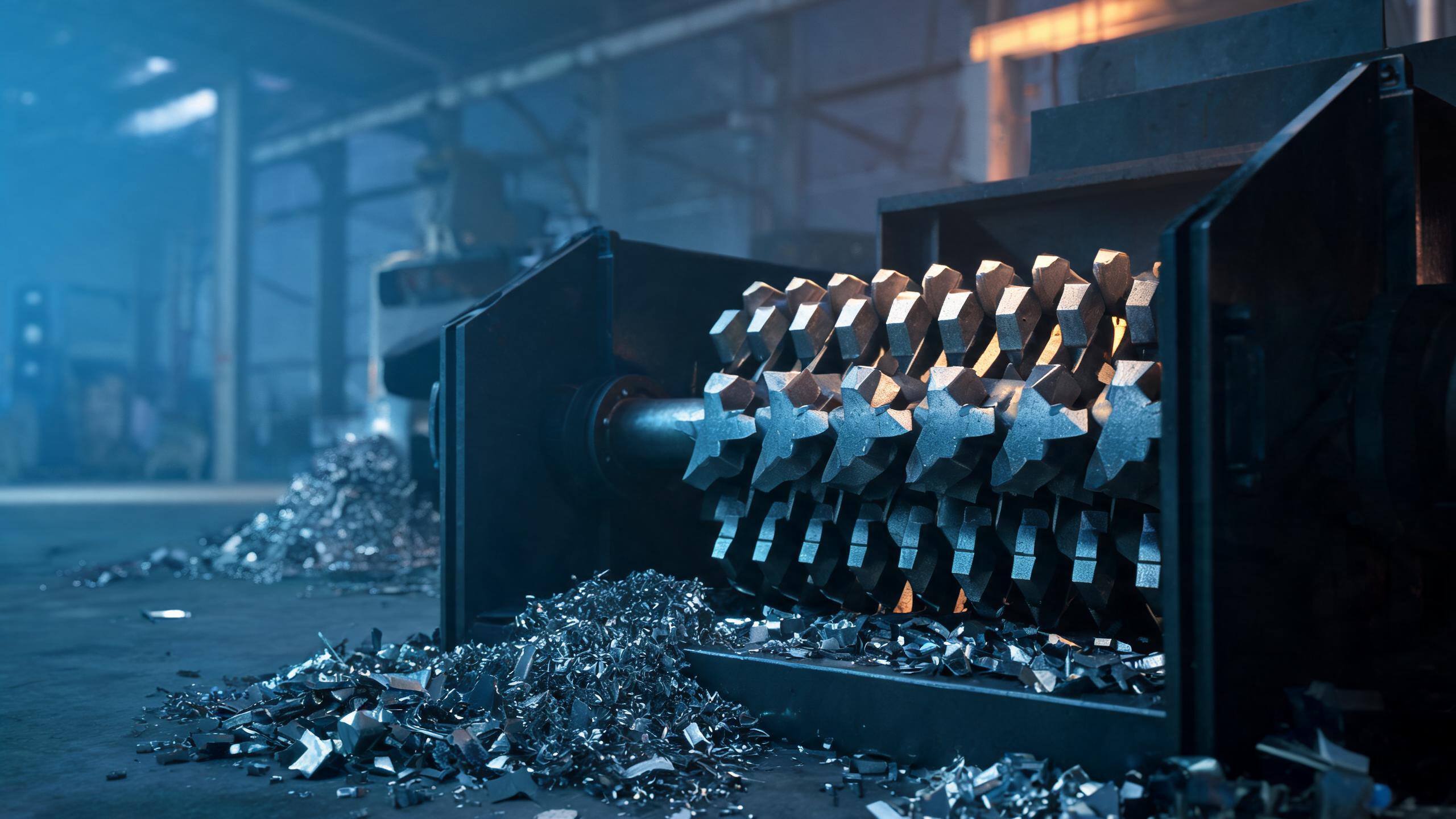
Shredders reduce mixed scrap into uniform fragments using rotating hammers or knives. Output size is controlled by screens. They are the workhorse of medium-to-large yards, and they are the most capital-intensive single purchase on this list. Sizes range from small single-shaft units (500 kg/hour) to industrial dual-shaft systems (20+ tonnes/hour).
Choose a shredder when: your volume justifies it (typically above 5–10 tonnes/day of mixed scrap), and your buyer pays a premium for shredded, uniform material.
2.4 Granulators and Cable Strippers
Granulators process copper and aluminium wire and cable into clean granules, separating the metal from insulation. Cable strippers handle thicker cables in a single pass. These machines are the entry point for yards moving into non-ferrous recovery, where per-tonne margins are higher than ferrous.
Choose a granulator when: you have a consistent supply of wire and cable, and you want to sell clean copper granules instead of mixed cable scrap.
2.5 Magnetic and Eddy-Current Separators
Magnetic separators pull ferrous material out of mixed streams. Eddy-current separators do the reverse — they repel non-ferrous metals (aluminium, copper, brass) away from non-metallic waste. These are almost always used as part of a processing line rather than as standalone machines.
Choose separators when: you are processing mixed waste streams (e.g., e-waste, shredded cars, municipal scrap) and need to produce clean, single-metal fractions.
| Equipment | Typical Input | Output Form | Indicative Throughput | Best For |
|---|---|---|---|---|
| Vertical baler | Light sheet, cans, UBC | Bales 300–800 kg | 1–5 t/day | Small yards, low power availability |
| Alligator shear | Beams, pipe, rebar | Cut lengths 300–800 mm | 2–8 t/day | Demolition and structural scrap |
| Single-shaft shredder | Mixed light scrap | Fragments 50–150 mm | 5–20 t/day | Growing yards with mixed input |
| Granulator | Wire, cable, radiators | Clean granules 2–10 mm | 1–3 t/day | Non-ferrous recovery, higher margins |
| Separator line | Mixed shredded waste | Single-metal fractions | Line-dependent | E-waste, auto shredder residue |
3. Sizing: Match Capacity to Real Throughput
The single most common mistake in equipment selection is buying a machine sized for a peak month, then running it at 30% utilisation for the rest of the year. A machine that runs at 60–80% of its rated capacity most days is a better investment than a bigger machine that idles.
Here is a simple sizing exercise:
- Take your average daily input over the last 6 months (not the best month).
- Add 20–30% headroom for growth over 24 months.
- Check the machine's rated throughput against that number — not against its theoretical maximum.
- Confirm the power draw matches your site's supply. A 75 kW shredder on a site with only 50 kW available is a non-starter unless you upgrade the electrical connection first.
If you are between two sizes, the smaller machine with a second shift option is often the smarter call. Labour is cheaper than capital in most Southeast Asian markets.
4. What to Check Before Buying
Beyond the brochure specifications, these are the practical checks that separate a good purchase from a costly one.
4.1 Power Supply and Voltage
Most industrial equipment is built for three-phase power. Confirm your site's voltage (220V/380V/415V are common across the region) and whether the machine's motor is wound for that voltage. Some suppliers offer dual-voltage motors; others do not. This is a simple question that avoids a very expensive surprise.
4.2 After-Sales Support and Spare Parts
Ask where the supplier's nearest service technician is, and how long it takes to get common wear parts (blades, hammers, screens, hydraulic seals). A machine that needs a 6-week wait for a blade set is a machine that loses you money. Prefer suppliers with a distributor or service partner in your country, or who can ship spare parts within days.
4.3 Local Compliance and Noise
Shredders and granulators are noisy. Check your local zoning and noise regulations before installation — a machine that violates noise limits at 7 a.m. will be a recurring problem. Some municipalities require permits for scrap processing operations. Confirm what documentation your supplier provides (CE marking, wiring diagrams, manuals in English or your local language) to support your permit application.
4.4 Reference Installations
Ask for reference installations in Southeast Asia — not just in the supplier's home country. Tropical humidity, dust, and inconsistent power grids stress equipment differently than temperate climates. A supplier who can show you a working installation in your region is worth more than one who only has glossy photos from Europe or China.
5. Budgeting and Payback
Prices for metal recycling equipment vary widely by brand, country of manufacture, and specification. Rather than quoting numbers here (which would be inaccurate and quickly outdated), use this framework to evaluate the investment:
- Calculate the value uplift: What is the price difference between selling loose scrap and selling processed material? Multiply that by your monthly tonnage. That is your gross benefit.
- Subtract operating costs: Power consumption (kW × hours × local electricity rate), labour, wear parts, and maintenance. Be conservative.
- Divide the machine price by the net monthly benefit. That gives you a rough payback period in months. A payback under 18 months is generally a sound investment; beyond 36 months, reconsider the sizing or the equipment type.
Also factor in transport savings. Denser bales and smaller fragments mean more tonnes per truck, which directly cuts your logistics cost per tonne.
6. Common Mistakes to Avoid
- Buying a shredder before you have the volume. A baler or shear is usually the right first machine for a mixed yard.
- Ignoring power constraints. Check your electrical supply before you fall in love with a machine.
- Choosing the cheapest option without checking spare parts availability. A machine that cannot be repaired is not a bargain.
- Not testing with your actual material. Reputable suppliers can run a sample of your scrap through their machine. If they refuse, that is a red flag.
- Overlooking dust and water management. Scrap processing creates dust and runoff. Check whether your site needs a basic water collection or dust suppression system for compliance.
7. Frequently Asked Questions
Q: Can I start with a baler and add a shredder later?
Yes. This is a common path. A baler handles light material, and you can add a shredder when volume justifies it. Ensure the baler you buy can handle the material mix you expect in 2–3 years.
Q: What is the minimum power requirement for a small shredder?
Small single-shaft shredders typically draw 15–30 kW. Confirm your site's three-phase supply and circuit capacity before installation. Details are available upon request from suppliers based on your specific model.
Q: How do I know if a granulator will pay for itself?
Calculate the price gap between mixed cable scrap and clean copper granules in your local market. If the gap is significant and you have a steady cable supply, a granulator often pays back within 12–18 months.
Q: Do I need a magnetic separator from day one?
Only if your input is mixed and you need to separate ferrous from non-ferrous. If you are buying sorted scrap, you can add separation later when you expand into mixed streams.
8. Next Steps
Before you contact any supplier, complete the material-flow exercise in Section 1. It takes an hour and will make every subsequent conversation more productive.
When you are ready to compare options, ask each supplier for:
- A written specification sheet with motor power, throughput, output size, and dimensions.
- Reference installations in Southeast Asia.
- Spare parts pricing and lead times for the top 10 wear parts.
- After-sales service terms and response time.
If you are evaluating specific machines and want to discuss how they fit your operation, contact us with your material mix and daily tonnage. We can help you match the right configuration to your site's constraints — power, footprint, and budget.