
BUYER GUIDE
If you run a recycling plant in Vietnam, Indonesia, Thailand, Malaysia, or the Philippines, you already know the problem: your waste stream is mixed, bulky, and hard to handle. Tires, scrap metal, municipal solid waste (MSW), construction debris — each behaves differently inside a shredder. Choosing the wrong machine size means either buying more capacity than you need or fighting jams and downtime from day one.
This guide explains how a double shaft shredder (also called a twin shaft shredder) works, how to match its size to your specific material, and what to check before you send an inquiry. No vague marketing — just the facts you need to make a sound purchasing decision.
- Double shaft shredders use two counter-rotating shafts with cutting discs for low-speed, high-torque shearing — ideal for tough, bulky materials.
- Machine size should match your feedstock density, particle size requirement, and throughput target — not just the biggest motor you can afford.
- Bolt-on cutting discs allow field replacement of wear parts, reducing downtime and maintenance costs.
- Check whether the supplier can adapt shaft configuration and drive torque to your material, and whether they offer installation supervision and operator training.
What Is a Double Shaft Shredder and How Does It Work?
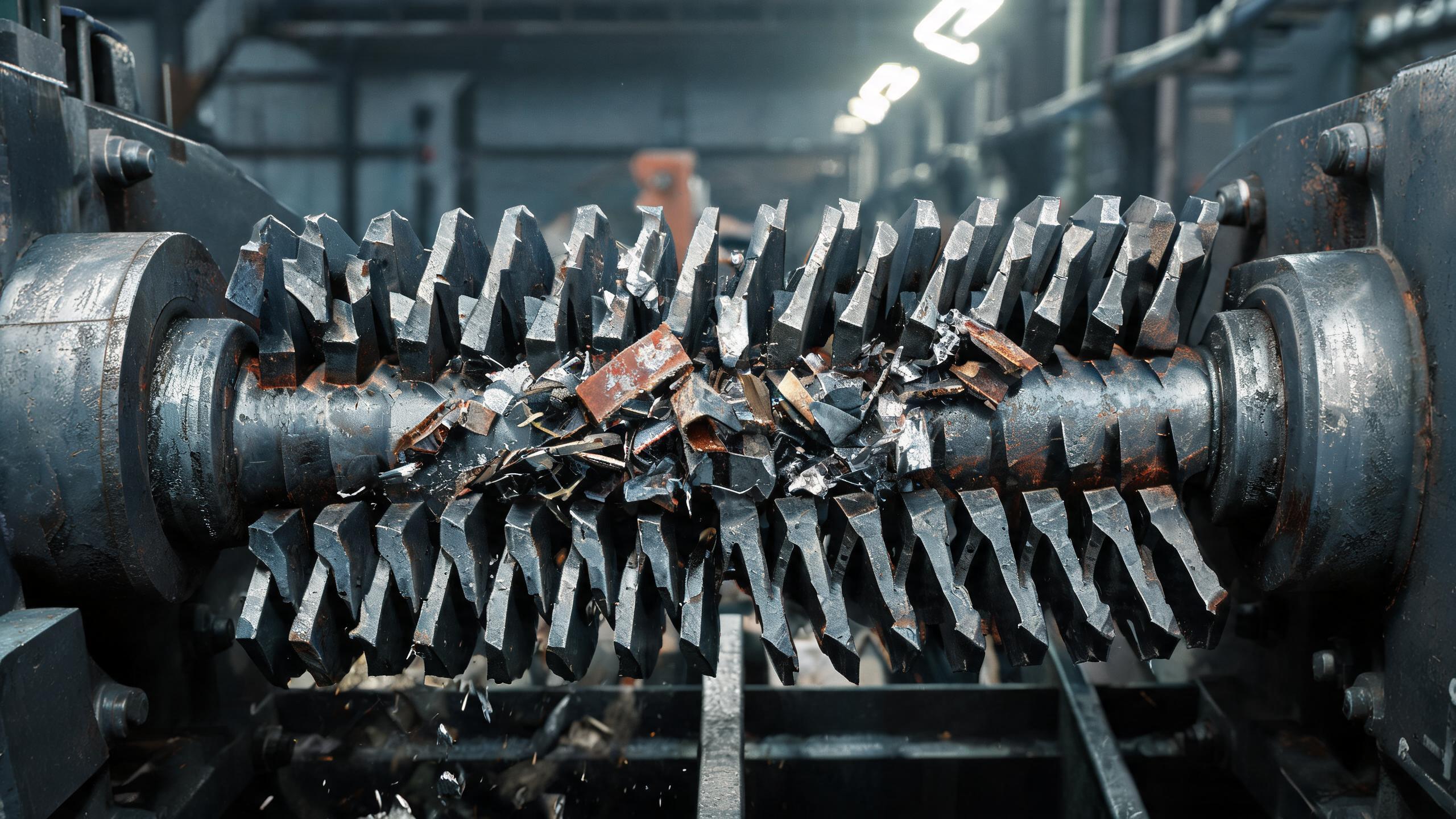
A double shaft shredder consists of two parallel shafts fitted with cutting discs that rotate in opposite directions. As material enters the hopper, the counter-rotating discs grab, tear, and shear it into smaller pieces. This design generates low speed and high torque, which means it can handle dense, tough materials without the high-speed impact that causes wear and noise in other shredder types.
The key advantage of twin-shaft design is its ability to process materials that are difficult to cut, such as tires with steel belting, bulky metal scrap, and mixed MSW. The shearing action is less dependent on material hardness and more on the force applied between the discs. This makes it a versatile choice for recycling operations that handle multiple waste streams.
Matching Machine Size to Your Waste Stream
No single shredder fits all materials. The right size depends on the physical characteristics of your input and the output you need. Here's how to think about it for common waste streams in Southeast Asia.
Scrap Metal
Metal scrap — whether from manufacturing offcuts, end-of-life vehicles, or demolition — is dense and abrasive. A double shaft shredder for metal needs a robust drive and heavy-duty cutting discs. The shaft configuration and drive torque must be adapted to the density of the metal you process. For example, light gauge steel (like car bodies) requires less torque than solid billets or engine blocks. You should ask your supplier how they adjust the machine for different metal densities, and whether they can provide a machine sized for your specific feed dimensions.
Tires
Tires are a common challenge in Southeast Asia, with growing stockpiles and environmental regulations. A twin shaft shredder can handle whole tires, including steel-belted radial tires, because the low-speed shearing tears the rubber and separates the steel wires without excessive heat. The size of the cutting chamber and the disc design determine how easily tires are pulled in. For tires, you need a machine with a feed opening wide enough to accept whole tires without pre-cutting, and a discharge size that matches your downstream process (e.g., a granulator or a wire separator).
Municipal Solid Waste (MSW)
MSW is heterogeneous: plastics, paper, organics, textiles, and occasional hard objects. The challenge is not just shredding but handling the variability. A double shaft shredder with a large feed opening and a sturdy hopper can process unsorted MSW, reducing its volume before further sorting or composting. The machine should be sized to handle peak loads — for example, during holiday seasons when waste volume spikes. You also need to consider discharge size: smaller output particles are better for downstream separation, but they increase energy consumption and wear.
Bulky Waste
Bulky waste — furniture, mattresses, white goods, and construction debris — often jams single-shaft shredders because of its size and shape. Double shaft shredders excel here because the counter-rotating discs grab and pull material into the cutting zone. The feed opening must be large enough to accept the largest item you expect, and the chamber design must prevent bridging (material arching over the opening).
Single Shaft vs. Double Shaft: Trade-Offs
If you are evaluating shredders, you will likely compare single-shaft and double-shaft designs. Here's a practical comparison:
| Factor | Double Shaft (Twin Shaft) | Single Shaft |
|---|---|---|
| Cutting principle | Low-speed, high-torque shearing between two counter-rotating shafts | High-speed rotor with a stationary counter-knife; material is cut by a screen |
| Best for | Bulky, tough, mixed materials (tires, metal, MSW, bulky waste) | Uniform materials requiring a consistent output size (e.g., plastics, wood) |
| Output size control | Less precise; depends on disc spacing and screen (if fitted) | Precise; output size determined by screen mesh |
| Maintenance | Bolt-on cutting discs can be replaced in the field | Screen and rotor knives require regular replacement; more wear parts |
| Energy efficiency | Lower speed means lower energy per ton for tough materials | Higher speed can be more efficient for soft materials |
For most recycling plants handling mixed waste, a double shaft shredder is the safer choice because it can handle unexpected materials without frequent jams. If you need a precise output size (e.g., for RDF production), a single shaft or a secondary shredder may be needed downstream.
Sizing Considerations: Feed Opening, Chamber, Drive, and Discharge
When a supplier asks for your material details, they are trying to determine four key parameters:
- Feed opening size: Must be large enough to accept your largest input piece without pre-processing. For tires, this means the width of a whole tire; for MSW, the size of typical bags or bundles.
- Chamber geometry: The shape and depth of the cutting chamber affect how material is pulled in and how easily it passes through. A deeper chamber can handle bulkier items, but may require more power.
- Drive torque: This is the force that rotates the shafts. Higher torque is needed for dense materials like metal or thick rubber. Ask the supplier how they adapt drive torque to your feedstock density — this is a key customization point.
- Discharge size: The size of the output particles determines downstream processing. Smaller particles require more passes or a finer screen, which increases energy use. Define your required discharge size before you compare machines.
Also consider your required throughput in tons per hour. This is not a fixed number — it depends on the material density, the discharge size, and the machine's configuration. A reputable supplier will ask for your material type, input size, and desired output to recommend a suitable machine. Be wary of suppliers who quote a machine without asking these questions.
Wear Parts and Maintenance: What to Ask
Shredders experience significant wear, especially with abrasive materials like metal and tires. The cutting discs are the main wear parts. Look for a machine with bolt-on/replaceable cutting discs — this allows you to replace worn discs in the field without replacing the entire shaft assembly. This reduces downtime and spare parts cost.
Ask the supplier:
- How long do the cutting discs typically last for your material? (They may not have exact data for your specific waste, but they should have experience with similar materials.)
- Are discs available as spare parts, and what is the lead time for delivery to your country?
- Can the discs be re-sharpened or re-built, or must they be replaced entirely?
- What is the maintenance schedule for bearings, seals, and hydraulic systems (if applicable)?
Regular maintenance is critical for shredder uptime. A supplier that offers installation supervision and operator training can help your team operate and maintain the machine correctly from day one — reducing the risk of premature wear and safety issues.
Supplier Evaluation Checklist
Before you commit to a supplier, use this checklist to compare quotes and technical proposals:
| Checklist Item | Why It Matters |
|---|---|
| Does the supplier ask about your material type, input size, and output size? | Indicates they are sizing the machine to your needs, not just selling a standard unit. |
| Can they adapt shaft configuration and drive torque to your feedstock density? | This is a sign of engineering flexibility, not just a catalog product. |
| Are cutting discs bolt-on and replaceable in the field? | Reduces downtime and maintenance complexity. |
| Is the machine configurable for 50 Hz and 60 Hz power systems? | Important for Southeast Asian countries with different grid frequencies (e.g., 50 Hz in Vietnam, 60 Hz in the Philippines). |
| Does the equipment carry CE marking? | Indicates compliance with EU safety and health standards, which is often a baseline for international buyers. |
| Does the supplier provide installation supervision and operator training? | Ensures your team can operate the machine safely and efficiently from the start. |
Also ask about spare parts availability, warranty terms, and after-sales support. A supplier that has been in business since 2008, like TIANGONG, is likely to have a track record of supporting international customers. However, always verify specific claims with the supplier directly.
Common Mistakes to Avoid
- Buying too large: A bigger machine costs more upfront and in energy. Match the size to your actual throughput, not your ambition.
- Ignoring discharge size: If your downstream process requires a specific output size, a shredder that produces much larger pieces will not work. Define your downstream requirements first.
- Forgetting about power compatibility: Check your local grid frequency (50 or 60 Hz) and ensure the machine is configured accordingly.
- Underestimating wear: Metal and tires wear out cutting discs quickly. Budget for spare parts and maintenance from the start.
- Not asking for references: Ask the supplier for examples of similar installations (not specific customer names if they are confidential, but at least the type of material and country).
Why Consider TIANGONG for Your Double Shaft Shredder?
TIANGONG, founded in 2008, builds twin-shaft/double-shaft metal shredders as part of its product line. Their machines are designed for low-speed, high-torque shearing, with bolt-on cutting discs that can be replaced in the field. They can adapt shaft configuration and drive torque to your feedstock density, and their equipment is configurable for 50 Hz and 60 Hz power systems. All machines are CE-marked, and they provide installation supervision and operator training to help you get the most out of your investment.
If you are evaluating a double shaft shredder for your recycling plant, contact TIANGONG to discuss your waste stream and requirements. Their team can help you size the machine correctly and answer any questions about customization, spare parts, and after-sales support.
Contact TIANGONG today to get a tailored recommendation for your tires, metal, or MSW application.