
BUYER GUIDE
Hotels, municipalities, and waste processors across Vietnam, Indonesia, Thailand, Malaysia, and the Philippines are under growing pressure to divert food waste from landfills. A food waste composting machine is one of the most direct answers—it turns kitchen waste into a stable compost product on-site, cutting disposal costs and generating a usable output.
This guide explains how these machines work, how to match capacity to your daily waste volume, and what actually drives return on investment (ROI). We also flag the variables you must confirm with suppliers, because the numbers that matter most—tipping fees and compost prices—vary by city and by season.
- Understand the four-stage process: feeding, dehydration and mixing, aerobic fermentation, and discharge.
- Match machine capacity to your peak daily food waste volume—not your average—and plan for seasonal spikes.
- ROI comes from landfill diversion savings, compost output value, and lower operating costs, but exact payback depends on local fees and prices.
- Ask suppliers for verified capacity data, installation supervision, training, and warranty terms before committing.
Why Southeast Asian operations are turning to on-site composting
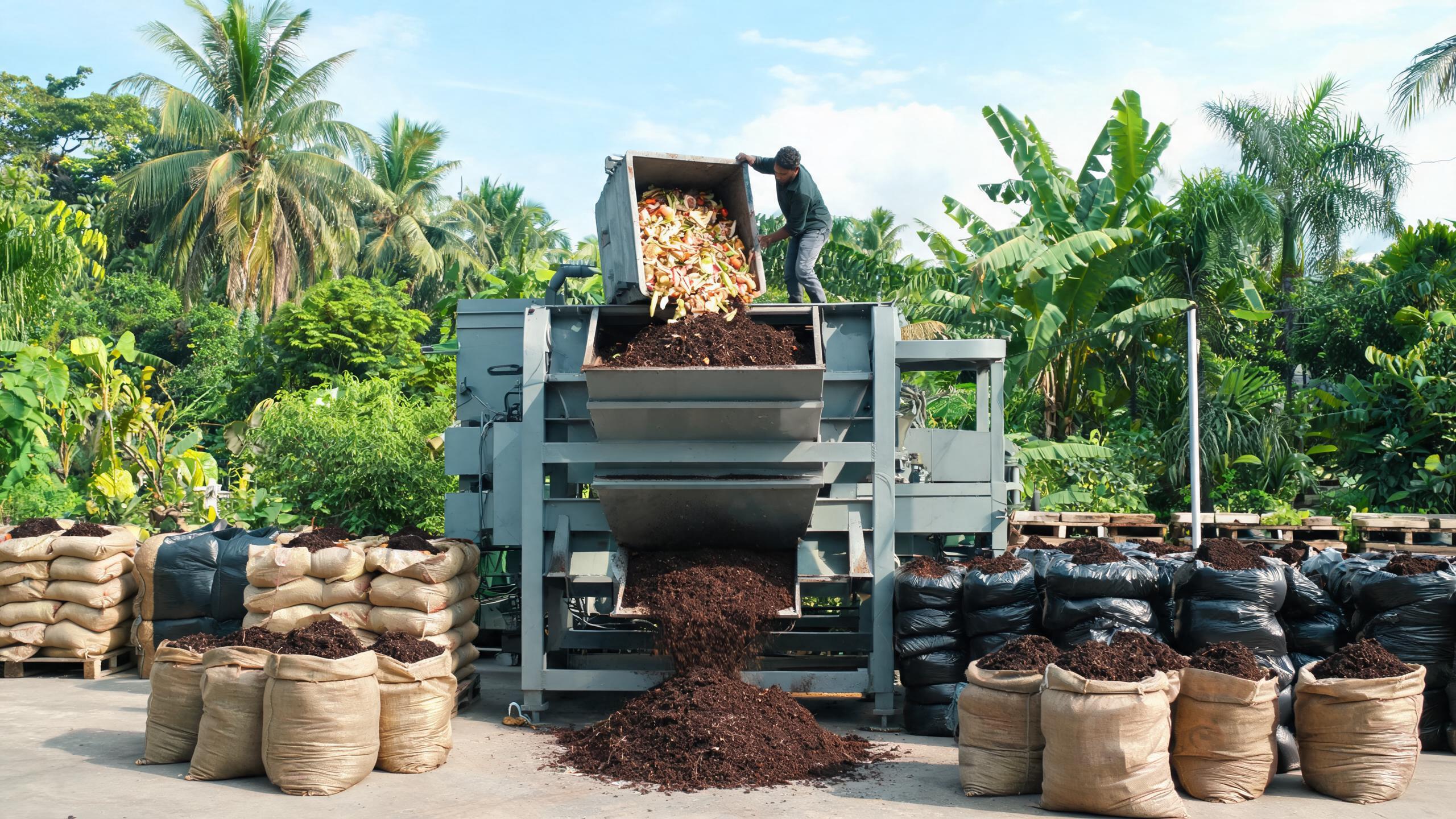
In many Southeast Asian cities, food waste is the single largest component of municipal solid waste. When it goes to landfill, it generates methane, attracts pests, and consumes scarce landfill space. For hotels, resorts, and food courts, food waste is also a direct cost: collection contracts, tipping fees, and the risk of fines for improper disposal.
An on-site food waste composting machine changes the economics. Instead of paying to have waste hauled away, you process it where it is produced. The volume is reduced substantially, and the end product—compost—can be used in landscaping, sold to farms, or given to employees. For municipalities, distributed composting reduces the burden on central treatment plants and extends landfill life.
How a food waste composting machine works
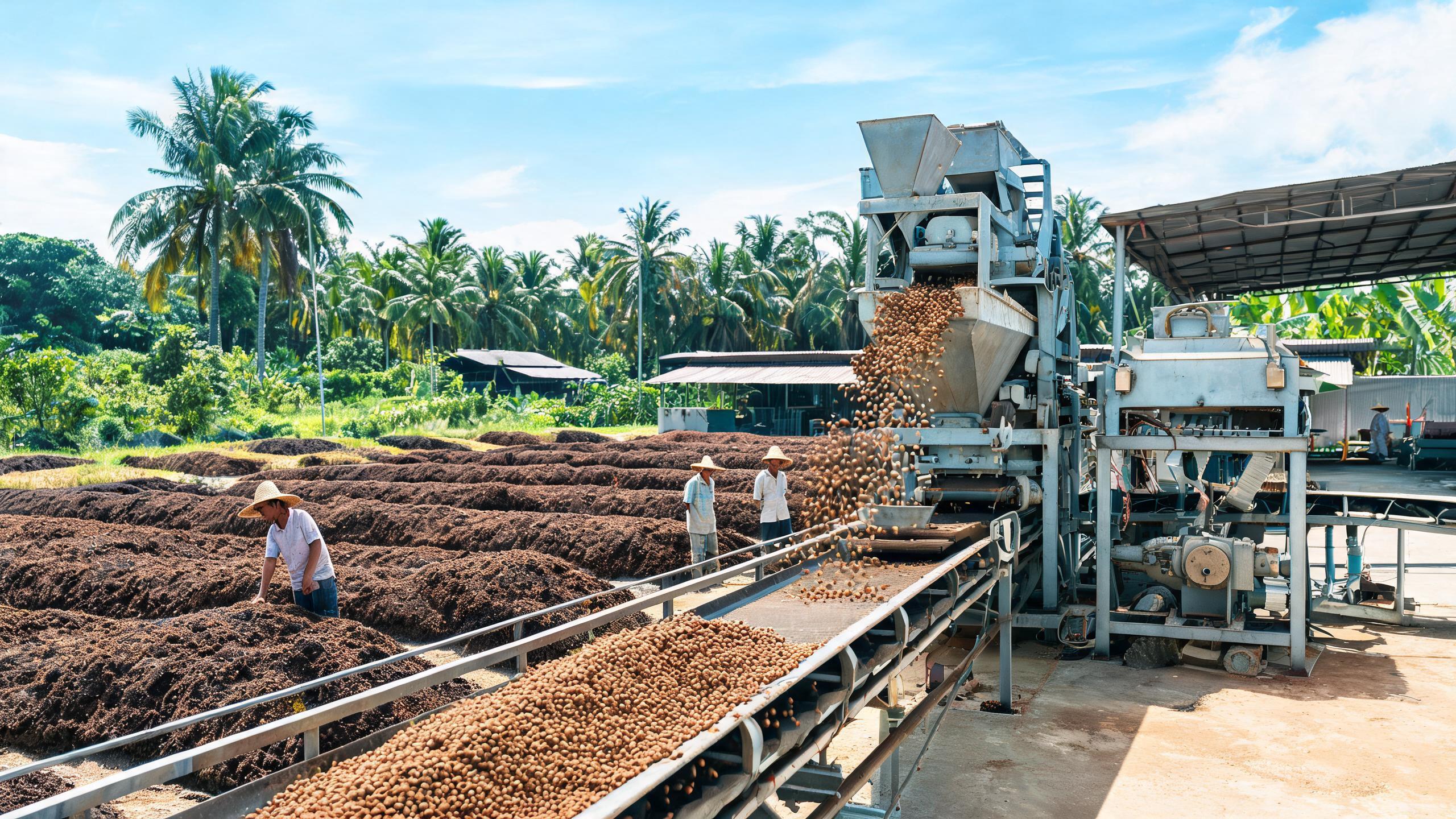
Most commercial and industrial food waste composting machines follow a similar four-stage process. Understanding each stage helps you evaluate equipment and ask the right questions.
Feeding
Food waste is loaded into the machine—manually, via a hopper, or through a conveyor system depending on the model. Some machines accept mixed waste directly; others require pre-sorting to remove plastics, metals, and glass. The feeding mechanism matters for operator convenience and safety.
Dehydration and mixing
Inside the machine, the waste is shredded or crushed and mixed with a bulking agent (such as sawdust or rice husk) to balance moisture and carbon-to-nitrogen ratio. Many machines include a heating and dehydration step that reduces moisture content. This is critical because high moisture is the main reason food waste rots quickly and smells. Dehydration also reduces the overall weight and volume before the biological stage begins.
Aerobic fermentation
The mixed material is then subjected to aerobic fermentation. The machine continuously aerates the material to supply oxygen to aerobic microbes, which break down organic matter. Temperature is controlled to accelerate the process and kill pathogens and weed seeds. The result is a stable, humus-like material that no longer attracts pests or produces foul odors.
Discharge
After the fermentation cycle, the finished compost is discharged. Depending on the machine, it may come out as a moist, crumbly soil amendment or as dried granules. Some systems include a bagging unit so the compost can be packaged directly for sale or distribution.
| Stage | What happens | Key benefit |
|---|---|---|
| Feeding | Waste is loaded, often after manual sorting | Controlled input quality |
| Dehydration and mixing | Shredding, moisture reduction, bulking agent added | Reduces weight/volume, prevents odor |
| Aerobic fermentation | Microbial breakdown with forced aeration | Stable, pathogen-free compost |
| Discharge | Compost is removed, often bagged | Usable product ready for application |
Choosing the right capacity: match the machine to your waste volume
Capacity is the most important purchasing decision. Get it wrong and you either pay for unused capacity or get stuck with a machine that cannot keep up with your daily output.
The first step is to measure your actual food waste generation. Weigh what the kitchen discards over a full week, including weekends and any banquet or event days. Hotels, for example, often see a big spike during holidays and wedding season. Municipalities must account for market days and seasonal fruit harvests.
Once you have your daily average and your peak day, you can compare machine capacities. Suppliers usually rate machines in kilograms (or tons) per day. A common rule of thumb is to choose a machine that can handle your peak daily volume with a safety margin above it, not just your average.
Also consider the retention time—how long the material stays in the machine before it is fully composted. Machines with a longer cycle may need a buffer of storage space for incoming waste. Ask the supplier for the cycle time and whether it changes with the season or the type of waste.
If your operation is small but growing, look for a modular design that lets you add capacity later. If you are a municipality, you may need multiple machines distributed across districts rather than one central unit.
- Weigh daily waste for at least one full week, including weekends.
- Identify your peak day (holidays, events, seasons).
- Add a safety buffer above the peak.
- Ask about cycle time and whether it varies.
- Consider future growth and modular options.
What drives ROI: landfill diversion, compost value, and operating costs
ROI for a food waste composting machine is not a single number—it is the sum of several cost savings and revenue streams. Here is how to think about each one.
Landfill diversion savings
The most immediate saving is what you no longer pay to have food waste collected and landfilled. In many Southeast Asian cities, tipping fees at landfills are rising, and some municipalities are starting to charge higher rates for organic waste or ban it from landfills altogether. If you currently pay per ton for disposal, a machine that reduces your waste volume substantially directly cuts that bill.
To estimate this, multiply your monthly food waste tonnage by your local tipping fee (per ton). That is your potential monthly saving. But note: tipping fees vary widely by city and province, and rates change over time. You must confirm the current rate with your local waste authority.
Compost output value
The compost produced can have value in three ways:
- On-site use: Hotels and resorts use it for landscaping, reducing the purchase of chemical fertilizers and soil conditioners.
- Sale: Municipalities and processors can sell compost to farms, nurseries, or soil blenders. Prices depend on quality, packaging, and local demand—typically lower in rural areas than near cities.
- Cost avoidance: Even if you give compost away, you avoid the cost of buying soil for landscaping projects.
The actual revenue from compost sales is often modest compared to the disposal savings, but it can tip the balance in your favor.
Operating costs
Running a composting machine consumes electricity, water, and bulking agents like sawdust or rice husk. You also need labor for loading, monitoring, and unloading. These costs are relatively predictable, but they vary by machine design and local utility rates. Ask the supplier for an estimated operating cost per ton of input, and then compare that with your current disposal cost per ton.
Maintenance is another factor. Look for machines with simple, robust components and easy access for cleaning. A machine that breaks down often will eat into your ROI quickly.
| ROI factor | What to calculate | Where to get the data |
|---|---|---|
| Landfill diversion | Monthly waste tons × local tipping fee | Local waste authority or your current disposal contract |
| Compost value | Compost produced × local market price | Local farms, nurseries, or compost buyers |
| Operating cost | Electricity + water + bulking agents + labor | Supplier estimates + your utility rates |
| Maintenance | Annual repair and spare parts | Supplier warranty terms and service history |
An honest note about ROI figures
We deliberately avoid giving you a payback period or a percentage return in this article. The reason is simple: the two biggest variables—tipping fees and compost prices—differ dramatically across Southeast Asia and even within a single country. A hotel in Bangkok faces different numbers than a municipality in a rural province of Vietnam.
What works in one location may not work in another. That is why any serious ROI calculation must be done with your local numbers. Ask suppliers to provide a sample calculation based on your waste volume and local fees. A reputable supplier will be happy to do this as part of the quotation.
Also, be aware that some suppliers publish attractive ROI figures that assume high landfill fees and high compost prices. Always verify those assumptions with your own data.
What to look for in a supplier
Beyond the machine itself, the supplier's support is critical to your long-term success. Here are the questions to ask:
- Installation supervision: Will they send a technician to oversee the setup? This is especially important for municipalities with complex site conditions.
- Operator training: Do they train your staff on loading, monitoring, and troubleshooting? Good training reduces downtime and ensures the machine runs at peak efficiency.
- Warranty: What is covered, and for how long? A standard 12-month warranty is common, but confirm the terms in writing.
- Spare parts availability: Are parts stocked locally or shipped from overseas? Long lead times can hurt you.
- After-sales service: Is there a local service network? If not, how fast can they respond?
TIANGONG, for example, has been active in solid waste treatment equipment since 2008 and operates a 12,000-square-meter facility. The company provides installation supervision, operator training, and a 12-month warranty on its equipment. These are the kinds of specifics that reduce your risk as a buyer.
Frequently asked questions
How much space do I need for a food waste composting machine?
Space requirements depend on the machine size and the need for storage of input waste and output compost. Ask the supplier for a layout drawing and clearance recommendations. Typically, you need space for the machine itself, a loading area, and a place to store compost before it is used or sold.
Are food waste composting machines suitable for all types of food waste?
Most machines handle a broad range of kitchen waste—fruit and vegetable scraps, cooked food, meat, and fish. However, large bones, coconut shells, and very fibrous materials may need pre-processing or may not break down completely. Check the supplier's list of acceptable inputs.
How long does a food waste composting machine last?
With proper maintenance, commercial units are built for many years of service. The body material, moving parts, and aeration components are the key items to inspect. Ask for references from other buyers who have run the machine for several years.
Can the compost be sold? What is the market like?
Yes, compost can be sold, but the market varies. In urban areas, landscapers and organic farms may pay a premium. In rural areas, buyers may expect it for free or at a very low price. Test the local market before relying on compost sales in your ROI model.
Next steps: evaluate your waste stream, then talk to suppliers
If you are seriously considering a food waste composting machine, start with a waste audit. Measure your daily volume, identify the peak, and understand the composition. Then approach two or three suppliers with your data and ask for a machine recommendation and a sample ROI calculation based on your local conditions.
Remember, the machine is only one part of the solution. The success of your composting program depends on your staff's willingness to sort waste, the machine's reliability, and the support you get from the supplier. Choose a partner who can demonstrate experience in your region and who is transparent about costs and performance.
TIANGONG has been building food waste treatment machinery and related solid waste processing equipment since 2008. With a 12,000-square-meter facility and a commitment to installation supervision, operator training, and a 12-month warranty, they are positioned to support buyers who need dependable equipment and practical guidance. Contact them with your waste data to get a tailored recommendation.