
Equipment Selection Guide
If you run a scrap yard, foundry or metal-processing plant in Vietnam, Indonesia, Thailand, Malaysia or the Philippines, the question is rarely "do I need a crusher?" It is "which crusher, sized how, and set up for what output?" A hammer mill crusher and a shear-type shredder both reduce metal, but they win on different feedstock and different output goals. Specifying the wrong one — or the right one with the wrong hammers, grate or motor — shows up later as blocked feed, short hammer life or a fragment size your downstream buyer will not accept.
This guide walks through the three variables that decide whether a hammer mill crusher fits your scrap: hammer type and material, grate slot size, and motor power. It also explains when a shear shredder is the better machine, so you can compare honestly before you commit capital.
- A hammer mill crusher suits brittle and medium-hard ferrous scrap — cast iron, engine blocks, steel billets, mixed ferrous — where you want a controlled fragment size.
- A shear shredder suits bulky, ductile or mixed light scrap where tearing and volume reduction matter more than fragment uniformity.
- Hammer material and reversibility set your service interval; grate slot size sets your output fragment; motor power sets your throughput ceiling.
- Match all three to your actual feed, not to a brochure headline.
How a Hammer Mill Crusher Works and What Feedstock It Suits
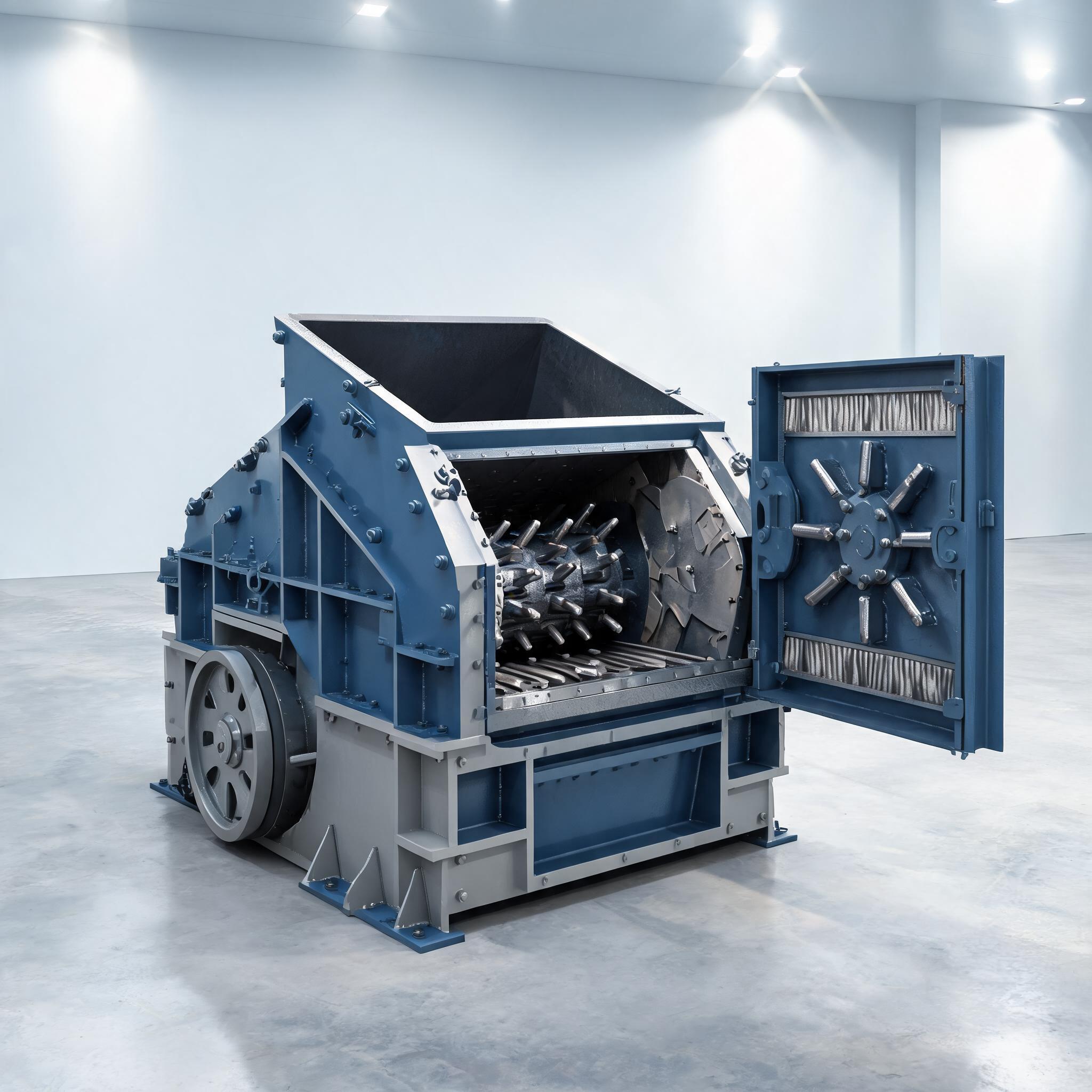
A hammer mill crusher reduces metal by impact. Free-swinging hammers mounted on a spinning rotor strike the feed, and the material breaks against the grate and the chamber walls. The grate holds material in the crushing zone until it is small enough to pass through the slots. That is the key difference from a shear shredder: a hammer mill produces a defined output fragment because the grate physically controls the exit size.
That impact mechanism suits feedstock that fractures rather than smears. Typical good fits include:
- Cast iron — engine blocks, housings, brake drums and similar parts. Cast iron is brittle and breaks cleanly under impact.
- Steel billets and heavier ferrous pieces — where you want to bring material down to a furnace- or mill-ready fragment.
- Mixed ferrous scrap — provided the feed is prepared so that oversized or tangled pieces do not bridge the hopper.
Feedstock that is highly ductile, wire-heavy or very bulky is usually better handled by a shear-type machine first, or by a shredder as the primary unit. A hammer mill crusher works best when the feed is reasonably consistent and free of material that will wrap around the rotor.
For continuous-shift processing of mixed ferrous scrap, the TG-Hammer 800 heavy-duty metal crusher pairs a 750 kW main motor with a 500-ton hydraulic compression ram. The ram presses bulky stock into the rotor so feed engagement stays consistent instead of stalling on a large, light piece.
Hammer Mill vs Shear Shredder: When Each One Wins
Buyers searching "hammer mill vs shredder" are usually trying to decide which machine to buy first. The honest answer depends on what you are feeding and what your customer wants out the other end.
A hammer mill crusher wins when:
- You need a controlled fragment size, because the grate sets the exit opening.
- Your feed is brittle or medium-hard — cast iron, billets, broken castings.
- You want to feed a downstream furnace, mill or separation line that prefers a defined fragment.
- You are processing mixed ferrous scrap that has already been pre-sorted for size.
A shear shredder wins when:
- Your feed is bulky, ductile or mixed light scrap — sheet, profiles, wire-heavy material.
- Your priority is volume reduction and tearing rather than a uniform fragment.
- You need a primary reduction step before finer processing.
Many yards run both: a shear shredder for primary volume reduction, then a hammer mill crusher for final sizing. If your feed is bulky and mixed, the TG-2200 twin-shaft metal shredder is the shear-type comparison point. If your feed is large and you need primary breakage before either, a primary jaw crusher is the usual upstream choice. The decision is not which machine is "better" — it is which one matches your feed and your output specification.
Matching Hammer Type and Material to Your Scrap
Hammers are the wear part that decides your maintenance cost and your downtime. Two things matter: the hammer material and whether the rotor is reversible.
Manganese steel hammers are the standard choice for ferrous scrap because they work-harden under impact, which helps them resist abrasion in a crushing chamber. On the TG-Hammer 800, the hammers are reversible manganese steel, which means you can turn them to use the second striking face before replacing them. That extends the service interval between replacements — a real cost factor if you run continuous shifts.
Match hammer choice to your feed:
- Cast iron and brittle feed — impact wear dominates; standard manganese hammers handle this well.
- Steel billets and harder ferrous — the hammer takes more direct load; confirm hammer profile and rotor configuration with the supplier for your specific billet size.
- Mixed ferrous with some tramp material — pre-sort to remove non-crushable items; no hammer survives a steady diet of uncrushable scrap.
Hammer profile, rotor knife arrangement and chamber geometry are configuration items, not off-the-shelf constants. Tiangong's engineering team configures rotor profiles, screen mesh openings and hopper dimensions to match each buyer's input material and downstream separation requirements, so the hammer setup is specified against your feed rather than a generic default.
Grate Slot Size and Output Fragment Control
The grate is what turns a crusher into a sizing machine. Material stays in the chamber until it is small enough to pass through the slots, so slot size is your primary control over output fragment.
On the TG-Hammer 800, grate bars are replaceable and available in multiple slot sizes. That matters for two reasons:
- You can change output fragment without changing machines. A tighter slot gives a finer fragment; a wider slot gives a coarser one and generally higher throughput.
- Worn grate bars are a replaceable part, not a chamber rebuild. Grate bars wear faster than the chamber, so replaceable bars keep maintenance predictable.
Choose your slot size by working backwards from your downstream requirement. If your furnace or separation line wants a specific maximum fragment, set the grate to that opening and accept the throughput that comes with it. If you want maximum tonnage and your buyer accepts a coarser fragment, open the slots. There is always a trade-off between fragment size and throughput — the grate is where you decide it.
Motor Power and Throughput Sizing
Motor power sets the ceiling on what the machine can crush and how fast. Undersize the motor and you will stall on hard feed; oversize it and you pay for capacity you do not use.
The TG-Hammer 800 uses a 750 kW main motor sized for continuous-shift processing of mixed ferrous scrap. Its rated throughput is 40 to 60 tons per hour, depending on feed density and fragment size setting. That range is not a marketing number — it is the real spread you get when you change grate slots and feed material. Dense, heavy feed at a wide slot sits near the top; lighter feed at a tight slot sits near the bottom.
When sizing motor power for your yard, consider:
- Feed density and hardness. Harder, denser feed demands more power per ton.
- Target fragment size. A tighter grate means more recirculation inside the chamber and lower throughput for the same motor.
- Shift pattern. Continuous-shift operation needs a motor rated for it, not an intermittent-duty unit.
- Electrical supply. Confirm your site voltage and frequency. A 60 Hz electrical variant of the TG-Hammer 800 is available on request, which matters for some Southeast Asian grids.
If you also need a secondary impact stage for finer or more cubical product, the TG-Impact 500 horizontal impact crusher is the secondary comparison point.
Buyer Checklist for Specifying a Hammer Mill Crusher
Before you request a quotation, gather the following. A supplier who configures to your feed will ask for these anyway.
- Feed material types and proportions — cast iron, billets, mixed ferrous, and roughly what share of each.
- Maximum feed size — the largest piece you will put in, and whether you will pre-sort.
- Target output fragment size — the maximum dimension your downstream buyer or furnace accepts.
- Required throughput — tons per hour you need to sustain across a shift.
- Shift pattern — single shift or continuous, since this drives motor and wear-part selection.
- Electrical supply — voltage and frequency at your site.
- Downstream separation — what comes after the crusher, so screen and hopper dimensions can be matched.
- Safety and compliance requirements — the TG-Hammer 800 is a CE-marked frame with technical file and declaration, and includes interlocked safety guards on rotor and hydraulic zones.
- Spare-parts plan — hammer and grate bar consumption, and whether a spare-parts kit is included.
Tiangong has manufactured metal shredders and crushers since 2008 from a 12,000 m2 production facility with in-house machining, welding and electrical assembly. The core line includes double-shaft shredders, four-shaft shredders, hammer crushers and integrated scrap processing lines. Standard-model lead times are under 45 days, and machines carry a 12-month warranty with spare-parts kits.
Hammer Mill Crusher vs Shear Shredder: Quick Comparison
| Decision factor | Hammer mill crusher | Shear shredder |
|---|---|---|
| Reduction mechanism | Impact against grate | Shear and tear between shafts |
| Best feedstock | Cast iron, steel billets, mixed ferrous | Bulky, ductile, mixed light scrap |
| Output fragment control | High — set by grate slot size | Lower — depends on shaft configuration |
| Typical role | Final sizing to a defined fragment | Primary volume reduction |
| Wear parts | Reversible manganese hammers, replaceable grate bars | Cutters and shaft components |
| When to choose it | Downstream needs a controlled fragment | Feed is bulky and mixed, size is secondary |
FAQ
Can a hammer mill crusher handle cast iron engine blocks?
Yes. Cast iron is brittle and fractures cleanly under impact, which is exactly what a hammer mill is built for. The main preparation step is removing any non-crushable attachments before feeding.
How do I change the output fragment size?
By changing the grate bar slot size. Replaceable grate bars are available in multiple slot sizes on the TG-Hammer 800, so fragment size is a configuration choice rather than a machine replacement.
What throughput can I expect?
The TG-Hammer 800 is rated at 40 to 60 tons per hour, depending on feed density and fragment size setting. Dense feed at a wide grate slot sits near the top of that range; lighter feed at a tight slot sits near the bottom.
Should I buy a hammer mill or a shear shredder first?
If your feed is brittle and your downstream buyer needs a defined fragment, start with the hammer mill. If your feed is bulky and ductile and you mainly need volume reduction, start with a shear shredder. Many yards eventually run both in sequence.
How often do hammers need replacing?
It depends on feed abrasiveness and throughput. Reversible manganese steel hammers let you turn them to use a second striking face before replacement, which extends the service interval. Confirm the expected consumption rate for your specific feed with the supplier.
Next Step
If you are evaluating a hammer mill crusher for cast iron, steel billets or mixed ferrous scrap, the fastest way to get an accurate configuration is to send your feed material types, maximum feed size, target fragment size and required throughput. Tiangong's engineering team will match hammer profile, grate slot size and motor power to your actual scrap rather than a generic specification.
Review the TG-Hammer 800 heavy-duty metal crusher specifications, or contact us with your feed details to request a configuration and quotation.