
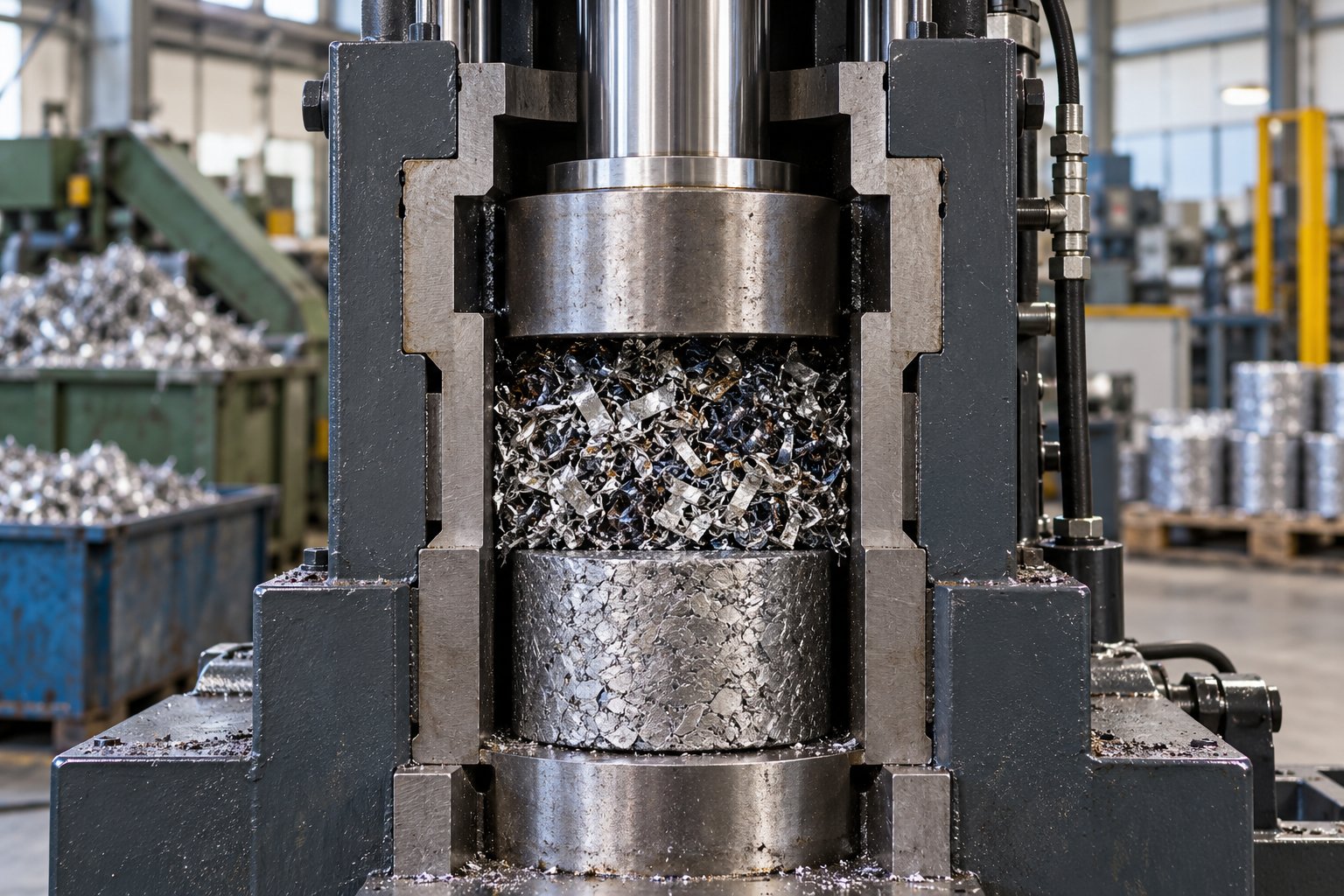
A metal briquetting machine works by squeezing loose metal chips or swarf inside a die chamber with a hydraulic ram. The ram compacts the chips into a dense briquette of consistent shape, while cutting fluid forced out during compression is collected for reuse. The briquette is then ejected from the die and dropped into a collection bin or conveyor. That is the whole cycle — feed, compress, eject, recover.
The detail that decides whether the machine performs is how the feed is prepared and how the ram, chamber, and die are sized for that feed. The sections below walk through each stage of the working principle and the material conditions that affect the result.
Key takeaways
- Compression is hydraulic: loose chips go in, a high-density briquette comes out.
- Cutting fluid squeezed out during compaction is recovered rather than lost to the swarf pile.
- Denser briquettes improve melting efficiency and cut transport cost, because less air and fluid are shipped.
- Feed cleanliness — clean chips versus mixed swarf — changes briquette quality and how much fluid can be recovered.
- A briquetting press sits between chip collection and the melting furnace or scrap dealer in a recycling line.
On this page
Stage 1: Feeding from the hopper
The cycle starts at the hopper. Chips and swarf are loaded — by conveyor, bucket, or manual feed depending on line layout — and move down into a metering or transfer zone that delivers material into the die chamber. The goal at this stage is a consistent fill, not a maximum fill. An overfilled chamber puts uneven load on the ram; an underfilled chamber produces a thinner or weaker briquette.
Feed rate also matters because the press works in cycles. The chamber needs enough material to form a full briquette before the ram advances. On an integrated line, the feed section is where incoming scrap is already sized and roughly de-oiled, so the press receives a steady stream rather than bursts.
Stage 2: Hydraulic compression in the die chamber
This is the core of the working principle. A hydraulic cylinder drives the ram forward into the die chamber. As the ram advances, the volume available to the chips shrinks, air escapes, and the chips are forced against each other and against the die walls. Metal does not melt or bind chemically here — it interlocks mechanically under pressure. The result is a solid, self-supporting briquette.
Two things happen at the same time as the volume shrinks:
- Density rises. The same mass of chips occupies far less space, which is what makes the briquette worth shipping and worth melting.
- Fluid is expelled. Cutting fluid and moisture clinging to the chips have nowhere to stay inside a closing void, so they are pushed out of the compact and drain away — this is the feed to the recovery loop described below.
The die chamber geometry sets the briquette's shape and size. A well-matched chamber and ram keep the compact uniform from piece to piece, which matters when the briquettes are charged into a furnace and you want predictable melt behavior rather than a mix of dense and crumbly pieces.
Stage 3: Ejecting the briquette
Once the ram reaches its compaction position and the briquette is formed, the compact has to leave the chamber. In a typical cycle, the ram retracts and an ejection action — often a second stroke or a dedicated ejector — pushes the finished briquette out of the die. It drops or slides onto a discharge conveyor or into a bin.
Ejection is where briquette quality shows. A briquette that holds its shape and leaves the chamber cleanly indicates good compaction; one that crumbles or sticks points to feed problems — too much fluid, mixed material, or a chamber that needs attention. The cycle then resets, the chamber refills, and the press repeats.
Stage 4: Cutting-fluid recovery loop
Because cutting fluid is squeezed out during compression, it can be captured instead of evaporating from an open swarf pile or dripping out during transport. A recovery loop collects the expelled fluid at the die area, channels it to a collection point, and returns it to the coolant system or to storage for reuse.
The economics are straightforward. Fluid that stays with the chips leaves the shop as waste and has to be replaced; fluid recovered at the press can go back into circulation. Recovery efficiency depends on the feed — the wetter and more oil-soaked the incoming swarf, the more there is to recover, and the more the recovery loop earns its place.
What the input material needs
The working principle assumes the press is fed material it can actually compact. Two broad feed conditions behave differently:
| Feed condition | What it means at the press | Effect on output |
|---|---|---|
| Clean, sorted chips — one alloy family, low contamination | Consistent fill, predictable compaction, fluid drains cleanly | Uniform, dense briquettes; recovered fluid is easier to reuse |
| Mixed swarf — mixed alloys, fines, tramp material, heavy fluid load | Uneven fill, variable compaction, more fluid to handle | Briquette quality varies; recovered fluid may need treatment before reuse |
Feed cleanliness affects briquette quality directly. Sorting by alloy helps the briquette match what the furnace or scrap buyer expects. Removing tramp material and excessive fines keeps the chamber from packing inconsistently. If the goal is maximum fluid recovery, feeding material that has not been sitting in an open pile for weeks gives the recovery loop more to work with.
Beyond cleanliness, size matters. Chips that are too long or stringy can bridge in the hopper or resist even filling; pre-shredding or screening upstream usually solves this and belongs to the feed-preparation stage of the line.
Where it sits in a recycling line
A briquetting press is not a standalone island in most shops. It sits downstream of chip collection and upstream of melting or scrap sale:
- Collection and conveyance — chips arrive from machining centers by conveyor, cart, or vacuum system.
- Preparation — shredding, screening, or de-oiling brings the feed into the range the press can handle.
- Briquetting — the press compacts the prepared feed and recovers cutting fluid.
- Discharge and logistics — dense briquettes are stacked, stored, and shipped or charged to the furnace.
For operations that want the whole chain in one footprint, an integrated system can combine the feed, preparation, and briquetting stages. The TG-ScrapLine 150 integrated scrap processing system is a turnkey 15 t/h line built around a hydraulic briquetting press, reaching a bulk density above 4.0 t/m3 after compaction. For shops that only need the compaction step, a standalone unit such as the TG-BriqPress 250 metal briquetting system handles hydraulic compaction and cutting-fluid recovery on its own, with transport cost reduced by a factor of 5 to 10 on the compacted output.
Briquetting press vs charcoal briquette press
It is worth separating the two, because the names are similar but the machines are not: a metal briquetting press compacts metal chips and swarf under hydraulic force to densify scrap and recover cutting fluid, whereas a charcoal briquette press forms fuel briquettes from carbonized biomass or coal dust and does not operate on metal scrap.
FAQ
Does the machine add a binder to hold the briquette together?
No binder is involved in metal briquetting. The briquette holds together because the chips interlock mechanically under hydraulic pressure. That is why feed composition and compaction consistency matter more than any additive.
Can I run mixed swarf through the press?
You can feed mixed swarf, but expect briquette quality to vary and recovered fluid to need more attention. If the briquettes are sold or charged to a furnace with an alloy specification, sorting the feed upstream is the more reliable route.
What happens to the cutting fluid that comes out?
It is collected at the press and returned to the coolant system or to storage for reuse. The volume recovered depends on how wet the incoming feed is and how well the recovery loop is set up.
How do I know the briquette density is high enough?
Check the briquette for shape retention and weight relative to its size, and confirm the bulk density the press is specified to reach. For a line-level figure, ask the supplier what density the configured system achieves on your material.
Choosing a press around the working principle
Once the cycle is clear — feed, hydraulic compression in the die chamber, ejection, fluid recovery — the buying questions become specific. What feed size and cleanliness will the press accept? What briquette shape and density does it produce? How is the recovered fluid routed? And does the press stand alone or integrate into a larger scrap line? Tian Gong has built metal briquetting equipment since 2008, with CE marking and ISO 9001 in place and a 12-month warranty on its systems. For a configuration matched to your chips and swarf, send the material details and line layout to start a quote.
Bulk density, throughput, and recovery figures depend on the specific system configuration and the feed material. Confirm the values that apply to your application with the supplier before specifying equipment.