BUYER GUIDE
If you run a scrap yard or manage a recycling plant in Vietnam, Indonesia, Thailand, Malaysia, or the Philippines, you already know that a metal shredder is not a one-size-fits-all purchase. The machine you choose determines your throughput, your output quality, your operating cost, and how much rework you have to do before selling the material. Get it wrong, and you are stuck with a machine that either jams on your feed, produces the wrong particle size, or runs at the wrong electrical frequency for your site.
This guide walks through the main types of metal shredder machines, how to match capacity to your actual feedstock, and a practical buying checklist to use when comparing suppliers. It is written for procurement decision-making, not for marketing fluff.
- Choose the shredder type based on your input material and target output size: single-shaft, twin-shaft, four-shaft, or hammer crusher.
- Capacity is not just a number on a brochure — it depends on bulk density, contamination, and how you feed the machine.
- Verify the electrical configuration (50 Hz vs 60 Hz) before ordering — many Southeast Asian sites run 50 Hz, while some equipment is built for 60 Hz.
- Ask for configuration details: rotor knife profiles, screen openings, and hopper dimensions should be matched to your material.
- After-sales support and spare parts availability matter more than the initial price.
Why the Type of Metal Shredder Machine Matters
Scrap metal comes in many forms: whole car bodies, mixed light iron, aluminum profiles, copper wire, steel drums, and industrial offcuts. Each has different density, shape, and contamination levels. The shredder type determines how efficiently you can process these materials and what size the output will be.
Manufacturers like TIANGONG (founded in 2008) build a range of metal shredders and crushers, including single-shaft, twin-shaft (double-shaft), four-shaft shredders, hammer crushers, and integrated scrap processing lines for steel, aluminum, copper, and mixed light metal. Understanding the differences helps you narrow down the right machine for your yard.
Types of Metal Shredder Machines
Single-Shaft Shredders
Single-shaft shredders use one rotating rotor with knives that work against a fixed counter-knife and a screen underneath. Material is pushed into the rotor by a hydraulic ram, and the output size is controlled by the screen opening.
Best for:
- Aluminum profiles and extrusions
- Copper wire and cable (with pre-processing)
- Plastic-coated metals and mixed light scrap
- Producing a consistent, uniform particle size
Single-shaft machines are often chosen when you need a controlled output size for downstream separation or briquetting. They handle lighter materials well but are not ideal for large, heavy steel parts.
Twin-Shaft (Double-Shaft) Shredders
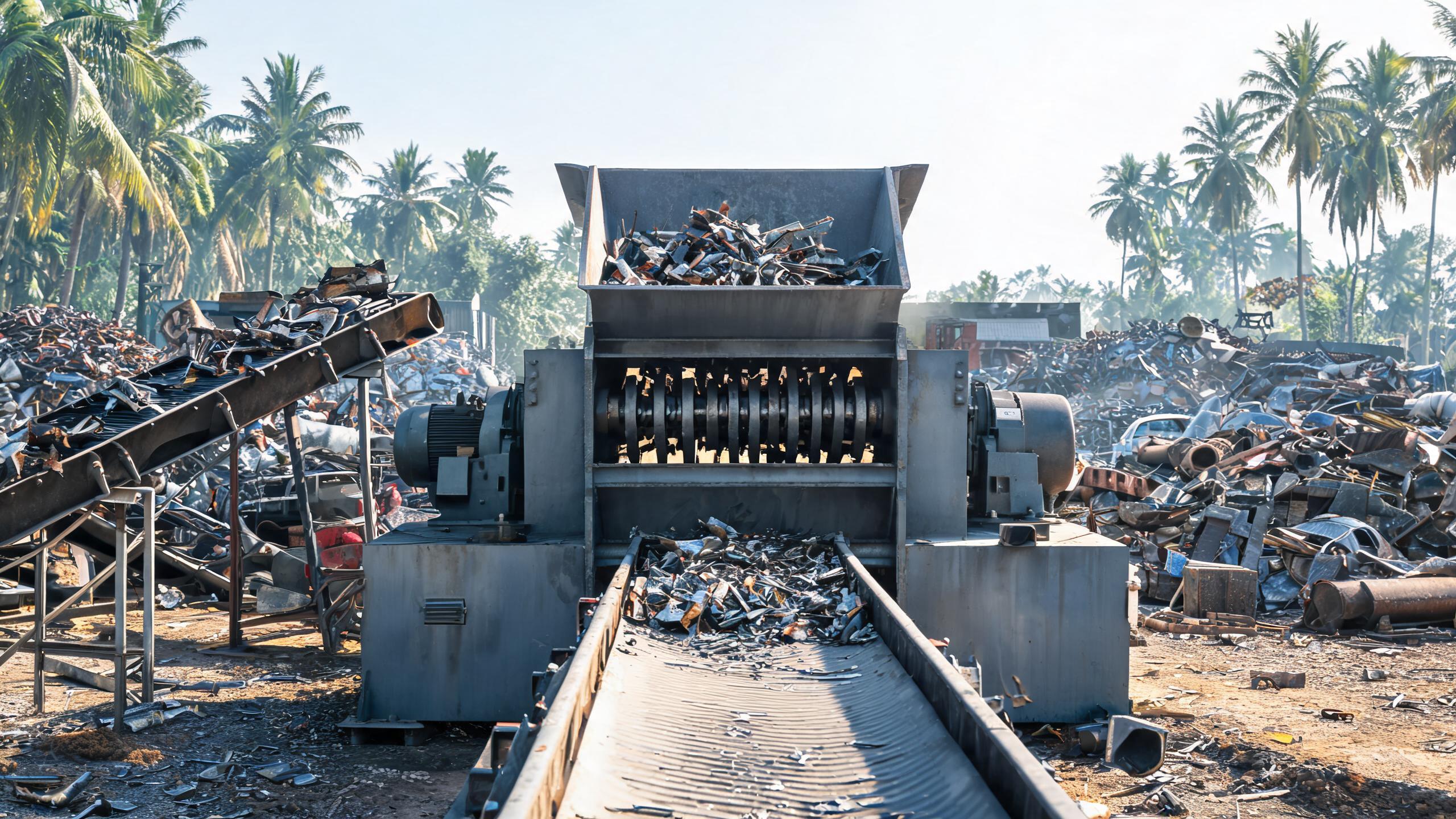
Twin-shaft shredders have two counter-rotating shafts with interlocking knives. They grab, tear, and shear material, making them effective for bulky or tough items. They typically do not have a screen, so output size is determined by knife width and spacing.
Best for:
- Steel drums, cans, and light steel scrap
- Mixed scrap with large dimensions
- Pre-shredding before a secondary crusher
- Reducing volume for transport or further processing
Twin-shaft shredders are a common first-stage machine in many scrap yards because they can handle a wider range of feed materials without much preparation.
Four-Shaft Shredders
Four-shaft shredders use two pairs of shafts — one pair cuts, the other pair sizes the material. This design gives more control over output size and produces a more uniform product. They are slower but more precise, and they handle materials that might jam a twin-shaft machine.
Best for:
- Materials that need a specific particle size
- E-waste, PCB boards, and mixed metal components
- Applications where oversize pieces cause problems downstream
Four-shaft machines are often used in recycling plants that need a consistent output for sorting or granulating.
Hammer Crushers
Hammer crushers use high-speed rotating hammers to impact and break material. They are aggressive and can handle harder and heavier materials, but the output is less uniform and there is more wear on the hammers.
Best for:
- Steel scrap, car bodies, and heavy mixed metal
- Pre-crushing before magnetic separation
- High-throughput operations where output size tolerance is wider
Hammer crushers are a good choice when your priority is volume reduction rather than precise sizing.
How to Match Capacity to Your Feedstock
Capacity is usually stated in tons per hour, but that number means little unless you know the density and form of your input material. The same machine can process very different tonnages of loose aluminum cans versus heavy steel parts, because the bulk density and the force required are very different.
Before you talk to a supplier, gather these facts about your feedstock:
- Material type: Steel, aluminum, copper, or mixed light metal?
- Form: Whole parts, compressed bales, loose scrap, or wires?
- Maximum dimensions: The largest piece the machine must accept.
- Contamination: Is there dirt, plastic, or non-metal content?
- Target output size: What size do you need for the next step (sorting, briquetting, melting)?
With these details, a supplier can configure the machine properly. For example, TIANGONG configures rotor knife profiles, screen openings, and hopper dimensions to the buyer's input material. That means the machine is not just a standard model — it is set up to match your specific scrap stream.
Be realistic about your peak load. If you sometimes receive large batches of whole car bodies, the machine must handle those peaks without constant jams. It is better to size slightly above your average throughput than to buy a machine that struggles on your busiest days.
Key Buying Checklist for a Metal Shredder
Use this checklist when comparing quotes and evaluating suppliers. It covers the technical and commercial points that matter most in a B2B purchase.
1. Feed Material and Machine Type
Confirm that the machine type matches your primary material. If you process mixed light metal, a twin-shaft or four-shaft may be better than a hammer crusher. If you need a uniform output for separation, a single-shaft or four-shaft with screen control is more suitable.
2. Output Size Requirements
What particle size do you need? If you sell the shredded material directly, buyers may specify a size range. If you have downstream equipment (magnetic separators, eddy current separators), the shredder output must be compatible. Screen openings and rotor knife profiles control this — make sure the supplier configures them for your target size.
3. Wear Parts and Maintenance
Shredders wear out. Knives, screens, and hammers are consumable items. Ask about:
- Expected wear part life for your material
- Cost and lead time for replacement parts
- Ease of access for maintenance
- Whether the supplier stocks spare parts
A machine that is cheap to buy but expensive to maintain will cost you more in the long run.
4. Power Supply: 50 Hz vs 60 Hz
This is a critical technical detail. Most of Southeast Asia runs on 50 Hz electrical systems, while some equipment is built for 60 Hz. If the machine is not configured for your local frequency, it will not run properly. TIANGONG configures equipment for both 50 Hz and 60 Hz, so you can specify your site's power supply when ordering. Confirm this with any supplier before you sign.
5. After-Sales Support and Spare Parts
In the recycling industry, downtime is lost money. Ask the supplier what support they provide after installation. TIANGONG, for example, offers installation supervision, operator training, and spare-parts support. This kind of support reduces the risk of extended downtime and helps your team operate the machine safely and efficiently.
6. Compliance and Certification
Depending on your market, you may need CE marking or other certifications. TIANGONG's equipment is CE-marked, which is important for buyers in many regions. Ask your supplier for the specific certifications they hold and whether they apply to the model you are considering.
Questions to Ask a Supplier Before Ordering
Do not be shy about asking detailed questions. A reputable supplier will welcome them. Here are the questions that separate a serious supplier from a reseller who just wants to close a deal.
- Can you configure the rotor knife profile and screen openings to my specific material and output size?
- What is the machine's capacity for my actual feedstock (not just a generic brochure number)?
- Is the machine built for 50 Hz or 60 Hz, and can you adjust it for my site's power supply?
- What after-sales services do you provide — installation supervision, operator training, spare parts?
- What is the lead time for spare parts, and do you stock them in my region?
- Do you provide integrated processing lines if I need a complete system (shredding, separation, conveying)?
- What is your manufacturing process — do you do in-house machining, welding, and electrical assembly?
If a supplier hesitates on these questions or gives vague answers, treat it as a red flag. You are buying a machine that will run for years; you need a partner who understands your process.
Integrated Scrap Processing Lines
If you are setting up a new recycling plant or upgrading an existing one, you may not just need a single shredder. Integrated scrap processing lines combine shredding with conveying, magnetic separation, eddy current separation, and sometimes briquetting. TIANGONG manufactures integrated lines for steel, aluminum, copper, and mixed light metal. These systems are designed to work as a whole, which can simplify procurement and commissioning.
If you are considering an integrated line, ask the supplier to design the layout around your specific material flow. A good line minimizes manual handling and maximizes recovery.
Why Manufacturing Quality Matters
Shredders operate under heavy stress. The quality of the machining, welding, and electrical assembly directly affects reliability and lifespan. TIANGONG performs in-house machining, welding, and electrical assembly, which gives them control over quality and allows for customization. When you evaluate a supplier, ask about their manufacturing process. A company that does its own fabrication is more likely to deliver a machine that meets your specifications than one that outsources everything.
Also, consider the company's track record. TIANGONG was founded in 2008, which means over a decade of experience in this niche. That kind of history matters when you need support years after the purchase.
Common Mistakes to Avoid
- Buying on price alone: The cheapest machine often has higher operating costs or shorter lifespan.
- Ignoring power supply: A 60 Hz machine on a 50 Hz site will not run correctly, and vice versa.
- Underestimating wear parts: Factor in the cost of knives, screens, and hammers over the machine's life.
- Not defining output size: If you do not specify the required output, the supplier may configure the machine for the wrong screen size.
- Overlooking after-sales: Installation supervision and operator training are not optional extras — they are essential for safe and efficient operation.
Next Step: Get a Configuration Consultation
Choosing a metal shredder machine for scrap recycling is a significant investment. The right machine will improve your throughput and product quality; the wrong one will cost you time and money. Start by defining your feedstock and output requirements, then use the checklist above to evaluate suppliers.
If you are in Vietnam, Indonesia, Thailand, Malaysia, or the Philippines and need a machine that matches your specific material, contact TIANGONG for a configuration consultation. They can help you select the right type, capacity, and configuration — including rotor knife profiles, screen openings, and hopper dimensions — based on your input material. With CE-marked equipment, 50/60 Hz options, and support for installation, training, and spare parts, TIANGONG is positioned to be a long-term partner for your recycling operation.
Reach out today with your material details and throughput goals, and get a machine that is built to work for your yard.