
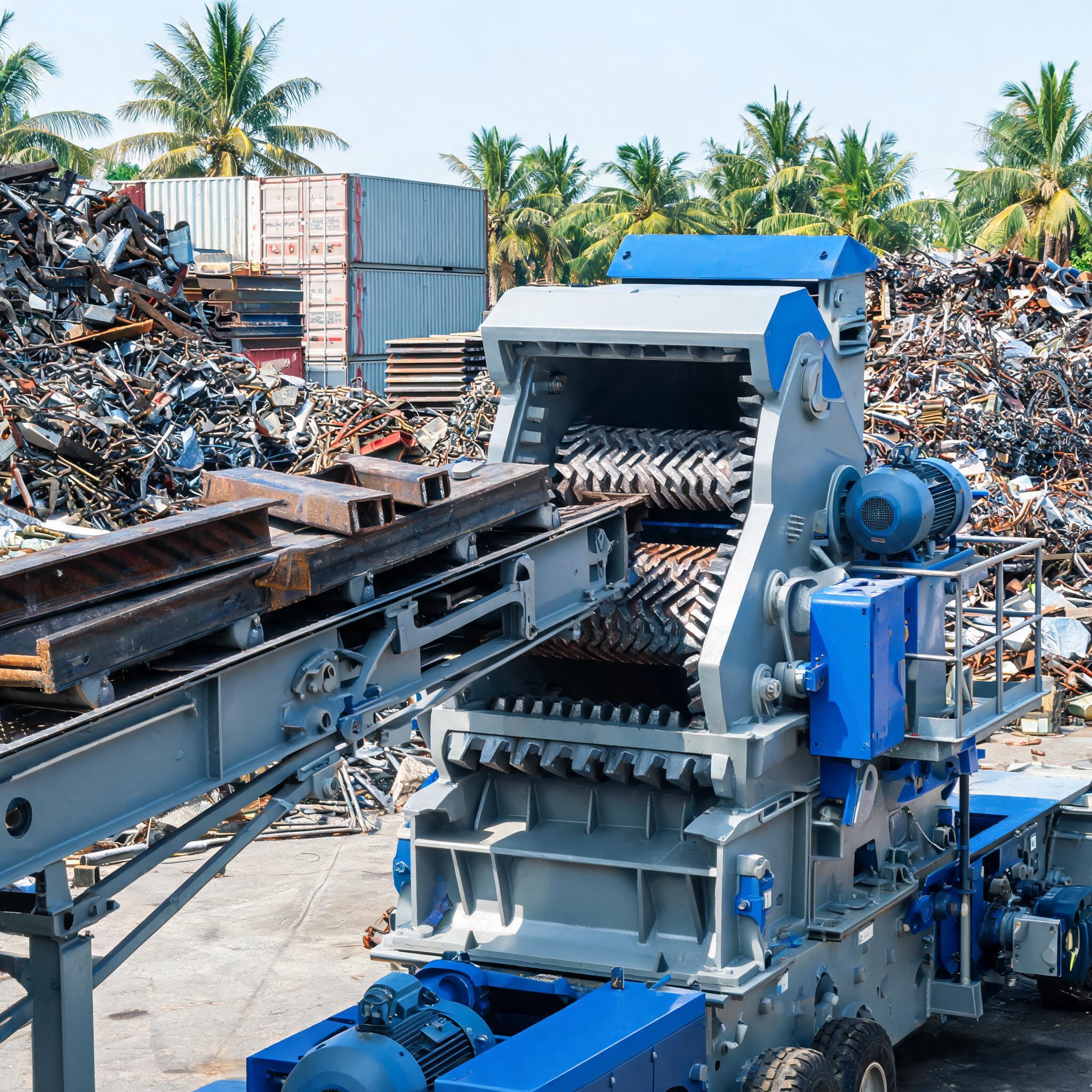
For scrap yard operators in Vietnam, Indonesia, Thailand, Malaysia, and the Philippines, the decision to move from selling loose scrap to operating a scrap processing line is often driven by the same pressure: buyers pay more for dense, clean, uniform material, and they pay less for mixed, bulky loads. An integrated scrap processing system addresses both by combining shredding, magnetic separation, and briquetting into one continuous flow.
This guide walks through the three core stages of an integrated line, what to check when configuring each stage, and why a turnkey system from a single China scrap processing equipment manufacturer can simplify plant setup compared to sourcing machines separately.
In this article
Stage 1: Primary Shredding
The first stage of any scrap processing line is size reduction. A shredder breaks down bulky scrap such as automobile bodies, light steel, and mixed ferrous material into smaller fragments that can be conveyed, separated, and compacted efficiently.
For medium-capacity yards, the key specification is the shredder's drive power and rotor design. A twin-shaft, low-speed, high-torque configuration is well-suited for mixed scrap because it tears material rather than relying on high-speed impact. This reduces the risk of jamming and allows the machine to handle material without pre-sorting—a significant operational advantage when input varies daily.
What to check in a primary shredder
- Input tolerance: Can the shredder accept whole car bodies, light steel, and mixed ferrous without manual sorting? This directly affects labour costs and throughput.
- Drive power: Higher kW generally means higher capacity and the ability to process denser material. For a 15 t/h line, a 250 kW main drive is a realistic benchmark.
- Output size: The fragmented size should match the downstream separation and briquetting requirements. Smaller fragments improve magnetic separation efficiency but increase energy consumption.
- Wear parts: Shredder blades and liners are consumables. Ask about wear life and replacement cost—this is a major operating expense over time.
Stage 2: Magnetic Separation
After shredding, the material is a mixture of ferrous metal, non-ferrous metals, and non-metallic residue. The purpose of magnetic separation is to extract clean ferrous material from this mix, increasing the purity and therefore the value of the final product.
There are two common configurations: an overband magnet suspended above the conveyor, or a drum magnet at the head pulley. The choice depends on the material depth and belt speed. For an integrated line, an overband or drum separator is typically matched to the shredder output to ensure complete coverage.
What to check in magnetic separation
- Magnet type and strength: Permanent magnets are common for medium-duty applications; electromagnetic versions allow adjustment but consume power.
- Belt width and speed: Must match the conveyor carrying the shredded material to avoid overflow or incomplete separation.
- Separation efficiency: While exact recovery rates depend on feed composition, the system should be designed to remove the majority of ferrous material in a single pass. Ask the supplier for test data with your specific scrap type.
- Residue handling: Non-magnetic residue needs a separate discharge path. Ensure your layout has room for both product and residue conveyors.
Stage 3: Briquetting
The final stage is densification. A hydraulic briquetting press compresses loose shredded scrap into dense briquettes or blocks. This dramatically increases bulk density, which translates into higher per-tonne sale value because transport and handling costs are lower for a given weight.
For example, the TG-ScrapLine 150 system uses a hydraulic briquetting press that raises bulk density above 4.0 t/m³. That means more metal fits in each truck container, and buyers typically pay a premium for dense, uniform feedstock.
What to check in a briquetting press
- Density output: Higher density is generally better, but it requires more hydraulic pressure and energy. Match the target density to what your buyers actually pay for.
- Cycle time: The press must keep up with the shredder and separator output. A bottleneck here will reduce the entire line's throughput.
- Briquette size and shape: Some mills prefer specific dimensions for feeding. Check if the press can be adjusted to produce different briquette sizes.
- Moisture content: Briquetting works best on dry material. If your scrap is often wet, consider a drying step or adjust the press settings.
Integrated Line vs. Separate Machines
Many scrap yards start by buying individual machines—a shredder here, a magnet there, a baler later. While this spreads out capital expenditure, it creates hidden costs: you must design the layout, match conveyor speeds, coordinate controls, and manage multiple suppliers. An integrated scrap processing system solves these problems by packaging all three stages into one engineered line.
Consider the TG-ScrapLine 150 from Tiangong as a reference. It is a turnkey 15 tonnes/hour system that combines a twin-shaft shredder, magnetic separator, and hydraulic briquetting press. The 250 kW shredder handles automobile scrap and mixed ferrous without pre-sorting. The magnetic separator pulls out clean ferrous. The briquetting press compresses it to above 4.0 t/m³. A PLC control system manages the sequencing and interlock safety across all stages.
Because the line is designed as one unit, you avoid the engineering headache of integrating components from different vendors. The PLC ensures that if one stage stops, the others shut down safely, preventing pile-ups and damage. This is a real advantage over a patchwork of separate machines with independent controls.
Key differences at a glance
| Aspect | Integrated Turnkey Line | Separate Machines |
|---|---|---|
| Engineering & design | Pre-engineered, matched components | You must design the layout and interfaces |
| Controls | Single PLC for sequencing and safety | Each machine has its own controls; interlock is your problem |
| Installation | Supervised by the supplier | You coordinate multiple installation teams |
| Warranty & support | Single point of contact | Multiple vendors, potential finger-pointing |
| Time to operation | Faster, as the line is pre-tested | Longer, due to integration work |
Configuration Checklist for Southeast Asian Yards
When you are ready to configure a scrap processing line, use this checklist to guide your discussions with suppliers. The answers will determine whether a standard line like the TG-ScrapLine 150 fits your needs or whether you require customisation.
- Define your input materials. List the types and sizes of scrap you process daily—automobile scrap, light steel, mixed ferrous, etc. This determines the shredder's required power and rotor design.
- Set your target throughput. How many tonnes per hour do you need? Tiangong's typical range is 2–30 t/h, so the TG-ScrapLine 150's 15 t/h sits in the middle. If your volume is lower, a smaller line may be more cost-effective.
- Decide on output density. What bulk density do your buyers require? If they pay a premium for 4.0 t/m³ briquettes, ensure the press can achieve that consistently.
- Consider your site layout. Measure the available space for the entire line, including conveyors and residue discharge. Ask the supplier for a layout drawing and required clearances.
- Check power availability. A 250 kW shredder plus downstream equipment requires a significant electrical supply. Verify your site's grid connection can handle the load.
- Plan for maintenance. Ask about wear part replacement intervals and availability of spare parts. In Southeast Asia, local support can be a deciding factor.
- Review safety and compliance. Look for CE certification and ISO 9001 manufacturing quality. These are not just badges—they indicate that the equipment meets international safety and quality standards.
Frequently Asked Questions
What is the difference between an integrated line and a shredder + baler setup?
An integrated line includes magnetic separation and briquetting, producing clean, dense ferrous material. A shredder + baler setup typically only compacts the material without removing non-ferrous contaminants, resulting in a lower-value product.
Can the TG-ScrapLine 150 handle car bodies?
Yes. The twin-shaft, low-speed, high-torque shredder with a 250 kW main drive is designed to handle automobile scrap, light steel, and mixed ferrous material without pre-sorting. This reduces manual labour and increases safety.
How much space does an integrated line require?
Space requirements vary by model and configuration. The TG-ScrapLine 150 is a complete line, so you need room for the shredder, magnetic separator, briquetting press, conveyors, and control panels. Ask the supplier for a detailed layout drawing and recommended clearances.
What after-sales support does Tiangong provide?
Tiangong includes installation supervision and operator training with the TG-ScrapLine 150. The line is backed by a 12-month warranty. The company, founded in 2008, operates a 12,000 m² facility and manufactures a range of processing equipment.
How do I know if a 15 t/h line is right for my yard?
Estimate your average daily scrap intake and the number of operating hours per day. If you process around 120 tonnes per day, a 15 t/h line running 8 hours would be a reasonable match. If your volume is significantly lower, consider a smaller line to reduce upfront cost and energy consumption.
Next Step: Get a Line Configuration Proposal
Configuring an integrated scrap processing system is a significant investment. The right line will reduce labour, increase output density, and improve the sale value of your scrap. The wrong configuration will create bottlenecks and maintenance headaches.
If you are evaluating a China scrap processing supplier, ask for a line proposal based on your specific input materials and target throughput. A reputable manufacturer should be able to provide a layout drawing, power requirements, and a list of included services.
To see how a turnkey line is structured, review the TG-ScrapLine 150 Integrated Scrap Processing System and compare its specifications against your yard's requirements. With the right configuration, your scrap yard can move from selling raw material to producing a premium product.