
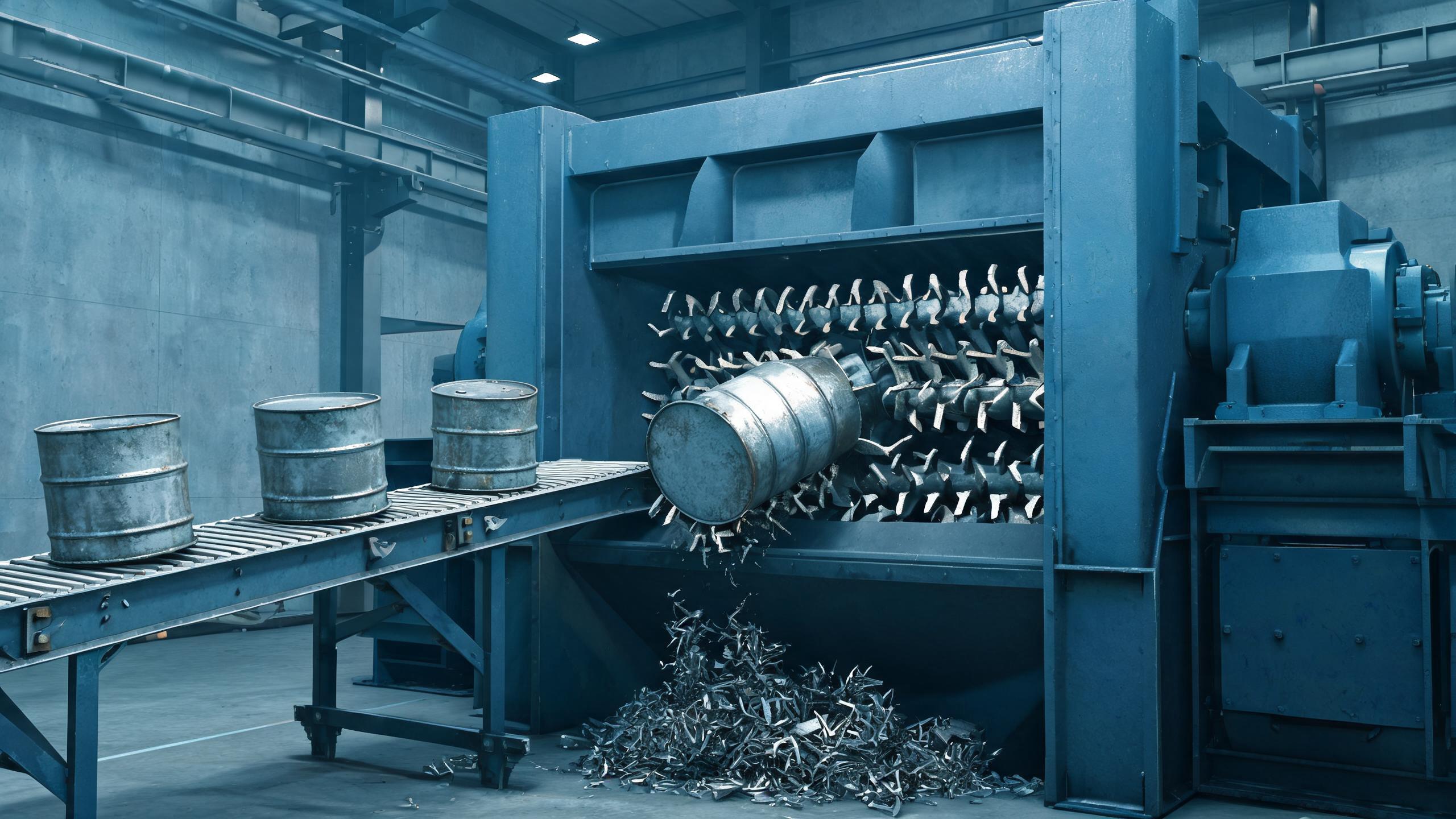
For B2B buyers evaluating shredding equipment, output particle size is rarely a minor detail — it determines downstream sorting efficiency, conveyor compatibility, melting feed quality, and whether your line meets end-customer specifications. Yet many buyers discover only after commissioning that the shredder produces material coarser or finer than expected, and that adjusting it is not as simple as changing one setting.
This guide explains the three variables that actually control output particle size in metal shredding — screen size, rotor speed, and blade configuration — how they interact, and the trade-offs you need to weigh before you order.
In this article
Screen Size: The Primary Gate
The screen (also called a sieve or grate) sits beneath the rotor and acts as the final gate for material leaving the cutting chamber. Material is reduced by the blades until it is small enough to pass through the screen apertures. In most metal shredding applications, screen size is the dominant control on output particle size — it sets the upper limit of what can exit the chamber.
If your output specification is tight — for example, a customer requires a consistent fraction for a specific process — the screen aperture is where you start. A smaller screen aperture produces finer output but reduces throughput, because material must be cut more times before it can pass. A larger screen aperture lets material exit sooner, increasing throughput but producing a coarser, more variable output.
One point to understand: the output is not uniformly equal to the screen aperture. Particles that pass through diagonally or that are already near the aperture size can exit without being cut to the nominal dimension. This means you should expect a size distribution around the screen opening, not a single uniform size. For critical applications, a secondary classification step (such as a downstream screen or magnetic separator) is often used to tighten the distribution.
Key takeaway: Screen size sets the maximum particle dimension. It is the first variable to specify, and the one with the most direct effect on output size. Confirm with your supplier how the screen is mounted, how quickly it can be changed, and whether different aperture sizes are available for the same machine frame.
Rotor Speed: Throughput vs. Fines
Rotor speed determines how often and how forcefully the blades strike the material. Higher rotor speed means more impacts per minute, which generally results in finer output — but it also brings trade-offs that buyers often overlook.
At higher speeds, the material spends less time in the cutting chamber per pass, which can increase throughput. However, high-speed operation also generates more heat, more wear on blades and screens, and a higher proportion of fine dust and small fragments. For metal shredding, excessive fines can be a problem: they are harder to handle on downstream conveyors, can be lost in separation steps, and may reduce the value of the recovered material.
Lower rotor speed produces a coarser, more consistent output with less dust and lower energy consumption per ton. It is often preferred for materials that are tough or that tend to heat-harden, such as certain alloy steels. The trade-off is lower throughput per hour, which may require a larger machine to meet your tonnage target.
Variable-speed drives are increasingly common on industrial shredders because they let you adjust rotor speed to match the material and the required output — run faster for light scrap, slow down for heavy or tough input. If your feedstock varies, this flexibility is worth asking about.
Blade Configuration: Shape, Number and Layout
Blade configuration is the third variable, and it affects output size in a more subtle way than screen or speed. It encompasses blade shape, the number of blades on the rotor, and how they are arranged along the shaft.
Blade shape determines the cutting action. Some blade profiles produce a shearing cut, which gives a cleaner, more uniform particle. Others produce a tearing or crushing action, which is more aggressive but yields a less uniform output. The right shape depends on the material: brittle castings behave differently from ductile wire or sheet metal.
The number of blades affects how many cutting events occur per rotor revolution. More blades mean more cuts per revolution, which can produce finer output at the same rotor speed. But more blades also mean more wear surfaces and higher power draw. There is a balance between cutting frequency and the machine's ability to drive the blades through the material.
Blade layout — how blades are staggered along the rotor — influences how material moves through the chamber. Some layouts push material toward the center; others move it from side to side. This affects how evenly the material is presented to the screen and how much recirculation occurs. A well-designed layout reduces "dead zones" where material sits uncut, improving both output consistency and throughput.
For a deeper look at how rotor and blade options are matched to specific waste streams, see our guide on single shaft shredder customization options.
How the Three Interact: Trade-offs to Know
In practice, screen size, rotor speed, and blade configuration are not adjusted independently. They interact, and changing one often requires compensating with another. Here are the trade-offs that matter most in metal shredding:
| Variable | To get finer output | To get coarser output | Main trade-off |
|---|---|---|---|
| Screen size | Use smaller aperture | Use larger aperture | Throughput drops as aperture shrinks |
| Rotor speed | Increase speed | Decrease speed | Higher speed = more fines, heat, wear |
| Blade count/layout | More blades / tighter layout | Fewer blades / wider layout | More blades = higher power draw, wear |
A common combination for consistent medium-fine output is a moderate screen aperture, medium rotor speed, and a blade layout designed for uniform cutting. For coarse output where throughput is the priority, a larger screen with lower speed and fewer blades is typical. For fine output where material value justifies the cost, a small screen, higher speed, and dense blade arrangement may be specified — accepting lower throughput and higher operating cost.
There is also a practical limit: below a certain screen aperture, throughput drops sharply and the machine spends most of its energy recirculating material. If your target particle size is very fine, a multi-stage process (a shredder followed by a granulator or mill) is often more economical than trying to achieve everything in one pass.
What to Confirm With Your Supplier
Before ordering, use this checklist to make sure the shredder you are considering can actually deliver your required output particle size — and that you know what it will cost in throughput and wear.
- Screen aperture range: What screen sizes are available for this machine model? How long does a screen change take, and is it a standard maintenance procedure?
- Speed control: Does the machine have a variable-speed drive, or is rotor speed fixed? If fixed, what speed is it set at, and can it be changed at the factory?
- Blade options: What blade shapes and counts are offered? Can the blade configuration be changed later if your feedstock or output requirements change?
- Expected output distribution: Ask for the typical particle size distribution (not just a nominal size) for your specific material at the operating point you are considering. A reputable supplier should be able to give you a realistic range.
- Throughput at your target size: Confirm the throughput rate at the screen size and speed you need — not just the maximum throughput at the largest screen. These can be very different numbers.
- Wear parts cost: Finer output and higher speed increase wear on blades and screens. Ask about expected wear life and the cost of replacement parts for the operating mode you plan to use.
If you are comparing machines from different manufacturers, ask each supplier to quote for the same output specification — same target particle size, same material, same throughput. This makes the comparison meaningful.
FAQ
Can I change the output particle size after the machine is installed?
Usually yes, within limits. Changing the screen is the most direct method and is a standard maintenance procedure on most shredders. If the machine has a variable-speed drive, rotor speed can also be adjusted. Blade configuration changes are more involved and may require factory support, so it is worth confirming beforehand whether this is feasible on the model you choose.
Is smaller screen always better for finer output?
Not necessarily. Below a certain aperture size, throughput drops sharply and the machine spends most of its energy recirculating material. For very fine output, a two-stage process (shredder plus granulator) is often more efficient than a single machine with a very small screen.
Why does my output contain particles larger than the screen aperture?
Particles that pass diagonally through the screen or that are already near the aperture size can exit without being cut to the nominal dimension. This is normal. If you need a tighter distribution, a downstream classification step is typically required.
What is the best configuration for mixed metal scrap?
Mixed feedstock is the hardest case because different materials respond differently to the same settings. A variable-speed drive and the ability to change screens are valuable in this situation, as they let you adjust the machine for different batches. Discuss your feedstock variability with the supplier before ordering.
How do I compare quotes from different shredder manufacturers?
Ask each supplier to quote for the same output specification — same target particle size, same material, and same throughput. Compare the expected output distribution, power consumption, and wear parts cost at that operating point, not just the machine price.