
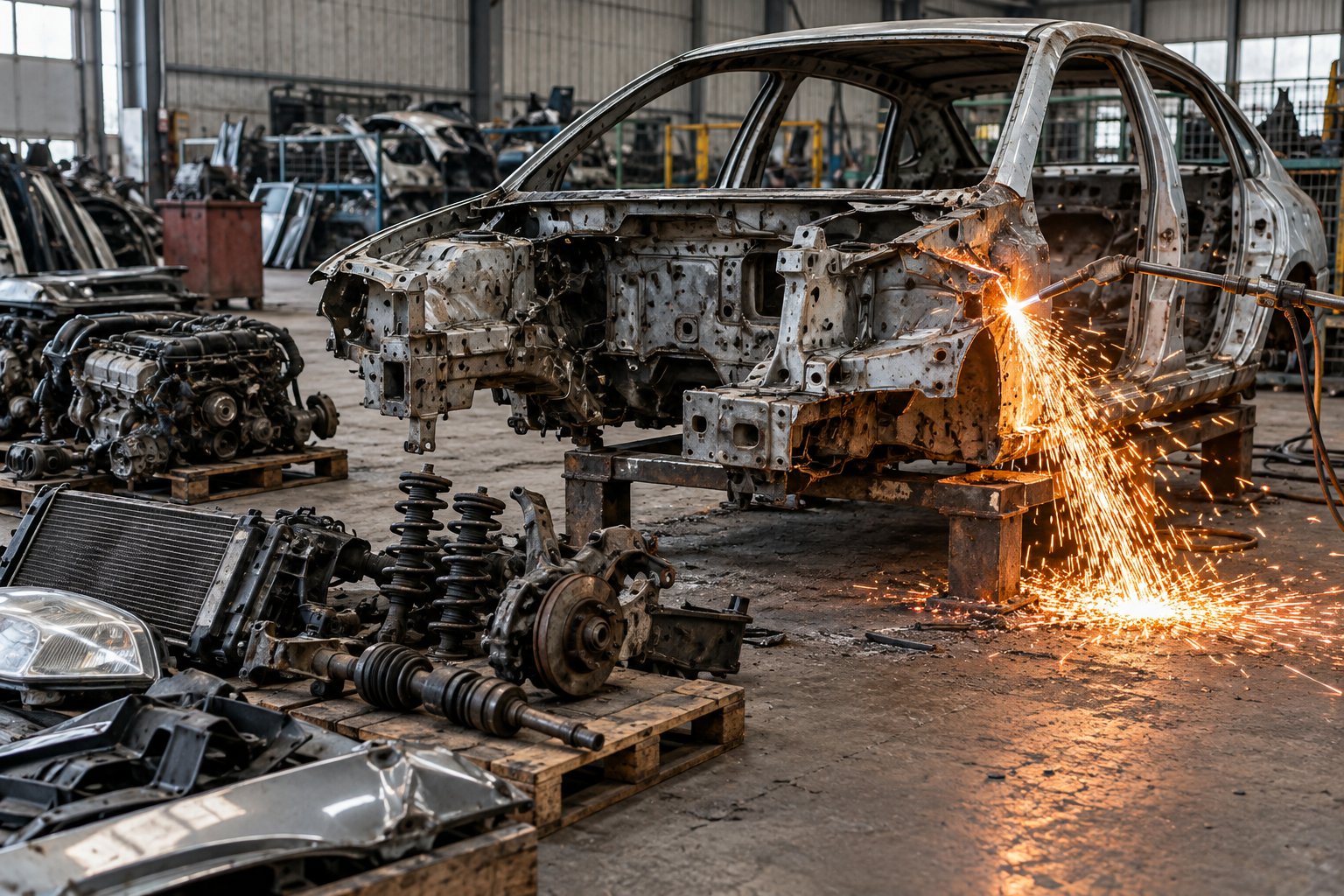
Cutting a car is the last step, not the first. Most of the money, the hazards and the paperwork sit in what you take off before the torch or shear ever touches the shell. This is the working sequence for how to cut up a car for scrap metal, together with the point where manual cutting stops making sense.
Key takeaways
- Drain and separate fluids first; a contaminated shell loses ferrous value and creates fire risk.
- The battery, catalytic converter, alloy wheels and wiring carry more value per kilogram than the shell.
- Remove the fuel tank, LPG tank and any pressurised struts before thermal cutting.
- Manual cutting suits a few cars a week; above roughly 15-25 t/h of vehicle feed, a shredding line is the practical route.
- One pass through a hammer shredder plus magnetic, eddy current and air separation splits the material into ferrous, non-ferrous and residue streams.
On this page
- Before any cut: fluids and the battery
- Components worth removing intact
- Wheels, glass and interior
- Shearing the shell
- When manual cutting stops making sense
- What one shredding pass produces
- FAQ
Before any cut: fluids and the battery
A vehicle that still holds its fluids is not a scrap car, it is a hazard with a chassis around it. Drain in the order below and keep each stream in a separate labelled container, because the resale route differs for each one.
- Fuel. Siphon or pump the tank dry and store it as a flammable liquid. Never cut near a tank that has not been drained and vented.
- Engine oil and transmission fluid. Both are collected as waste oil and can usually go to a licensed re-refiner. Drain while the engine is still warm if it has run recently.
- Coolant. Ethylene glycol is toxic and must not go to drain. Keep it separate from oil.
- Brake fluid. Water-soluble and contaminates oil streams; keep it in its own container.
- Refrigerant. Recover the air-conditioning charge with proper recovery equipment rather than venting it.
- Battery. Disconnect the negative terminal first, then the positive, and remove the lead-acid battery as a complete unit. It is a regulated item in most markets and has a well-established recycling value.
Only after the fuel tank is drained and removed should you consider cutting anywhere near the floorpan or rear axle area. A residual vapour pocket is enough to cause an explosion when a torch or shear opens the tank.
Components worth removing intact
Selling parts is almost always better than selling shredded metal, because a working alternator or a genuine catalytic converter is worth many times its weight in mixed scrap. Remove these before you reduce the shell.
- Catalytic converter. Cut the exhaust pipe on both sides and take the converter whole. Its internal platinum-group metals make it the single most valuable small component on most cars.
- Alloy wheels and tyres. Alloy wheels are a clean aluminium stream and should never be mixed with steel. Tyres come off separately; they are a distinct disposal route.
- Alternator, starter motor and ECU. Copper windings and reusable electronics.
- Wiring loom. Strip out what comes easily; copper-bearing cable is a separate grade.
- Radiator and heater core. Often aluminium or copper-brass.
- Airbags and seat-belt pretensioners. These are pyrotechnic devices and must be deployed or removed under a controlled procedure before the hull is processed. Leaving them in is a genuine safety issue at the shredder.
- LPG or CNG tank, if fitted. Remove, de-pressurise and handle as a pressure vessel.
On a modern car, this stage can take longer than the cutting itself. On a high-volume yard, the labour is organised as a fixed station sequence so that no car reaches the shear with a converter or battery still attached.
Wheels, glass and interior
These three are about reducing contamination and handling weight, not about extracting high-value metal.
- Wheels. With alloys already removed, steel wheels and tyres come off the hubs. Tyres must be separated from the rims; a whole wheel with a tyre attached is not a clean steel feed.
- Glass. Remove windscreen, side and rear glass. Laminated windscreen glass and tempered side glass behave differently under a hammer mill and both should be diverted from the ferrous stream. Glass also adds weight that earns nothing.
- Interior. Seats, carpet, headliner and trim are mostly mixed plastics, foam and fabric. Strip them to a light fraction container. This is the single largest volume of non-metallic material in a passenger car and it decides how much residue your operation generates per vehicle.
- Plastic bumpers and fuel tank. Once drained, the plastic tank and bumpers go to the same light fraction rather than into the shredder feed.
At the end of this stage you should be able to look at the shell and see steel, some aluminium castings, and not much else. That is the correct condition for cutting.
Shearing the shell
With fluids out, pyrotechnics out and the light fraction stripped, the remaining body shell is a structural steel object. Reduce it to a size your downstream equipment can accept.
- Separate the powertrain. Pull the engine and gearbox as one assembly if you can lift them; an engine block is a dense cast-iron item and is often worth selling as a rebuildable core.
- Cut the roof and pillars. A shear or a hydraulic cutter opens the body along the pillars. Aim for a bundle that will not jam the feed opening of the next machine.
- Flatten or bale the body. Some yards use a baler or a crusher to compact the shell before transport; others feed it loose. Either way, the target is a dense, uniform bundle.
- Keep grades separate. Cast aluminium, sheet aluminium, clean steel and mixed heavy melt are separate containers. Mixing destroys the value you spent the whole sequence protecting.
Manual thermal cutting and hydraulic shearing are flexible, require one skilled operator, and can follow the shape of the car without a fixed layout. They are also slow, they consume gas or power per cut, and the cut edges are inconsistent in size, which is exactly what downstream shredding equipment does not like.
When manual cutting stops making sense
The break-even point is not a single number, but the deciding factors are consistent across yards:
| Condition | Manual cutting still works | Industrial shredding is the better route |
|---|---|---|
| Vehicles per week | Low volume, one or two operators | Continuous feed, multi-shift |
| Labour cost per vehicle | Low, skilled cutter available | High, cutting labour dominates cost |
| Output specification | Loose heavy melt bundles | Clean ferrous and non-ferrous fractions for mills |
| Material recovery | Limited to what is dismantled by hand | Recovers small non-ferrous and residue streams |
| Space and layout | Open yard, flexible | Fixed line with feed, shredder, separation |
In practice, once a yard is processing vehicles continuously rather than one at a time, the cutting station becomes the bottleneck. At that point the shell is fed whole or partially reduced into a shredder, and size reduction and material separation happen in the same machine.
A dedicated vehicle shredder such as the TG-VehShred 800 handles this stage: 800 kW drive power, a 1800 x 1200 mm feed opening, throughput of 15-25 t/h and a CE mark. Behind it, a TG-Hammer 800 hammer mill with a 750 kW main motor, 500 t hydraulic compression and reversible manganese steel hammers processes 40-60 t/h for higher-volume lines. The larger Tian Gong TG-ELVLine 300 end-of-life vehicle recycling line combines hammer shredding with magnetic separation, eddy current separation and air classification in a single pass.
What one shredding pass produces
The reason shredding replaces manual cutting at scale is that it delivers three defined output streams instead of one mixed pile.
- Ferrous metal. Recovered by magnetic separation, this is the main saleable product of most vehicle recycling operations.
- Non-ferrous metal. Aluminium, copper and brass recovered by eddy current separation. This is the fraction that manual dismantling misses and that pays for the equipment over time.
- Residue. Light fluff, foam, fabric and dust separated by air classification. This needs its own disposal or energy recovery route, and reducing its volume is one reason to strip the interior before shredding.
The trade-off is layout: a shredding line needs a defined feed area, enough power supply for the drive motor, and downstream separation equipment, and it does not follow the shape of an individual car the way a shear does. For a yard still working vehicle by vehicle, manual cutting remains the flexible option.
FAQ
Can I cut a car with a fuel tank still in it?
No. Drain and remove the tank first, and let it vent. Residual vapour in an emptied tank is still explosive when a torch or shear opens the shell around it.
What is the most valuable part of a scrap car?
Usually the catalytic converter, followed by the battery, alloy wheels and copper-bearing components. The shell is the lowest-value fraction by weight.
Do I need to remove the glass before shredding?
It is not strictly required for a shredder to operate, but glass adds weight that earns nothing and it contaminates the ferrous stream. Diverting it improves the quality of the output.
How do I know when to move from manual cutting to a shredding line?
When cutting labour, not vehicle supply, becomes the limiting factor on throughput. Model it on tonnage per hour: a shredder in the TG-VehShred 800 class processes 15-25 t/h, which is well beyond what manual cutting can sustain with the same crew.
Equipment specifications vary with configuration and site conditions. Confirm power supply, layout and required output fractions with the equipment supplier against your actual vehicle mix before specifying a line.