
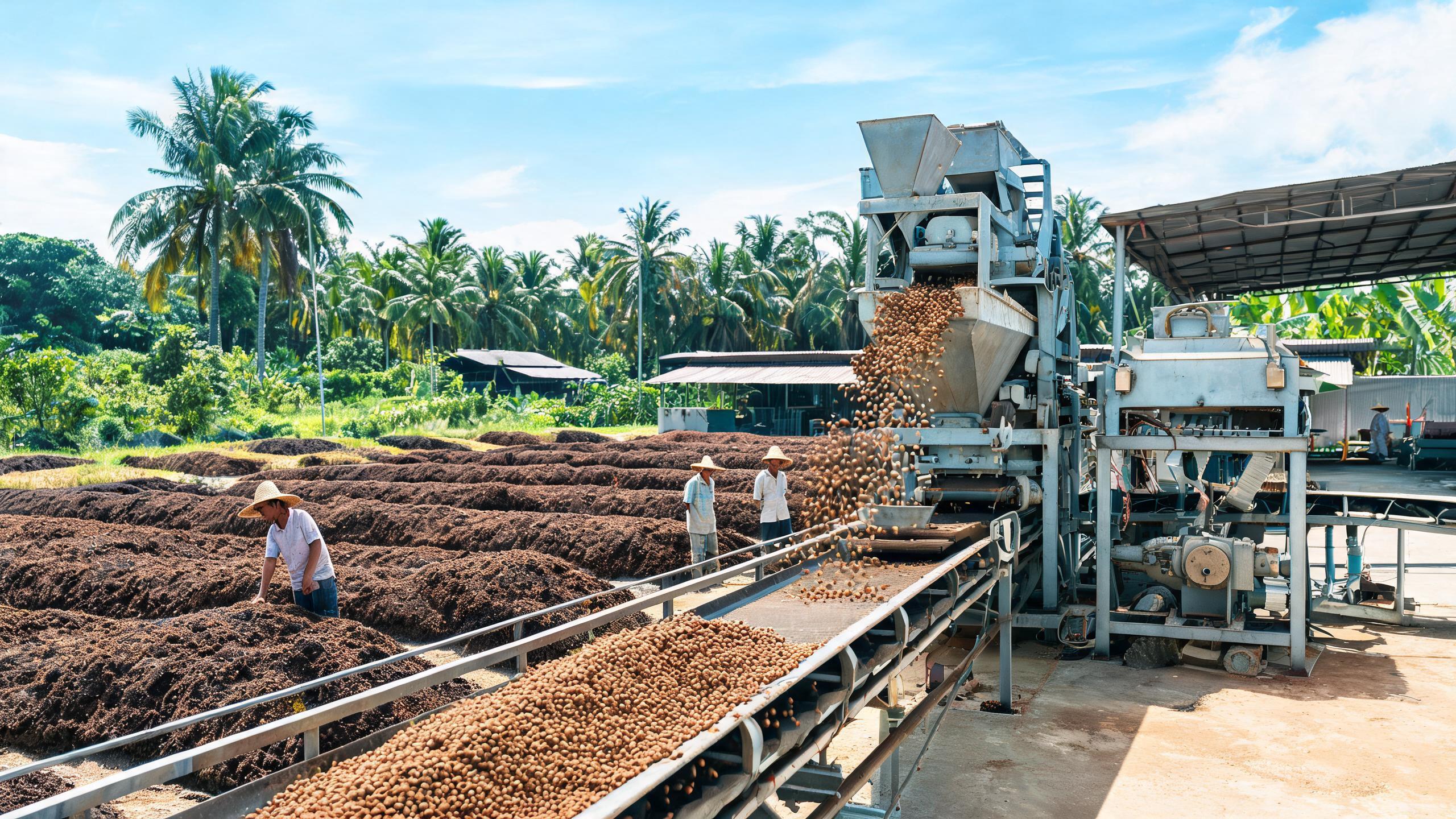
BUYER GUIDE
Why Organic Fertilizer Demand Is Growing in Southeast Asia
Across Vietnam, Indonesia, Thailand, Malaysia, and the Philippines, the push for sustainable agriculture is no longer a niche trend. Governments are tightening regulations on chemical fertilizer use, soil degradation is becoming a visible problem, and export markets are demanding produce grown with lower chemical residues. At the same time, the region generates enormous volumes of organic waste—livestock manure, food waste, and agricultural residues—that are often underutilized.
For agribusiness investors, this creates a clear opportunity: convert that waste into a marketable product. An organic fertilizer production line lets you turn a disposal problem into a revenue stream, while supporting the region's shift toward regenerative farming.
But building a line is not just buying a few machines. You need to understand the process, size each stage to your feedstock, and choose equipment that can handle your specific materials—and your local power supply. This guide walks you through the entire process, from raw material preparation to final packing.
- Plan the line around your feedstock—manure, food waste, and agricultural residue each behave differently.
- Each stage (crushing, mixing, composting, granulation, drying, screening, packing) must be sized to match the others to avoid bottlenecks.
- Verify power compatibility (50 Hz vs. 60 Hz) and ask about installation supervision and operator training.
- Common mistakes: undersizing the composting area, ignoring moisture control, and buying a granulator before confirming your final product form.
The Stages of a Complete Organic Fertilizer Production Line
A complete line typically follows a sequence: raw material crushing and grinding, mixing, composting and fermentation, granulation, drying and cooling, screening, and packing. Each stage has a specific function, and the output of one feeds into the next.
1. Raw Material Crushing and Grinding
Most organic materials arrive in uneven sizes—straw, stalks, manure lumps, food waste chunks. A crusher or grinder breaks these down into a uniform particle size. This is critical because smaller, consistent particles decompose faster and mix more evenly. For fibrous materials like agricultural residue, you may need a dedicated shredder. For wet materials like manure, a crusher designed for high-moisture content is essential.
2. Mixing
After crushing, you need to blend different feedstocks to achieve the right carbon-to-nitrogen (C:N) ratio and moisture content. A mixer combines manure with straw, sawdust, or other bulking agents. Proper mixing ensures that the composting process works efficiently and that the final fertilizer has a consistent nutrient profile. Mixers come in various designs—horizontal, vertical, and double-shaft—each suited to different material types and batch sizes.
3. Composting and Fermentation
This is the heart of the line. During composting, microorganisms break down organic matter, generating heat and transforming the material into stable humus. The process requires oxygen, moisture, and time. You can compost in open windrows, in aerated static piles, or in fermentation tanks. The choice depends on your climate, space, and whether you need to speed up the process. Proper aeration and turning are essential to avoid anaerobic conditions, which cause odor and nutrient loss.
4. Granulation
Once the compost is mature and screened, you can form it into granules. Granulation improves handling, storage, and application. There are two main types: wet granulation (using a rotary drum granulator or disc granulator) and dry granulation (using an extrusion granulator). Wet granulation works well with materials that have the right moisture content and produces round, uniform granules. Dry granulation is better for materials that are too dry or have a high fiber content. The choice depends on your final product specification and the characteristics of your compost.
5. Drying and Cooling
Fresh granules are often too moist and warm to pack. A rotary dryer reduces moisture to a safe level for storage, preventing caking and microbial regrowth. A cooler then brings the temperature down so the granules don't continue to lose moisture or degrade in the bag. These stages are energy-intensive, so it's worth considering heat recovery or using waste heat from the composting process.
6. Screening
After drying, granules pass through a screen to remove oversize and undersize particles. The on-size product goes to packing; the off-spec material is returned to the granulator or crusher for reprocessing. Screening ensures a consistent product that meets customer expectations.
7. Packing
The final stage is weighing and bagging. Packing equipment can be semi-automatic or fully automatic, depending on your production volume. A good packing line includes a hopper, weighing scale, and bag sealer. Consider whether you need to pack in standard bags, bulk bags, or both, and confirm bag formats with your target customers.
How to Size Each Stage to Your Feedstock
The capacity of each machine must match your feedstock type and volume. A line designed for poultry manure will not work the same way for rice straw, because the bulk density and moisture content are different.
| Feedstock | Key Characteristics | Equipment Considerations |
|---|---|---|
| Livestock manure (chicken, pig, cattle) | High moisture, high nitrogen, may contain bedding | Use a crusher that handles wet, sticky materials; consider a dewatering step if moisture is too high. |
| Food waste (kitchen, restaurant, market) | High moisture, variable composition, may contain contaminants | Pre-sort and remove plastics/metals; use a shredder for size reduction; fermentation may need faster aeration. |
| Agricultural residue (straw, husks, bagasse) | Dry, fibrous, high carbon, low moisture | Use a heavy-duty crusher or shredder; add water or co-compost with wet materials to adjust moisture. |
Start by calculating your daily feedstock input. Then work backward: composting reduces the volume of raw material considerably, so your granulator needs to handle the post-compost volume, not the raw input. A common mistake is buying a granulator that is too small for the output of the composting stage, creating a bottleneck.
Also consider the moisture content at each stage. Compost needs a moisture level suited to healthy microbial activity, and dried granules must be dry enough for safe, caking-free storage. The exact target values depend on your feedstock and local climate — confirm them with your equipment supplier during line design, and make sure the equipment can handle these variations.
Equipment Selection Considerations
When selecting organic fertilizer equipment, look beyond the initial price. Consider these factors:
- Material compatibility: The machine must be able to handle your specific feedstock—its moisture, fiber content, and abrasiveness. Corrosion-resistant materials are important for wet, acidic materials.
- Power supply: Your local grid frequency matters. Equipment configurable for both 50 Hz and 60 Hz gives you flexibility. Confirm with the supplier that the motors and controls are compatible with your local power.
- Automation level: A fully automated line reduces labor but requires higher upfront investment and more technical skill to maintain. A semi-automatic line may be more appropriate for a startup.
- Ease of maintenance: Look for machines with accessible parts, standard bearings, and simple controls. Downtime is costly in a production line.
- After-sales support: Ask about installation supervision and operator training. A supplier that provides these services reduces your risk of commissioning problems.
Common Planning Mistakes
Many new operators make the same errors. Avoid these:
- Undersizing the composting area: Composting takes time. If your composting pad is too small, you can't process the volume your crusher and mixer can produce, creating a backlog.
- Ignoring moisture control: Too wet, and the compost goes anaerobic; too dry, and the microbes slow down. Plan for water addition and drainage.
- Buying a granulator too early: Granulation is the most expensive stage. Make sure your compost is mature and consistent before investing in a granulator. Some producers start by selling compost in bulk, then add granulation later.
- Not planning for dust and odor: Crushing, drying, and screening create dust. Composting creates odor. Install dust collection and biofilters or other odor control measures.
- Overlooking the power supply: A line that requires 60 Hz in a 50 Hz country will need a converter, adding cost and complexity. Check compatibility upfront.
Supplier Evaluation Checklist
Choosing the right supplier is as important as choosing the right machine. Use this checklist when evaluating a potential partner:
- Product range: Does the supplier offer complete line equipment, or only individual machines? A supplier with a full range—crushers, mixers, granulators, dryers, and packing machines—can better integrate the line.
- Experience: How long have they been in the industry? A company with a track record, like TIANGONG (founded in 2008), has likely dealt with a variety of feedstock and site conditions.
- Customization: Can they configure the line for your specific feedstock and power supply? Ask about 50 Hz/60 Hz options.
- Installation and training: Do they provide installation supervision and operator training? This is critical for a smooth startup.
- Spare parts availability: Where are they located? Can you get spare parts quickly? A local distributor or warehouse is a plus.
- References: Ask for contact details of existing customers in your region. Follow up to ask about their experience.
TIANGONG, for example, supplies organic fertilizer complete equipment sets, along with crushers, solid waste treatment equipment, mixers, and food/kitchen waste processing machines that can feed into an organic fertilizer workflow. They also offer equipment configurable for 50 Hz and 60 Hz, and provide installation supervision and operator training. This kind of integrated support can simplify your project.
Frequently Asked Questions
What is the minimum investment for an organic fertilizer production line?
Investment varies widely based on capacity, automation level, and feedstock type. There is no one-size-fits-all number. You should request a detailed quotation from suppliers based on your specific requirements.
Can I use the same line for different feedstocks?
Yes, but you may need to adjust settings or add pre-treatment steps. For example, food waste may require more sorting and shredding than manure. Discuss your feedstock mix with the supplier to ensure flexibility.
How long does the composting process take?
The duration depends on the method (windrow, aerated static pile, in-vessel), the C:N ratio, moisture, and turning frequency. It can range from a few weeks to a few months. The supplier can help you estimate based on your specific conditions.
What is the difference between a disc granulator and a rotary drum granulator?
A disc granulator produces uniform, round granules and is often used for smaller capacities. A rotary drum granulator can handle higher throughput and is suitable for larger lines. The choice depends on your production scale and desired granule quality.
Next Steps: Plan Your Line with a Reliable Partner
Building an organic fertilizer production line is a significant investment. The key is to plan carefully, understand your feedstock, and choose equipment that fits your local conditions. A supplier that offers complete line equipment, power flexibility, and after-sales support can make the difference between a smooth operation and a costly learning curve.
If you are in the early planning stage, contact TIANGONG for a line configuration consultation. Their team can help you assess your feedstock, recommend a suitable layout, and provide a quotation tailored to your needs. With experience since 2008, they have the knowledge to guide you from composting to granulation.
Note: This article is for informational purposes. Equipment specifications, capacities, and configurations should be confirmed directly with the supplier based on your project requirements.