
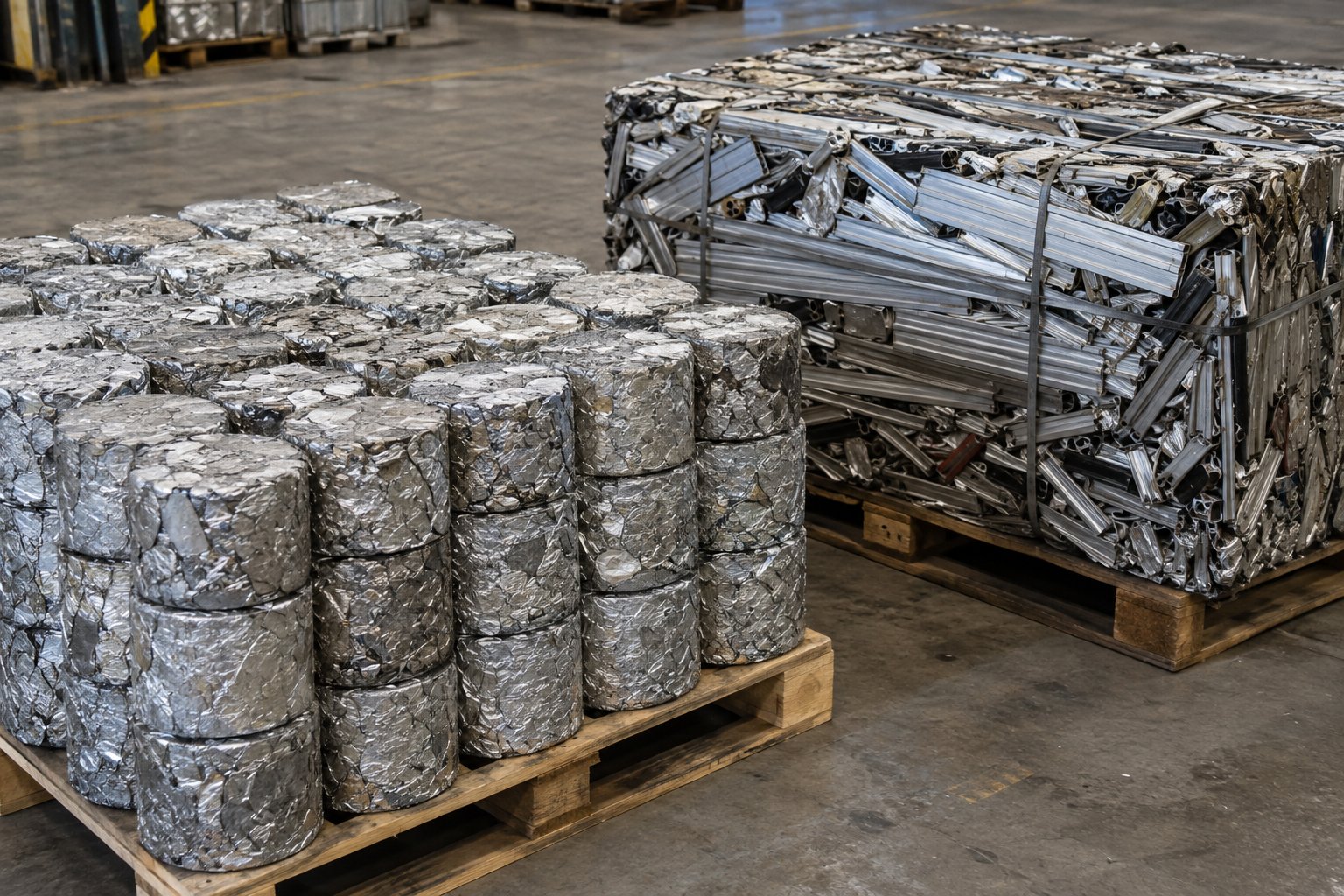
"What is aluminum scrap worth today" has no single answer, because your load does not have one price — it has a price that is calculated from five things: its grade, its alloy mix, how clean it is, what form it is in, and the benchmark reference on the day you sell. Two loads that both weigh the same can be quoted differently, and both quotes can be correct. This guide is written for the seller: it shows you how to look at your own pile, estimate where it sits, and understand why a yard arrives at the number it does.
What actually sets your number
- Grade and alloy mix — separation is the single largest lever.
- Contamination — anything that is not aluminum is paid as a deduction, not as metal.
- Form — loose, baled, or briquetted changes handling, freight, and melt loss.
- The day's benchmark reference — quotes move with the metal market, not with your yard's mood.
- Your volume and repeatability — one-off loads and recurring supply are priced differently.
Start With Grade, Because That Decides Most of the Value
Before any number is discussed, a buyer looks at your material and assigns it to a grade. Grade is not a compliment or an insult; it is a description of what the furnace will receive. Aluminum scrap is broadly divided into a few families, and within each family the alloy matters.
Cast versus wrought
Cast aluminum — engine blocks, transmission housings, pump bodies, die-cast parts — and wrought aluminum — extrusions, sheet, profiles, window frames, tubing — behave differently in a furnace and are usually traded as separate grades. If your pile mixes both, expect it to be priced as the lower-value fraction unless you separate it first. Sorting cast from wrought is the highest-return hour of work most sellers can do.
Alloy identity
Within wrought, a buyer wants to know whether the material is a recognizable extrusion alloy, a painted or coated sheet, or a mixed unknown. Where alloy identity can be established — consistent profiles from the same production line, for example, rather than a random assortment — the load is easier to place and easier to price. Where it cannot, the load is treated as mixed, and mixed is priced as mixed.
Common grade families a seller will hear named
- Clean extrusion / profile — same-alloy, coating-free, uniform material.
- Painted or coated extrusion — same shape, but the coating has to burn off or be removed.
- Clean sheet and clip — thin-gauge material with low attachment.
- Castings — heavier sections, often with inserts and oil.
- Mixed / irony aluminum — aluminum still attached to steel, which must be separated downstream.
- Swarf, turnings, and chips — machining by-product, usually carrying cutting fluid and fines.
Contamination Is a Deduction, Not a Detail
Every pound of your load that is not recoverable aluminum is a pound the buyer cannot sell, and it also costs something to remove. That is why contamination lowers the price twice. The contaminants that show up most often in real loads are:
- Attached steel — screws, hinges, brackets, rebar, fasteners still in the frame.
- Non-metallic attachment — rubber seals, plastic trim, glass, gaskets, foam.
- Liquids and oils — cutting fluid in swarf, oil in castings, coolant residue.
- Coatings — paint, anodizing, powder coat, and adhesive films.
- Moisture and dirt — relevant when material has been stored outdoors, because weight is measured as received.
This is also where form and preparation start to overlap with price. A loose pile of oily swarf, a dense bale of mixed sheet, and a briquette of dry machining chips are three different products to a furnace, even when the aluminum content is the same. Briquetting compacts swarf and can recover cutting fluid in the process; the TG-BriqPress 250 metal briquetting system is built for steel, cast iron, aluminum, copper, and brass swarf, and its purpose in a pricing conversation is straightforward: denser material moves at lower transport cost per unit of metal, and fluid that would have been a contaminant can be recovered instead of shipped.
Form: Loose, Baled, or Briquetting
Form does not change the chemistry of your aluminum. It changes how the load is handled, transported, and fed, and those things are part of what a buyer is paying for.
| Form | What it means to the buyer | Typical seller consideration |
|---|---|---|
| Loose | Low bulk density, more handling per tonne of metal | Simple to produce, but freight and handling are charged against the load |
| Baled | Denser, easier to load and stack | Needs a baler; bales may need opening again before further processing |
| Briquetted | Compacted, more uniform, easier to charge | Needs a briquetting press; suited to swarf and fines |
If a load arrives as bales and needs to be broken down before it can be sorted or fed, that step belongs in the chain too. A TG-BaleShred 1000 bale shredder is used to open baled material so downstream separation can actually work on it.
Why the Same Weight Gets Two Different Quotes
This is the part most sellers find confusing, and it is worth being precise about. When you call two yards with "20 tonnes of aluminum," you are not describing a product. You are describing a weight. The buyer has to convert that weight into a recoverable-metal estimate, and different buyers make different assumptions.
The benchmark reference moves daily
Scrap quotes are referenced against benchmark metal prices rather than invented on the spot. The exact relationship between a scrap grade and the benchmark is a commercial term — it depends on the grade, the recovery, the processing cost, and the buyer's own position — but the mechanism is the same everywhere: when the reference moves, quotes move with it, even for material that has not changed at all. This is why a quote from last month is not a quote for today.
Recovery is an estimate, not a measurement
Out of your 20 tonnes, how much is actually saleable aluminum? Nobody knows for certain until the load is processed. One buyer may price on a conservative recovery assumption; another may be more optimistic because their downstream line handles that material well. Same pile, different assumption, different number.
Scale, freight, and repeatability
- Distance to the consuming mill — freight is a real cost and it comes out of the load's value.
- Load size — a full truckload and a partial load are not priced the same way per unit.
- Recurring supply — a seller who can deliver a predictable monthly grade is easier to plan around than a one-off lot.
How to Estimate What Your Own Load Is Worth
You do not need a price list to get a useful estimate. You need to describe your load the way a buyer will describe it back to the mill.
- Weigh it accurately. Get a real scale ticket, not a visual guess. Everything downstream depends on this number.
- Sort by family. Separate cast from wrought, and separate swarf from solid material. Keep the streams apart.
- Identify the alloy where you can. Consistent extrusions from one production source are worth describing as such; unknown mixed material should be described honestly as mixed.
- Quantify contamination. Estimate what fraction of the load carries steel, rubber, plastic, paint, or oil. Even a rough figure tells the buyer you have looked.
- Decide on form and preparation. Loose, baled, or briquetted; dry or oily; sorted or combined. Preparation is often the difference between a load that gets quoted and a load that gets a lower quote.
- Ask for the quote basis. Ask what grade the buyer is quoting, whether the price is against a published reference, and what deductions apply. A quote you can break down is a quote you can compare.
Where Processing Equipment Changes the Math
Preparation is not only about getting a better grade. It is also about reducing the costs that a buyer subtracts before paying you. A line that shreds, removes ferrous material magnetically, separates non-ferrous fractions with an eddy current separator, and then briquettes the fines produces a denser, more uniform, furnace-ready output. The TG-AluLine 200 aluminum scrap recycling processing line combines those four stages — twin-shaft shredder, magnetic removal, eddy current separator, and hydraulic briquetting press — into one flow, which means material that would otherwise be sold as mixed or as loose swarf can be sold as sorted and briquetted instead.
For a seller deciding whether that investment is worthwhile, the question to answer first is what your current load is being downgraded for: contamination, low bulk density, or mixed alloy. The equipment fixes handling and density. It does not fix an alloy mix you have not separated, and it does not turn a contaminated load into a clean one by itself.
Frequently Asked Questions
Is there one published price for aluminum scrap today?
No. Published scrap references exist, but they are reference points for specific grades, not a single number that applies to every load. Your actual quote depends on which grade your material is assigned to, how much recoverable aluminum the buyer expects, and the day's benchmark reference. That is why two quotes for the same weight can both be legitimate.
Does cleaning my aluminum scrap really change the price?
It changes the grade and the deductions, which is what changes the price. Removing attached steel, rubber, plastic, and oil reduces what the buyer has to pay to process the load, and it moves material out of a mixed category into a defined one. The effect is largest when the contamination is heavy — a load of frames with steel hinges attached is a different material than the same frames with the hinges cut off.
Why is aluminum swarf priced differently from solid scrap?
Swarf, turnings, and chips are a by-product of machining. They are usually fine, often carry cutting fluid, and have low bulk density, all of which make them more expensive to handle and transport per unit of metal. Briquetting compacts swarf and can recover cutting fluid in the process, which addresses both the density and the fluid issue. A standalone briquetting press such as the TG-BriqPress 250 handles aluminum as well as steel, cast iron, copper, and brass swarf.
What should I tell a buyer when I request a quote?
Give the weight, the grade families present, the alloy identity where you can support it, the form (loose, baled, or briquetted), and the contamination you know about. Then ask what grade the quote is based on and what deductions apply. Sellers who describe the load accurately tend to get quotes they can compare directly, rather than numbers that shift once the material is inspected.
This article explains how aluminum scrap loads are valued. It does not quote prices. For a figure on a specific load, the grade, weight, and reference basis have to be confirmed between you and the buyer.