
If you run a machine shop, you already know the pile beside the chip conveyor. The question behind "what is metal swarf" is rarely academic: it is whether that pile is a waste-handling cost or a revenue stream. The short answer is that metal swarf is the material removed by cutting tools during machining, and it is almost always worth collecting. Whether it is worth selling depends on how you prepare it.
What you will get from this article:
Swarf defined by operation and form; the main metal types and how they behave; the three reasons loose swarf is difficult to sell; and the two-step route (shredding then briquetting) that turns loose chips into a material a scrap buyer or foundry will accept.
What is metal swarf?
Metal swarf is the collective term for the small metal particles produced when a cutting tool removes material from a workpiece. It covers a range of physical forms, and the form matters because it determines how the material packs, flows, drains and sells.
- Chips: short, broken fragments from turning, milling or drilling. They are the most common form on a shop floor and the easiest to handle.
- Turnings: longer, curled or tangled strands, typical of lathe work. They nest together and trap coolant and air.
- Filings and fines: the very small particles from sawing, grinding or finishing operations. Fines can be difficult to drain and are often mixed with other waste.
The term is used loosely across the trade, but in purchasing and scrap discussions, swarf is understood to mean machining debris rather than offcuts, skeleton scrap, or rejected parts. That distinction matters: offcuts and rejects are solid pieces with known weight and density, while swarf is loose, wet and bulky. The two are priced and handled very differently.
Swarf arises from nearly every metal-cutting operation: turning, milling, drilling, boring, sawing, broaching and grinding. If the process produces a cut, it produces swarf.
The main types of metal swarf
Swarf is usually sorted by the base metal, because the alloy determines both the recovery value and the processing route. Mixed swarf is worth less than clean, single-metal swarf, so segregation at the machine is the first step in recovering value.
| Type | Typical source | Handling note |
|---|---|---|
| Aluminum swarf | Milling, turning and drilling of aluminum parts | Light and highly voluminous; tangles easily; often carries coolant |
| Steel swarf | Turning and milling of carbon and alloy steel | Heavier than aluminum; can be sharp; usually magnetic, which helps separation |
| Cast iron swarf | Machining of castings | Breaks into small, dusty chips; abrasiveness affects handling equipment |
| Brass swarf | Turning and milling of brass components | High recovery value relative to volume; keep segregated from other metals |
| Copper swarf | Machining of copper parts and busbars | High recovery value; even small quantities justify separate collection |
Aluminum, brass and copper swarf carry higher per-kilogram value than steel or cast iron, which is why mixing them with steel turnings is an expensive habit. At minimum, keep ferrous and non-ferrous streams apart. Where the volume justifies it, separate aluminum, brass and copper individually.
Why loose swarf is hard to sell
Most machine shops start by storing swarf in bins or drums and calling a scrap dealer. That often produces disappointing results, and three specific reasons explain why.
Low bulk density
Loose chips and tangled turnings are mostly air. A drum or skip fills quickly but weighs relatively little, so the material occupies a large share of your floor space and of any transport you pay for. Scrap dealers and foundries work on weight, and a load that is mostly voids is expensive to move. Transporting loose swarf means paying to move air alongside metal.
Coolant and cutting fluid contamination
Swarf leaves the machine coated in cutting fluid. That fluid has two negative effects at the point of sale. First, it adds weight that is not metal and that the buyer must account for. Second, it drips and pools during storage and transport, which creates housekeeping and environmental issues for both you and the buyer. Many buyers discount wet material heavily, or refuse it outright, because the fluid content is uncertain.
Handling and fire risk
Loose swarf is awkward to handle. Turnings tangle, fines sift through equipment gaps, and the material is difficult to feed into any downstream process at a controlled rate. There is also a genuine safety dimension: fine metal particles coated in oil or cutting fluid can self-heat under certain conditions, and stored piles of oily fines are a recognized fire risk in machining environments. Compacting the material reduces both the surface area exposed to air and the volume of fluid available to feed a smolder.
From waste to sellable material: shredding and briquetting
The route from problematic waste to a material a buyer will accept is mechanical, and it has two stages: size reduction, then compaction.
Step 1: shredding for consistent size
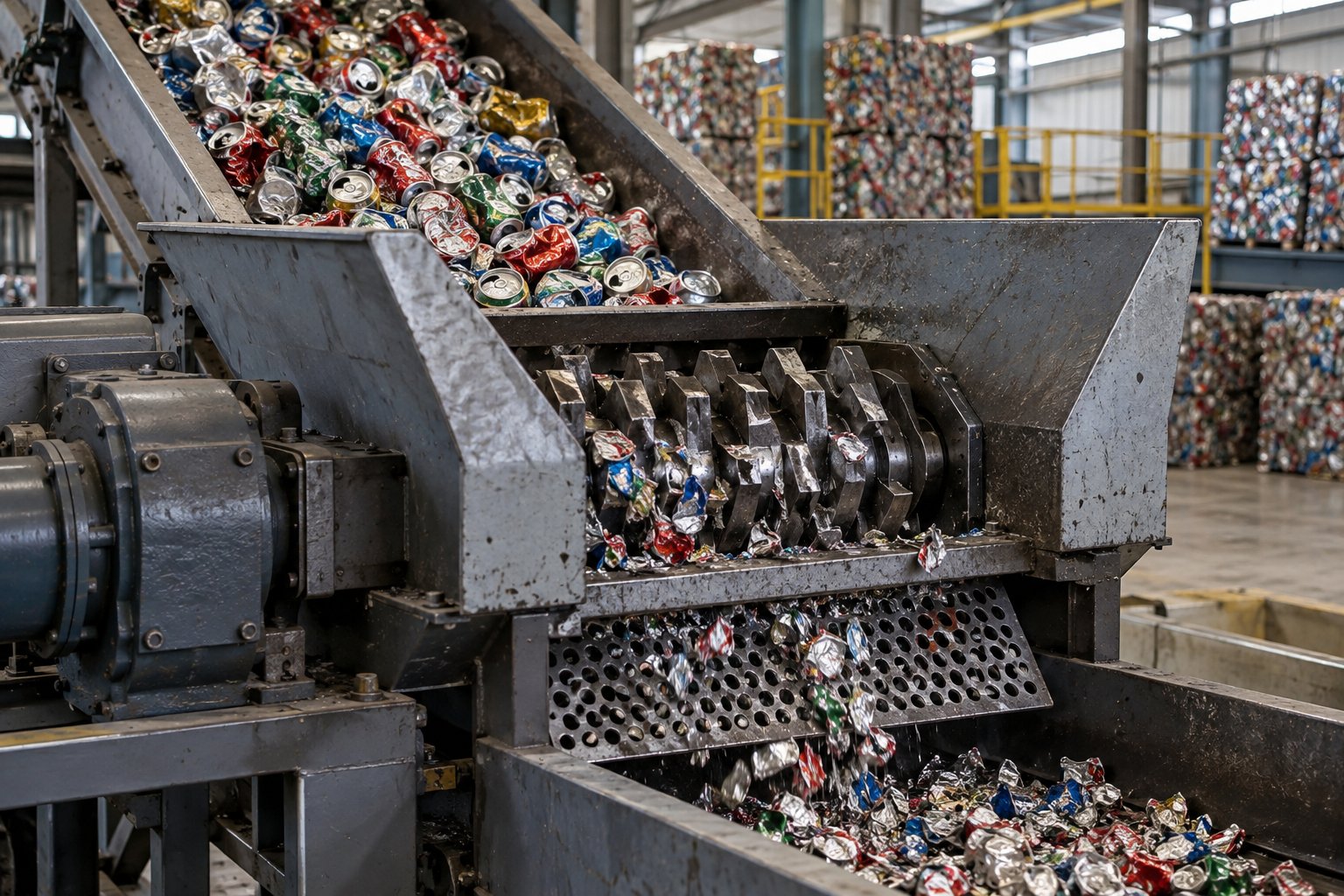
Long turnings and tangled chips need to be reduced to a consistent, flowable size before they can be fed reliably into a press. A purpose-built shredder for this job uses low-speed shearing rather than high-speed impact. Low-speed shearing matters with non-ferrous material such as aluminum, because it avoids the repeated hammering action that can work-harden light alloys and make them brittle or springy.
The TG-AluShred 120 is a twin-shaft shredder built for aluminum swarf, turnings and chips. Its inclined hopper helps material feed down into the cutting chamber rather than bridging above it, sealed bearings keep abrasive fines and fluid out of the drive components, and a discharge screen controls the output particle size. The unit is CE marked and available for 50 Hz or 60 Hz power supplies.
Step 2: briquetting for density and fluid recovery
Once the swarf is a consistent size, a hydraulic briquetting press compacts it into dense cylindrical briquettes. The TG-BriqPress 250 is a standalone system that handles loose chips, turnings and swarf in steel, cast iron, aluminum, copper and brass. Two outcomes matter commercially:
- Volume reduction: dense briquettes cut transport costs by roughly 5 to 10 times compared with moving the same weight of loose swarf, because you are no longer paying to move voids.
- Cutting fluid recovery: the press expresses cutting fluid during compaction. That fluid can be collected and returned to the machining process instead of being lost in the chip bin or paid for as contaminated waste.
Briquettes also change how the material is perceived at the point of sale. They are uniform, drainable, easier to weigh and easier to load. That consistency is what lets a machine shop move from paying to dispose of swarf to selling it as a defined grade.
What actually determines swarf value
Two shops with identical machines can get very different returns from the same alloy. The difference usually comes down to four factors.
- Alloy cleanliness: single-metal swarf commands more than mixed swarf. Segregate at the machine, not at the bin.
- Fluid content: drier material is worth more. Recovering and returning cutting fluid improves both the scrap price and your consumable spend.
- Density and form: compacted, uniform briquettes are easier for a buyer to handle and value than loose, tangled turnings.
- Consistency of supply: a buyer who can rely on a regular, consistent grade of material tends to offer better terms than one pricing a one-off, poorly described load.
None of these require changing how you machine. They require changing how you collect, prepare and present the material that machining already produces.
Is it worth collecting?
For most machine shops, yes, with two conditions. The first is segregation: keep ferrous and non-ferrous streams apart, and split aluminum, brass and copper where volumes allow. The second is preparation: shredding and briquetting are what convert a bulky, wet, awkward waste into a dense, drainable, sellable grade.
Shops producing small volumes of mixed swarf may find that the handling effort outweighs the return. Shops producing regular volumes of aluminum, brass or copper swarf are typically leaving value on the floor if they simply bin it. The practical test is to weigh what you generate in a month, check the fluid content by looking at what drains out of the bin, and ask a scrap buyer what they would pay for loose swarf versus dry briquettes of the same alloy.
If you want to know whether shredding and briquetting fit your swarf volume and alloys, send us your material type, approximate monthly volume and current handling method. We can tell you which configuration suits your operation.
FAQ
Is swarf the same as scrap?
Not quite. Scrap is a broad term that includes offcuts, rejected parts and obsolete assemblies. Swarf specifically refers to the chips, turnings and filings removed by cutting tools. The distinction matters because swarf is loose and wet while most scrap is solid, so the two are priced and processed differently.
Can all metal swarf be briquetted?
The TG-BriqPress 250 handles steel, cast iron, aluminum, copper and brass swarf. As a rule, the material needs to be reduced to a consistent size first so it feeds evenly into the press, which is why shredding normally comes before briquetting.
Does briquetting remove all the cutting fluid?
No. Compaction expresses a substantial amount of fluid, which can be collected and reused, but the briquette is not a dry, fluid-free product. The point is to recover what can be recovered and to present a consistent, drainable material to the buyer.
Do I need a shredder if I only briquette?
If your swarf is already short chips of consistent size, a press alone may be sufficient. If you generate long turnings or tangled aluminum chips, reducing the size first gives a more even feed and a more uniform briquette.