
Scrap Car Pricing Mechanics
If you have ever called three yards about the same car and received three different answers, you already know that scrap car price is not a fixed figure. It is a calculated settlement that reflects what a yard can recover from your vehicle, minus its costs to collect, process and dispose of it. No single database holds "the" price for a 2009 sedan or a 2015 pickup. Instead, every yard builds a value from the same handful of variables, weighted by local conditions.
This article explains those variables as mechanisms, not numbers. Once you understand how a yard arrives at its figure, you can predict which factors will raise or lower an offer, and why the price an owner receives differs from the value a dismantler sees.
Key takeaways
- Weight is the base: a scrap car is priced primarily on the curb weight of the hulk that arrives at the yard.
- The underlying ferrous benchmark moves daily, so quotes are time-sensitive.
- A complete car pays more than a stripped one — catalytic converter, battery, wheels and wiring are removed value.
- Condition penalties (missing engine, flat tires, rust, debris) reduce recoverable material or increase handling cost.
- Regional yard economics and collection fees explain why the same car prices differently in two towns.
- Owners and dismantlers see different prices because the dismantler's margin depends on recovery efficiency after purchase.
What this article covers
Weight: the base of every valuation
Scrap vehicle pricing starts with mass. A yard's first question is not "what model is it?" but "what does the hulk weigh?" The relevant figure is curb weight — the mass of the vehicle with standard equipment, fluids and a full tank, as it would sit on a scale. Everything else adjusts that base.
Two vehicles of the same model year can have different curb weights depending on trim, engine, drivetrain and optional equipment. A yard that buys on weight will therefore treat a base sedan and a loaded version differently, even though both look similar in a driveway. The scale reading at the yard is the final authority; advertised curb weights are a reference, not a guarantee.
Because the base is weight-based, the most direct way to understand an offer is to know the approximate curb weight of your vehicle and the fact that the yard applies a per-unit rate to it. The rate itself is where the next variable enters.
The daily ferrous benchmark
A scrap car is predominantly ferrous metal by mass. The yard's offering rate tracks an underlying ferrous benchmark — the published price signal for scrap steel that mills, foundries and exporters use. This benchmark is not set by the yard; it moves with regional and export demand, mill intake, and broader commodity conditions.
The practical consequence is that a quote has a shelf life. A valuation given on Monday may not hold on Friday if the benchmark has moved. Yards typically quote against the current benchmark plus or minus a handling margin, and they protect themselves by shortening the validity of the offer. Sellers who delay a collection by a week or two may find the number has shifted in either direction.
This is also why two yards in the same city can quote differently on the same day: they may be reading different benchmark points (local mill versus export), or applying different margins for their own processing costs.
Complete versus stripped vehicles
A vehicle that arrives complete contains several components with value independent of the steel shell. When those components are removed before sale, the payout falls — not because the yard is penalizing the seller, but because the valuable fractions are no longer in the package.
The components that most affect a scrap car price when missing include:
- Catalytic converter. Contains platinum-group metals; a high-value item that yards and dismantlers recover separately.
- Battery. Lead-acid batteries carry a separate recovery value and are regulated as a distinct waste stream.
- Aluminum wheels. Aluminum is a non-ferrous fraction with its own price; steel wheels do not add the same value.
- Copper wiring and harnesses. Copper commands a premium over ferrous scrap and is often removed before the hulk is weighed.
- Radiator, alternator and other non-ferrous assemblies. Each is a separate material stream with its own recovery route.
A yard cannot pay for material that is not there. If you have already sold the converter or kept the wheels, expect the offer to reflect the reduced content of the hulk. Conversely, a complete vehicle with all original components intact gives the yard more recovery options and supports a stronger figure.
Condition factors and penalties
Beyond missing parts, several condition issues change how a yard values a vehicle. These are not cosmetic judgments; they affect how the hulk can be handled, weighed and processed.
| Condition factor | Why it affects the price |
|---|---|
| Missing engine or transmission | Removes a large mass of recoverable metal and any rebuildable core value. |
| Flat or missing tires | Makes the vehicle difficult to load and move; may require extra equipment or labor. |
| Excessive rust | Reduces recoverable clean steel and can increase processing time or residue. |
| Extra debris or trash inside | Adds non-recoverable weight and disposal cost; the yard pays for metal, not waste. |
| Non-factory modifications | May introduce mixed materials that complicate separation or reduce clean fractions. |
| Fluids not drained | Requires handling and disposal under environmental rules, adding cost before processing. |
Note that some of these factors are negotiable in the sense that they can be corrected before sale — inflating tires, removing debris, or draining fluids may improve the offer. Others, such as a missing engine or advanced rust, are structural and will be priced in.
Regional variation and collection fees
Two identical vehicles can receive different offers in two different towns. The reasons are local, not arbitrary:
- Distance to a mill or port. Yards farther from their ultimate buyer face higher transport costs, which they deduct from what they can pay.
- Local benchmark basis. Some regions price off a domestic mill; others off export. The two can diverge.
- Yard capacity and demand. A yard with a full inventory may quote conservatively; one needing volume may be more aggressive.
- Regulatory environment. Different jurisdictions impose different handling, storage and disposal requirements, each with a cost.
- Collection fees. If the yard has to send a truck, the transport cost is either deducted from the offer or billed separately. A pickup from a remote location can materially change the net figure.
This is why a seller should always ask whether an offer is "as delivered" or includes collection, and whether it is net of any fees. The headline number matters less than the net settlement after logistics.
Owner price versus dismantler economics
Why does the owner of a car receive less than the car is "worth" to a dismantler? Because the two parties are pricing different things.
When an owner sells a car to a yard, the owner is selling a single unit, once, with no further processing capability. The yard must then cover its own costs: transport, weighing, depollution (fluid and battery removal), dismantling, storage, and eventual sale of the recovered fractions. The offer to the owner is therefore the yard's expected recovery value minus those costs and a margin.
A dismantler operates at a different scale. Its economics depend on recovery efficiency after purchase — how completely it can separate ferrous, non-ferrous and residue fractions, and how quickly it can turn a hulk into saleable material. The more efficient the recovery, the more the dismantler can afford to pay for the input vehicle and still profit. This is why a dismantler may pay more for a complete car than a general scrap yard, and why the same car has different values in different hands.
In short: the owner's price reflects the yard's cost structure; the dismantler's price reflects a recovery business model. They are not the same number because they are not the same transaction.
How yards recover value after purchase
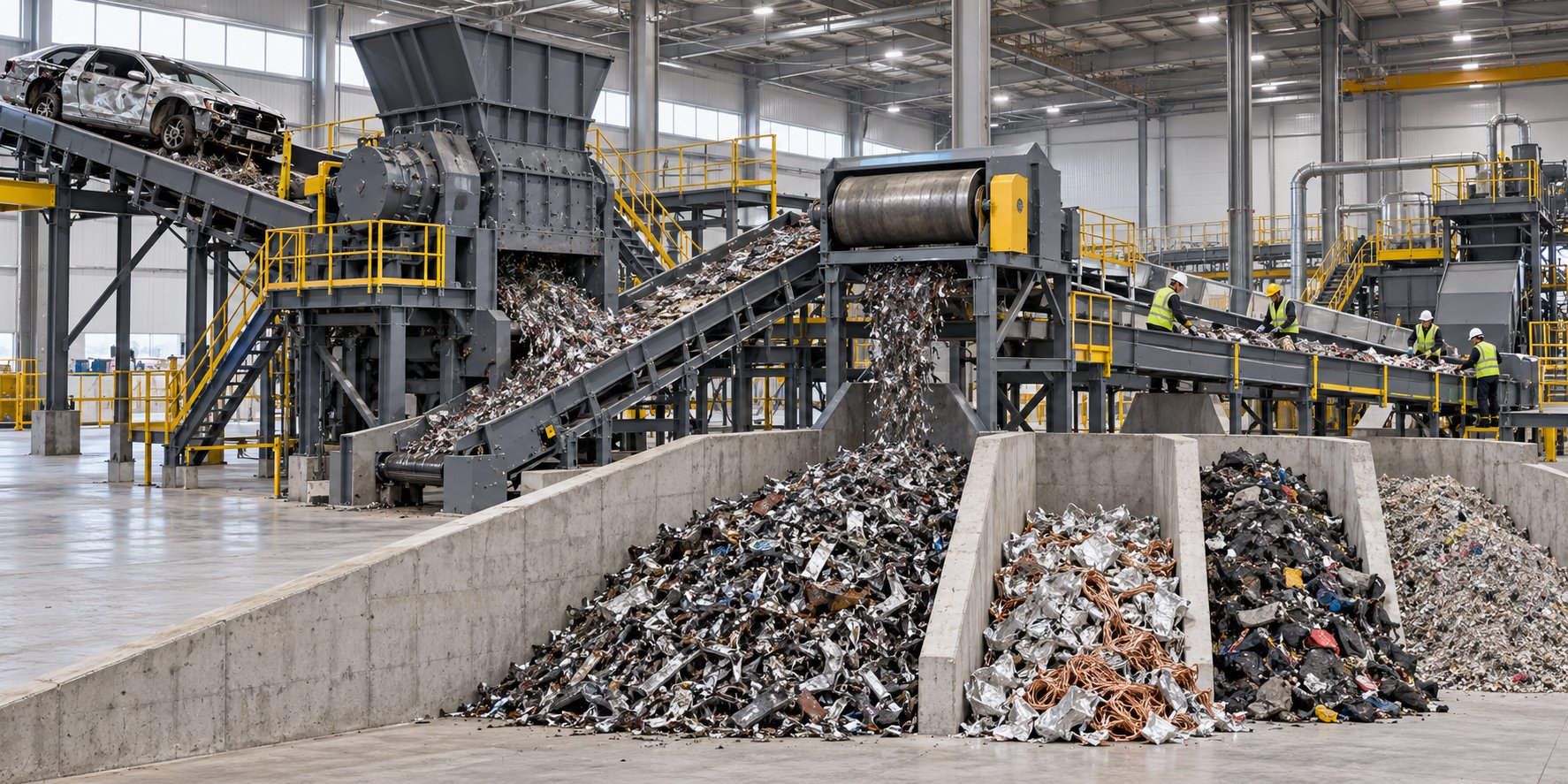
Once a vehicle is purchased, the yard's task is to convert a mixed-material hulk into clean, saleable fractions. The sequence typically involves depollution (removing fluids, battery and sometimes the catalytic converter), then size reduction and separation.
For operations that process end-of-life vehicles at volume, an integrated shredding and separation line is the core asset. Equipment such as the TG-ELVLine 300 End-of-Life Vehicle Shredding and Recycling Line from Tian Gong combines hammer mill shredding with magnetic separation, eddy current separation and air classification to recover ferrous, non-ferrous and residue fractions in a single pass. Tian Gong has been manufacturing this type of equipment since 2008, and the line carries CE marking.
The relevance to pricing is direct: the more complete and clean the separation, the higher the recovered value per ton of input, and the more a yard can afford to offer upstream. Recovery efficiency is not an abstract concept — it is the mechanism that connects the price a yard pays to the material streams it can sell.
FAQ
Why did my quote change between two calls?
The underlying ferrous benchmark moves daily. A yard typically ties its offer to the current benchmark, so a quote from last week may not be valid today.
Does removing the catalytic converter hurt my price?
Yes. The converter contains platinum-group metals with separate recovery value. If it is missing, the yard cannot recover that value, and the offer reflects the reduced content.
Do aluminum wheels matter?
They do. Aluminum is a non-ferrous fraction with its own price. Steel wheels do not add the same value, so a car with alloy wheels intact is worth more as scrap.
Is a heavier car always worth more?
Weight is the base, but not the only factor. A heavy car that is stripped, rusty or full of debris can be worth less than a lighter complete car. The valuation weighs mass against condition and content.
Why do two yards in the same area quote differently?
They may price off different benchmarks (domestic mill versus export), carry different transport costs, or have different inventory positions. Collection fees also vary.
Does the dismantler pay more than a general yard?
Often, yes — because the dismantler's economics depend on recovery efficiency after purchase. A dismantler equipped to separate ferrous, non-ferrous and residue fractions can extract more value per vehicle and may pass some of that back into the purchase price.
The bottom line
Scrap car price is a settlement built from weight, the daily ferrous benchmark, the completeness of the vehicle, its condition, and local yard economics including collection. It is not a published number but a calculated value that changes with time and place. Understanding how scrap cars are priced helps sellers ask better questions — about net settlement, about what has been removed, and about how the yard will recover value after purchase.
If you operate a yard or dismantling business and want to improve your own recovery economics, the equipment that does the separation is the place to start. The TG-ELVLine 300 End-of-Life Vehicle Shredding and Recycling Line is one option to evaluate against your throughput and material mix.