
Ferrous Market Basics
Anyone searching for the steel scrap price right now usually wants one number. What they actually need is to understand which number applies to them — and why it changes every week.
What is the steel scrap price right now?
There is no single national steel scrap price. Ferrous scrap is bought and sold per metric tonne, origin-dependent, and settled by grade, so the figure a yard posts for heavy melting scrap and the figure a mill pays for shredded auto scrap are two different prices on the same day. Any number you read online is a reference point for a specific grade in a specific region at a specific moment — not a quote for your load. Copper trades in dollars per pound because individual loads are small and dense in value; steel is priced per tonne precisely because loads are large, heavy, and graded. That single difference explains most of what puzzles first-time sellers.
Key takeaways
- Ferrous scrap is priced per metric tonne, not per pound.
- Two yards can quote different prices for the same grade on the same day — origin, freight, and local mill demand all matter.
- Grade, contamination, preparation, and volume determine where a load falls in the local range.
- The only reliable "right now" price comes from a specific yard against your specific material.
Why steel prices sit so far below copper
The gap between ferrous and non-ferrous scrap prices is not a market anomaly. It reflects raw material economics. Copper carries far more value per unit of weight because it is scarcer and more energy-intensive to produce; steel is produced at enormous scale from abundant raw material. A tonne of ferrous scrap simply does not carry the same value as a tonne of copper.
For buyers and processors, that has a practical consequence: on ferrous, your margin is won or lost on weight, grade, and logistics, not on a few cents per unit. A truckload of baled light steel that ships one tonne heavier than expected is worth more than a small improvement in the posted price. This is why serious scrap yards talk about densification, freight, and turnaround far more than they talk about the daily index.
What moves ferrous prices
Ferrous prices are driven by mill and foundry demand. When steelmakers are running hot and buying scrap, prices climb; when melt shop activity slows, they fall. Several forces feed into that:
Mill and export demand
Electric arc furnace mills are the largest consumers of ferrous scrap. Their order books, outage schedules, and production targets set the baseline. When export demand from import-heavy regions competes for the same material, that adds upward pressure. Neither is predictable on a daily basis, which is why prices move on weekly — sometimes monthly — cycles rather than by the hour.
Season and weather
Collection volume is seasonal. Cold weather, snow, and spring rains reduce how much scrap reaches yards, tightening supply and often firming prices. Construction season influences demolition scrap flowing in. These patterns repeat, but their timing varies by region, so a national average misses local reality.
Freight and logistics cost
Scrap is heavy and low-value per tonne. Freight is a large portion of the cost of moving it. When fuel and trucking rates rise, the net price at the yard falls even if the mill's posted buying price holds steady. Distance to the consuming mill is one reason the same grade has different values in different regions.
Grade and local specifications
Each mill sets its own specifications for what it will accept. A grade that suits one melt shop may be rejected or downgraded by another. The published price you find online frequently corresponds to a specific grade under specific specifications — something a general search cannot tell you.
What determines the price a yard pays you
When a yard quotes your load, four factors decide where it lands within the local range.
| Factor | What the yard is assessing | Effect on your price |
|---|---|---|
| Grade | Basic identity of the material — heavy melting, shredded, light steel, etc. | Higher-grade material commands a higher price per tonne. |
| Contamination | Non-ferrous attachments, dirt, rubber, oil, moisture, mixed metals | Dilutes value; may trigger rejection or downgrade. |
| Preparation | Cutting, baling, shredding, sorting, density | Well-prepared material loads more efficiently and gets a better offer. |
| Volume | Consistency and frequency of supply | Repeat volume supports a stronger price than one-off lots. |
Contamination is the most common reason a seller walks away disappointed. A load of steel with copper wire still attached, plastic trim, or concrete rubble is not a steel load — it is a mixed load, and it will be priced accordingly, or refused. Non-ferrous metals mixed into ferrous scrap are the classic case: they don't belong in the melt and cost the mill real money to deal with.
Preparation matters because mills and yards buy what they can feed directly into their process. Unprepared material — long, tangled reinforced bar, loose light steel — requires handling before it can be charged. That handling is a cost, and it comes out of your price. Material that arrives dense, clean, and consistently sized is worth more because it costs the buyer less to use.
How processing raises ferrous value
The logic behind on-site processing is simple: convert a mixed, low-density pile into a graded, dense product the mill can use directly, and the same metal is worth more per tonne.
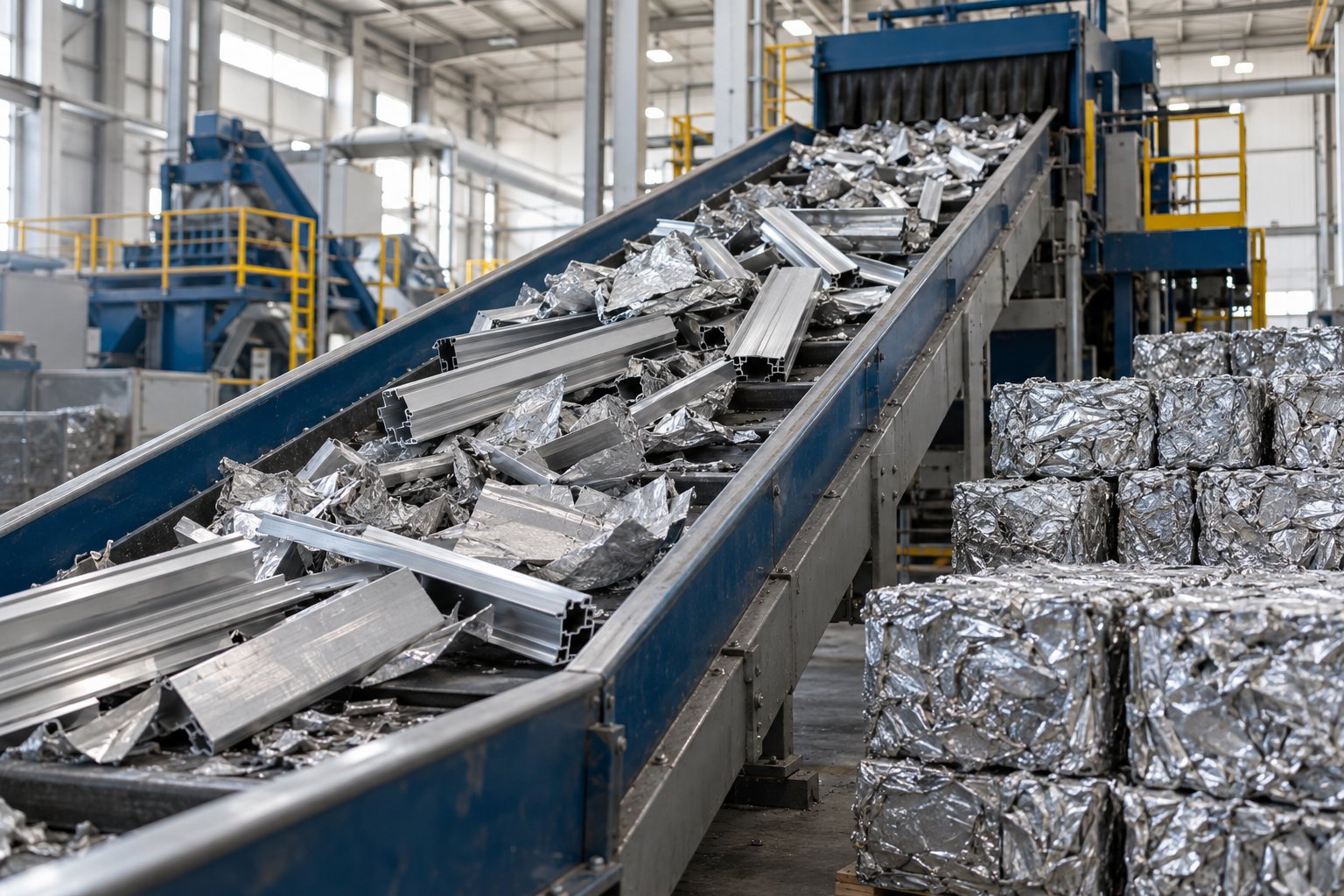
A turnkey line such as the TG-ScrapLine 150 Integrated Scrap Processing System illustrates how this works. Its twin-shaft primary shredder handles automobile scrap, light steel, and mixed ferrous without pre-sorting — reducing the labor that sorting before shredding would require. An overband magnetic separator then pulls clean ferrous away from non-magnetic residue, which directly addresses the contamination penalty. A hydraulic briquetting press raises bulk density above 4.0 t/m3, so more metal fits into the same container or truck. The line is rated at 15 t/h, with a 250 kW main shredder drive and PLC control across the process. The system is CE certified and manufactured under ISO 9001.
None of those specifications tells you the price of scrap. What they do is change where your output falls within the range. Cleaner ferrous means fewer downgrades. Higher density means lower freight cost per tonne shipped. Consistent grading means a buyer can place your material against a known specification instead of treating it as an unknown lot.
How to find your price today
A daily price index is a starting reference, not an answer. To get the price that actually applies to you:
- Confirm the grade your material falls into and check the mill's current specification for that grade.
- Estimate contamination and moisture, since both reduce payable weight.
- Ask at least two local yards for a price per tonne, not per pound, and ask what deduction applies to your specific material.
- Factor freight distance — a slightly lower yard price closer to the mill can net more than a higher price that requires long haulage.
- If you generate large volumes, consider processing first. Shredding, baling, or briquetting is a capital decision, but it moves your material up within its grade rather than simply accepting the posted range.
FAQ
Is there one steel scrap price for the whole country?
No. Prices vary by region, by grade, and by mill specification. Published figures represent a reference point for a defined grade and location, not a universal price.
Why is steel scrap priced per tonne and copper per pound?
Copper carries far higher value per unit of weight and moves in smaller, denser lots, so pound pricing is convenient. Ferrous scrap moves in large tonne-scale loads at lower value per unit, so tonne pricing is standard.
Does shredding or baling raise the price per tonne?
It can, because preparation reduces handling and contamination and increases bulk density, both of which lower the buyer's cost. The exact effect depends on your material, local specifications, and the buyer.
How often do ferrous prices change?
They move on weekly or monthly cycles driven by mill demand, export activity, season, and freight. Daily movement is unusual in ferrous compared with non-ferrous.
What is the biggest reason a yard rejects a load?
Contamination. Mixed non-ferrous attachments, oil, rubber, and moisture are the most common causes of downgrade or rejection.
If you're evaluating processing equipment to improve the grade and density of the ferrous you sell, review the TG-ScrapLine 150 Integrated Scrap Processing System or contact us with your material type and target throughput so we can confirm what the line supports for your operation.