
What Is Yellow Brass Scrap Price?
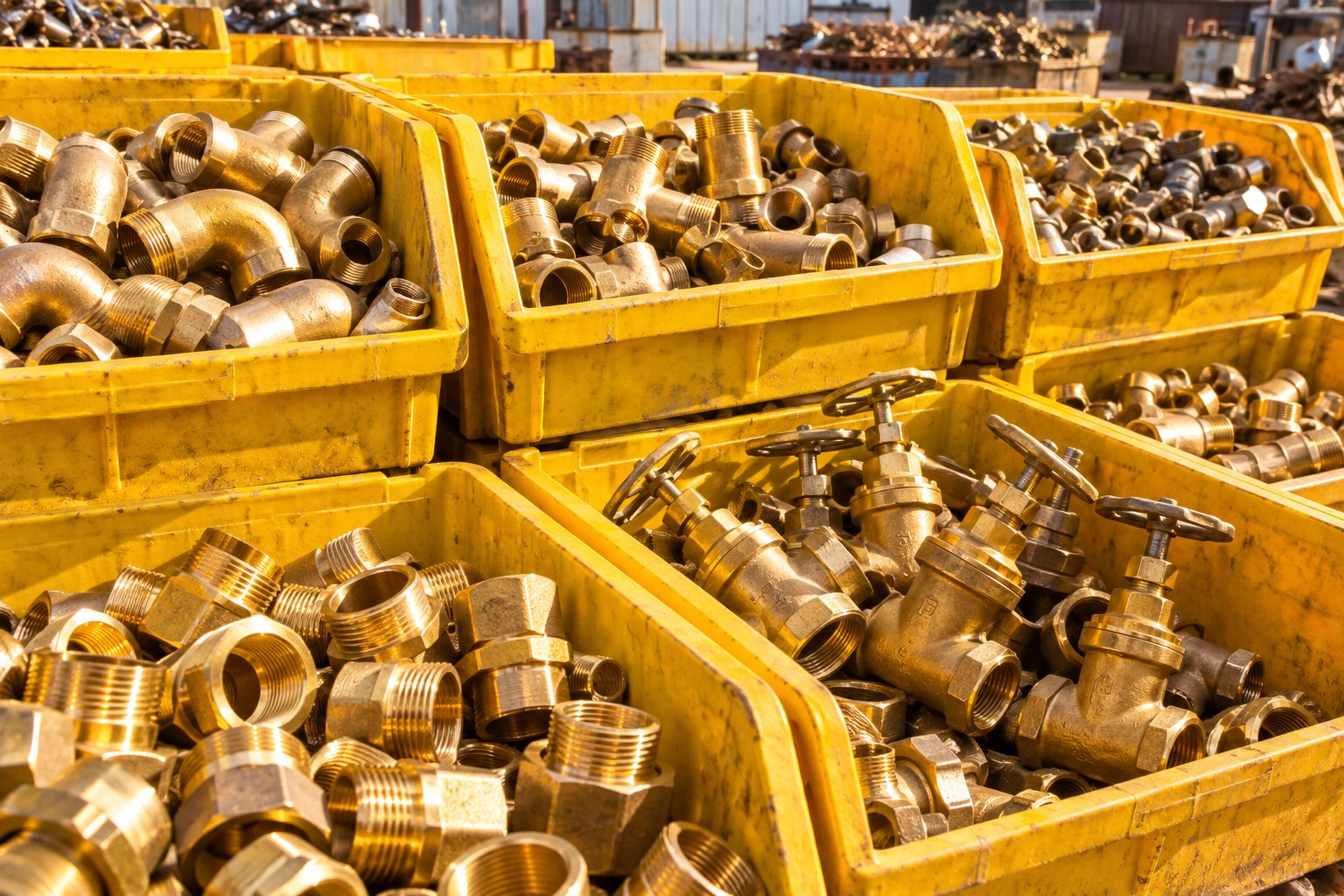
The yellow brass scrap price is what a scrap yard or processor pays per unit of weight for yellow brass — a copper-zinc alloy that appears in most household and commercial plumbing hardware. The price is set by the recovery value of the copper inside it, minus the cost of removing anything attached to it. It is quoted as a grade-specific rate, which means a bucket of clean yellow brass faucet bodies and a bucket of fittings with steel nuts, solder, and rubber seals do not earn the same money even though both are "brass."
If you are sorting a demolition or plumbing haul right now, the useful question is not a single number — it is which of your material actually qualifies as clean yellow brass, and what will be deducted from the rest.
Key takeaways
- Yellow brass is the copper-zinc alloy used in most plumbing hardware: faucets, valves, supply fittings, and brass cartridge cases.
- Clean yellow brass is a standard, widely traded yard grade. It is not a niche or specialty category.
- Value is driven by copper content, alloy identity, and how much foreign material must be removed before the metal can be remelted.
- Steel and iron attachments, solder, plating, rubber, and plastics all lower the payout.
- A magnet and a fast sort by hand are the two tools that most often separate a clean load from a downgraded one.
Where Yellow Brass Sits on the Brass Grade Ladder
Scrap brass is graded mainly by alloy composition, because that determines what a foundry or mill can make from the melt. Yellow brass occupies the middle-to-upper rung for common material: it is not the richest brass you can sell, but it is far from the bottom.
Red brass: higher copper, a different grade
Red brass contains a higher proportion of copper and correspondingly less zinc than yellow brass. That copper-heavy chemistry gives it a different color — warmer, redder — and it is treated as a separate, typically higher-value grade. Red brass turns up in older plumbing, valve bodies, and some cast fittings. If you mix red brass into a yellow brass load, you are usually giving away money, because the two are priced differently even though they sit in the same pile on many job sites.
Yellow brass: the common household and commercial grade
This is the brass most people actually handle. Faucet bodies, shower valves, ball valves, compression fittings, hose bibs, and spent cartridge cases are yellow brass. Its zinc content makes it easier to machine and cast and cheaper than red brass, which is why it became the default material for mass-produced plumbing hardware.
Dirty brass: the bottom of the ladder
"Dirty brass" is not a metallurgical grade so much as a condition description. It covers brass that is heavily contaminated with attachments, mixed with other metals, or coated in a way that makes separation uneconomical. It is bought, but it is bought at a discount to reflect the work required to clean it up.
| Grade | Typical material | How it is generally valued |
|---|---|---|
| Red brass | High-copper castings, older valve and plumbing bodies | Separate, copper-rich grade |
| Yellow brass (clean) | Faucets, valves, fittings, cartridge cases, plumbing hardware | Standard traded grade; priced on copper recovery |
| Yellow brass (contaminated) | Same parts with steel nuts, solder, rubber, or plastic still attached | Downgraded to reflect removal cost |
| Dirty / mixed brass | Mixed alloys, heavily attached or unsorted scrap | Lowest tier; sold on condition, not on alloy alone |
Grades and naming conventions vary between yards and regions. Confirm how your local buyer names and separates them before you deliver.
What Actually Drives the Price
Three factors decide what a yard will pay, and none of them is negotiable at the scale of a single delivery.
- Copper content. Copper is the value carrier in brass. The more copper the alloy holds, the more the melt is worth.
- Alloy identity. Yellow brass must be yellow brass. Mixed or unknown alloys cannot be sold against a single grade specification.
- Cleanliness. Every gram of steel, solder, rubber, or plastic that has to be pulled off before melting is a cost the buyer passes back to you.
Deductions are the practical expression of that third factor. They are not a penalty or a negotiating tactic — they are the estimated cost of getting your material to a saleable state.
Contamination That Lowers Your Payout
Yellow brass hardware is rarely delivered in its pure alloy form. It comes with a supporting cast of other materials, and each one subtracts from the grade.
Steel and iron attachments
Steel handles, stems, screws, backing nuts, and mounting brackets are the most common contamination on plumbing brass. They are also the easiest to detect: a magnet will find them immediately. Brass itself is not magnetic, so anything that sticks to a magnet inside a brass load is a deduction.
Solder, brazing, and joints
Sweated fittings carry solder at the joints, and older solder may contain lead. Solder is a different alloy from the brass body, and a buyer cannot treat a soldered assembly as clean yellow brass. Cutting joints apart and keeping the brass separate is one way to protect the grade.
Plating and coatings
Chrome-plated and nickel-plated fixtures present a surface that is not brass at all. The plating is thin, but it is a different metal and it has to be accounted for. Painted or powder-coated parts fall into the same category.
Rubber, plastic, and organics
Seals, O-rings, gaskets, plastic handles, and valve seats are non-metallic and burn off or have to be removed. They add weight you are not paid for and processing time the buyer has to absorb.
Sorting practice that protects grade
- Run a magnet across every load before it leaves your site.
- Keep red brass separate from yellow brass — the color difference is a reliable first check.
- Cut soldered joints rather than delivering assemblies whole.
- Remove plastic and rubber parts during teardown, not at the yard.
- Keep brass turnings and chips apart from solid brass; they are a different material form.
Why Turnings and Chips Are a Separate Conversation
Machining brass produces turnings and chips rather than solid parts. They are the same alloy, but they behave differently in handling and transport: they are light, they trap air, they take up far more volume per unit of weight, and they are harder to load cleanly. That makes them a distinct stream from solid yellow brass, and buyers treat them accordingly.
For processors and machine shops generating brass turnings, densifying the material before shipment is one practical way to reduce the volume you are paying to move. The TG-BriqPress 250 metal briquetting system is built for exactly this step, compacting brass turnings so that transport cost per unit of metal drops substantially — the manufacturer describes a 5–10x reduction in transport cost for the densified material compared with loose turnings.
For mixed loads that contain brass fittings alongside other light non-ferrous and non-magnetic metal, the TG-LightMetal 80 light-duty metal shredder uses two 15 kW motors to size-reduce fittings and light metal before sorting or shipping. Both machines are built by Tian Gong, a manufacturer founded in 2008 and operating under CE marking and ISO 9001.
What to Confirm With Your Buyer
Because grading terminology, deduction rules, and moisture or attachment policies differ between yards and regions, the most efficient preparation is a short conversation before your first delivery. These are the questions that change the outcome:
- Does the yard recognize "clean yellow brass" as a distinct grade, and what does it include?
- How are attached steel and non-metallic parts treated — deducted by weight, or rejected outright?
- Are plated fixtures accepted in the same grade or treated as a lower one?
- Is there a separate category for turnings and chips, and how is it priced relative to solid brass?
- Is red brass accepted on the same ticket, or does it need to be delivered separately?
Bring a magnet and a sample of each stream you plan to deliver. A buyer who can see your sorted material can tell you in minutes which grade each pile falls into, and that answer is worth more than any general figure you will find online.
Processing Brass Scrap Before It Ships
If your operation generates brass turnings, mixed light metal, or unsorted fittings, tell us the material mix and the volume you handle per month. We can point you to the machine configuration that fits the stream.
Request machine details