
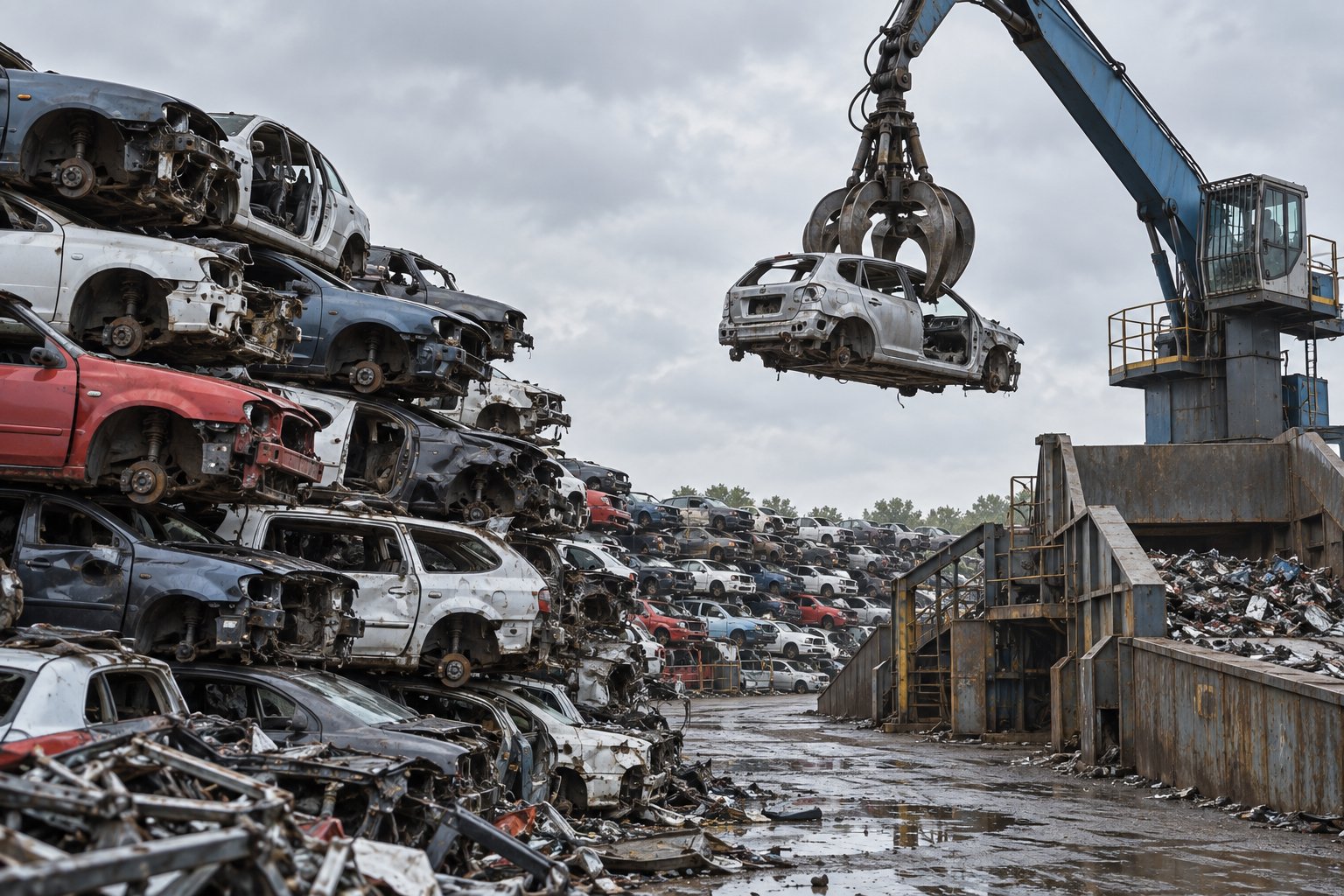
Scrap Car Sourcing
Recyclers who buy junk cars rarely rely on a single channel. Auction volume is steady but competitive; private sellers are cheap per unit but slow to accumulate; tow and repair partners deliver units already off the road. The workable setup is usually two or three channels feeding the same yard, chosen for the paperwork you can verify and the collection cost you can absorb. This guide walks through the seven sources that show up most often in practice, what to check in each, and where the real margin sits after the car is on your lot.
Key takeaways
- Salvage and insurance write-off auctions give predictable volume but the highest bidding competition.
- Licensed dismantlers and salvage yards are the fastest legal route — and the easiest paperwork to audit.
- Private sellers, tow operators, and repair shops trade volume for negotiation and relationship work.
- Fleets, dealers, and municipal programs are contract-based and reward patience with consistent supply.
- Collection logistics and depollution capacity decide whether a cheap car is actually cheap.
Salvage and Insurance Write-Off Auctions
Insurance total-loss auctions and salvage auctions are the standard starting point for yards that need volume. Vehicles arrive with a documented reason for the write-off — collision, flood, fire, theft recovery — and the auction house handles the seller side, so you bid against other dismantlers and rebuilders rather than negotiating one car at a time.
What to check before you register and bid:
- Title type. Salvage, rebuilt, and clean titles carry different resale and dismantling restrictions. Read the announced title status on each lot, not the photo.
- Damage disclosure. Flood and fire cars are usually cheaper to buy but need more depollution care before processing.
- Fee stack. Hammer price, buyer premium, gate fee, and storage after pickup all affect your landed cost per ton.
- Pickup window. Auction yards charge daily storage once the collection window closes, which can erase a good bid.
Pricing here is competitive and transparent: the winning bid is the market. If you buy regularly, budget for auction fees as part of the vehicle cost, not as overhead.
Licensed Dismantlers and Salvage Yards
Buying from another licensed dismantler or salvage yard is the most straightforward legal transaction in this list. Both parties already operate under the same environmental and vehicle-handling rules, so the paperwork is familiar and the vehicle is usually already depolluted or at least drained.
- Verify the licence. Confirm the seller's dismantling or salvage licence is current before agreeing to a bulk lot.
- Ask what has been removed. Catalytic converters, batteries, and fluids may already be stripped; that changes both the price and the remaining recoverable value.
- Confirm ownership transfer documents. You need a clear chain showing the seller had the right to sell, especially for lots assembled from multiple sources.
- Negotiate on weight and grade. Bulk lots from a yard are often priced per unit or per ton, so agree on how the weight is determined.
Collection is usually straightforward: these sellers have loading equipment and can often deliver if the distance is short.
Private Sellers and Classified Listings
Private listings — online marketplaces, local classifieds, noticeboards — are where per-unit prices are lowest and negotiation is real. The trade-off is time. You are buying one car at a time from someone who may not know what paperwork they hold.
- Title in the seller's name. A car registered to a relative, a deceased owner, or a business needs extra documents before you can legally take it.
- Liens and outstanding finance. An unpaid loan can follow the vehicle. Check before money changes hands.
- Keys and access. A car with no keys is not impossible to move, but it changes how you load and transport it.
- Price expectation. Private sellers anchor on scrap value plus sentiment. Bring a clear per-unit offer and walk away when the paperwork is unclear.
This channel works best when you can collect the same day with a flatbed or tow truck, so keep transport available before you commit to a purchase.
Towing Companies and Repair Shops
Tow operators and independent repair shops sit on a steady trickle of vehicles their owners have abandoned or declined to repair. These are often the easiest cars to buy because the shop wants the space back.
- Abandoned-vehicle rules. A car left on private property is not automatically the shop's to sell. Ask what notice or lien process the shop has completed.
- Repair-declined vehicles. These usually have a current owner who still holds the title, so the shop can broker the sale but may not be the legal seller.
- Volume arrangement. A standing agreement — you collect on a fixed schedule at an agreed per-unit price — beats chasing individual cars.
- Access and condition. Many of these cars are non-running and may be blocked in a yard, so confirm how you will load them.
Pricing is negotiated, not auctioned. The relationship matters more than any single transaction; a shop that calls you first is worth paying slightly more per unit.
Fleet and Rental Companies
Fleet operators and rental companies retire vehicles on a schedule, usually through an internal disposal process, a contracted remarketer, or a closed auction. The big advantage is consistency: the same makes and models arrive in batches, with service records and known histories.
- Contract terms. Fleet disposals are often awarded on a fixed-term contract, so expect a tender or on-boarding process rather than a one-off purchase.
- Condition reports. Ask for the disposal condition report and confirm whether fluids and batteries are still in place.
- Title and registration. Fleet vehicles are usually clean-titled and registered to the company, which simplifies transfer.
- Collection schedule. Batch collection from one depot is far cheaper than picking up scattered units.
Because fleet lots are predictable, they suit yards that want to plan depollution and processing runs instead of reacting to whatever arrives.
Dealer Trade-In and End-of-Life Units
Franchise and independent dealers take in trade-ins that are too old, too damaged, or too expensive to recondition. Those end-of-life units usually go to whichever dismantler has a working relationship with the dealership.
- Who holds the title. On a trade-in, the dealer normally holds a signed title transfer; confirm it is complete and matches the vehicle.
- Consistency. A dealer relationship delivers a few cars a month rather than a truckload, but the volume is steady and the paperwork is clean.
- Pricing basis. Dealers typically want a fixed per-unit quote or a monthly settlement, not a daily negotiation.
- Pickup timing. Dealer lots are tight on space, so same-week collection is often part of the deal.
Municipal and Abandoned-Vehicle Programs
Local authorities remove abandoned and illegally parked vehicles, and many run periodic disposal rounds or contracted auctions. These programs are less frequent but can deliver volume in one go.
- Eligibility. Some programs only sell to licensed dismantlers or registered recyclers; confirm you qualify before bidding.
- Documentation. Municipal sales come with their own transfer paperwork and sometimes a wait before the title is released.
- Condition. Abandoned vehicles sit outside, so expect weather damage, missing parts, and flat or missing wheels.
- Collection logistics. Multiple pickup points across a district can make transport the biggest cost. Confirm whether the municipality consolidates the vehicles.
Comparing the Channels
The right mix depends on whether you need steady volume, low unit cost, or clean paperwork. The table below summarizes the trade-offs.
| Channel | Paperwork risk | Price dynamic | Collection |
|---|---|---|---|
| Salvage / insurance auctions | Low — title status disclosed | Competitive bidding | Strict pickup window |
| Licensed dismantlers / yards | Low — same regulator | Negotiated per lot | Seller has loading gear |
| Private sellers | Medium to high | Negotiated, flexible | One car at a time |
| Tow operators / repair shops | Medium — depends on lien status | Negotiated, relationship-based | Often non-running |
| Fleet / rental | Low — company-titled | Contract or tender | Batch pickup |
| Dealer trade-ins | Low — transfer on file | Fixed quote | Same-week pickup |
| Municipal programs | Medium — release delays | Fixed or auctioned | Multiple points |
What to Check Before You Pay
Whichever channel you use, the same checkpoints decide whether the purchase is clean:
- Ownership and title. The seller must be the registered owner or hold a documented right to sell. Match the vehicle identification number to the paperwork.
- Legal purchase conditions. Some jurisdictions require the buyer to be a licensed dismantler to take ownership of a salvage-titled vehicle. Confirm your licence covers the purchase before bidding.
- Price basis. Agree in writing whether the price is per unit, per ton, or per lot, and who pays auction fees, storage, and transport.
- Collection plan. Know before you buy whether the vehicle rolls, steers, and brakes, whether keys are present, and what equipment is needed to load it.
- Fluids and hazards. Flood, fire, and long-abandoned cars need extra care during depollution; factor that into the price you are willing to pay.
Why Processing Capacity Sets Your Real Buying Price
Sourcing is only half the business. The price you can afford to pay per car depends on how much recoverable material you get out of it and how fast you can move hulks through depollution and shredding. A yard that has to stockpile hulks for weeks carries the cost; a yard that can process continuously turns each purchase into cash sooner.
That is where processing equipment matters. The TG-ELVLine 300 End-of-Life Vehicle Shredding and Recycling Line from Tian Gong is built as an integrated line: a hammer mill shredder, magnetic separator, eddy current separator, and air classification work in a single continuous pass to turn depolluted vehicle hulks into sorted ferrous, non-ferrous, and residue fractions. Tian Gong has manufactured this equipment since 2008, and the line carries the CE mark.
For a recycler, the practical link runs in both directions. A line with reliable throughput supports a higher offer price at auction, because you are not paying storage on cars waiting for processing. It also lets you accept lower-grade purchases — flood cars, stripped hulks, abandoned vehicles — that competitors avoid because their downstream separation cannot handle the mixed feed. Before committing to a volume channel, it is worth confirming your depollution and shredding capacity can absorb the worst cars that channel will send you.
Frequently Asked Questions
Do I need a licence to buy junk cars?
In many jurisdictions, buying salvage-titled or end-of-life vehicles for dismantling requires a recycler or dismantler licence, and some auction houses and municipal programs will only sell to licensed buyers. Check the rules that apply where you operate before registering to bid.
Which channel gives the lowest price per car?
Private sellers and tow operators usually have the lowest per-unit prices because there is no auction premium and the seller wants the space back. The cost is time: you buy one car at a time, and paperwork can be incomplete.
How do I verify a vehicle before buying it?
Match the vehicle identification number to the title and registration, confirm the seller is the registered owner or holds a documented right to sell, and check for outstanding finance or liens. For auction lots, read the announced title status rather than relying on the listing photo.
What makes a junk car expensive to collect?
Non-running condition, missing wheels or keys, blocked access at the seller's site, and scattered pickup points all raise transport cost. Confirm loading requirements and pickup location before agreeing on a price.
Should I depollute before shredding?
Yes. Fluids, batteries, and other hazardous components need to be removed before a vehicle hulk enters a shredding line. Depollution protects the downstream separation equipment and keeps the recovered ferrous and non-ferrous fractions cleaner.
Next Step
Choose your sourcing channels first, then size the processing line to match the volume and quality those channels will deliver. If you want to compare the TG-ELVLine 300 against your expected intake, share your typical daily hulk volume and the vehicle types you buy most often, and the Tian Gong team can advise on the configuration that fits.
Sourcing rules, title requirements, and licensing conditions vary by country and region. Confirm the specific requirements that apply to your operation before purchasing end-of-life vehicles.