
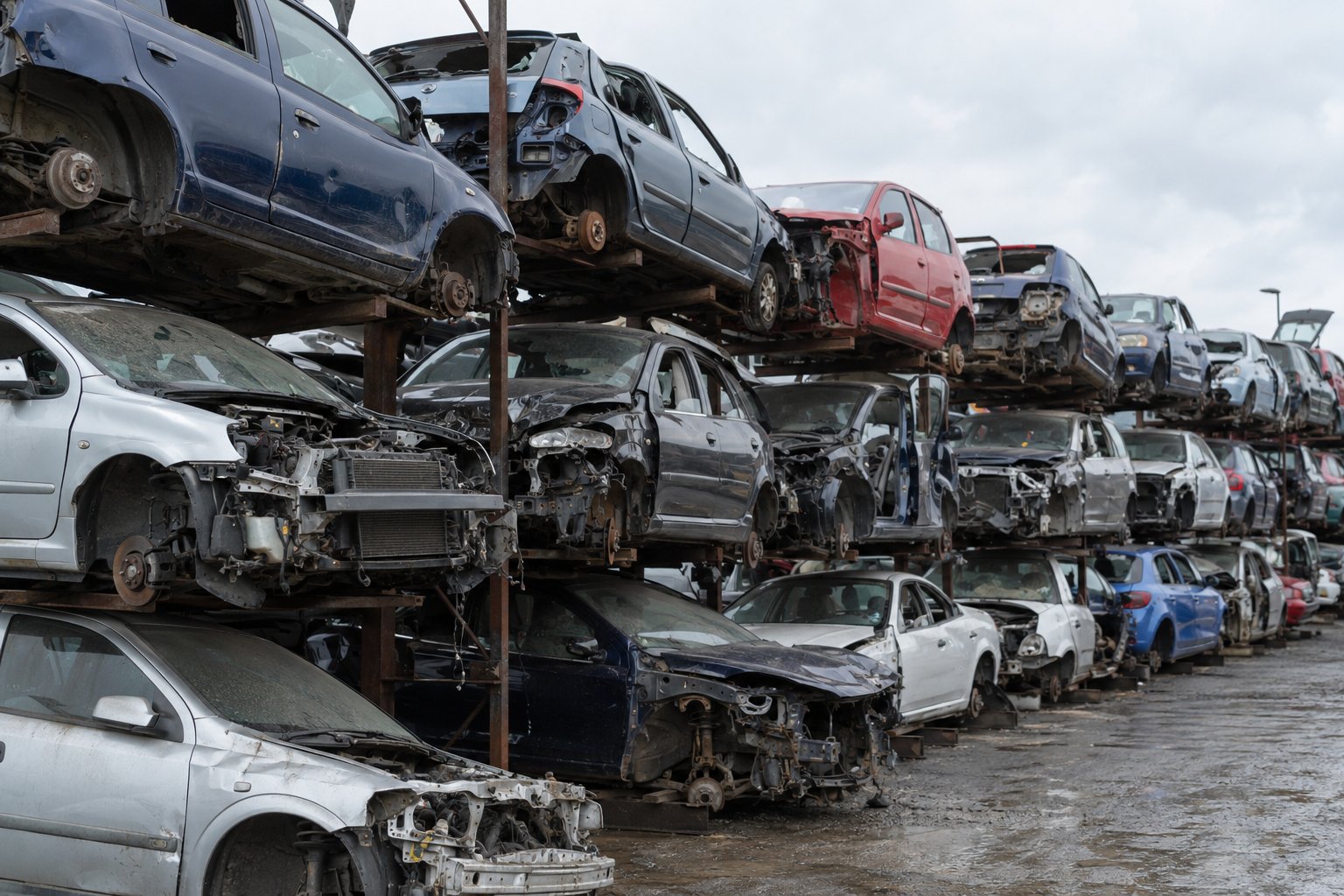
Scrap cars do not arrive from a single supplier. An end-of-life vehicle (ELV) reaches a yard through one of a handful of channels, and each channel behaves differently on volume, paperwork, condition and cost-per-unit. Knowing which channel you are buying from tells you more about the load than any photo attached to the listing. What follows is a practical sourcing map for scrap yards, dismantlers and metal recyclers buying whole cars for processing.
Key takeaways
- Five channels supply most ELV volume: insurance write-off auctions, towing and impound lots, auto dismantlers, fleet retirements, and direct owner drop-offs.
- Each channel differs in title status, paperwork quality, and how much pre-processing the car has already had.
- Contamination, fluid handling and missing documentation are the most common costly surprises.
- Throughput planning matters: the shredding or recycling line you feed determines what condition of car is actually profitable for you.
Why the Source Channel Changes Everything
Two cars of the same make and model can arrive with completely different economics depending on where they came from. A vehicle pulled from an insurance auction often arrives with a salvage or branded title and may already be partially stripped. A car turned in by its owner at the yard gate typically comes whole, wet, and full of personal contents. A retired fleet unit almost always arrives at a predictable interval with service records, which is a very different buying proposition.
When buyers search for where to buy scrap cars, the honest answer is that there is no single market. There are several, and the right one depends on your processing capacity, your paperwork tolerance, and whether you want whole vehicles or pre-stripped hulks. Match the channel to your equipment before you match it to price.
The Main Sourcing Channels
Insurance Write-Off Auctions
Insurers dispose of vehicles declared a total loss through salvage auctions. This is often the largest single source of late-model ELVs. Vehicles are categorized by damage type and title status, and the categories matter enormously to a recycler.
- Catastrophic or non-repairable categories are the cleanest fit for shredding — the car will never return to the road, so there is no risk of a repaired vehicle re-entering the stream.
- Repairable categories can still be bought for scrap, but expect competition from rebuilders who may outbid you.
- Title status (salvage, rebuilt, branded, clean) follows the car forever. Verify the title document before bidding, not after.
Most auctions publish lot photos and damage descriptions, but photos show the body, not the underside, the engine bay, or the fluids. Budget a physical or third-party inspection for any volume purchase.
Towing and Impound Lots
Municipal and private towing operators accumulate vehicles that were abandoned, seized, or towed after accidents and never reclaimed. After the required notice period, these cars can be sold for scrap. Volume here is steady but unpredictable — you are buying from a lot that fills up based on events, not a production schedule.
Two things to check carefully in this channel: whether the legal hold period has genuinely expired, and whether the lot can provide a clean transfer document. A car with an unresolved lien or an open legal hold is not a car you can legally process, regardless of the price.
Auto Dismantlers and Salvage Yards
Established dismantlers buy cars, pull the parts that sell, and then need to move the remaining hulks. If you operate a shredding or recycling line, dismantlers can be a reliable secondary supplier — you are buying a car that has already had its most valuable components removed, which lowers your cost but also lowers your recoverable non-ferrous and parts value.
The trade-off is explicit: a dismantler hulk is cheaper and lighter, but you are paying for a shell. Know what has been pulled before you agree to a rate.
Fleet and Rental Fleet Retirements
Commercial fleets, rental companies and government motor pools retire vehicles on a schedule — often based on mileage, age or lease term, not on damage. These cars tend to arrive in bulk, at a known interval, with maintenance histories. For a recycler who values predictability, fleet retirement is often the most attractive channel.
Expect a procurement process rather than a spot purchase. Fleet managers usually want a standing arrangement, documented removal, and confirmation that the vehicle is legally disposed of. That documentation requirement is a filter: yards that can provide proper ELV paperwork win these contracts.
Direct Owner Drop-Offs
Individual owners bringing a car to the yard gate still supply a meaningful share of scrap volume, especially older vehicles with no resale value. This channel is the least predictable but the lowest-friction: the car is whole, the owner is present, and the title is usually available on the spot.
The trade-off is contamination. Owner drop-offs arrive with fuel, oil, coolant, batteries, tires, and personal belongings. Every one of those is a disposal cost or a safety issue that has to be handled before processing.
Comparing the Channels Side by Side
| Channel | Typical condition | Volume pattern | Main risk |
|---|---|---|---|
| Insurance write-off auction | Whole, damaged, sometimes partly stripped | High, regular | Title status and hidden damage |
| Towing / impound lot | Whole, neglected | Irregular | Legal hold and lien status |
| Auto dismantler | Pre-stripped hulk | Steady secondary supply | Lower recoverable value |
| Fleet / rental retirement | Complete, serviced | Bulk, scheduled | Procurement and documentation requirements |
| Direct owner drop-off | Whole, contaminated | Low, unpredictable | Fluids, tires, personal contents |
What to Check Before You Pay for a Car
Condition checks are cheap; processing surprises are not. Run the same checklist regardless of channel.
Legal and Documentation Status
- Title and ownership: confirm the seller has the right to transfer the vehicle. Match the name on the title to the seller's identification.
- Lien and hold status: check for outstanding finance or legal holds before money changes hands.
- Disposal record: for fleet and auction purchases, confirm what certificate of destruction or transfer document you will receive and who issues it.
Physical and Mechanical Condition
- Frame and structural damage: bent frames and crushed structures affect how the vehicle feeds into a shredder.
- Missing components: an engine or transmission already removed changes both the weight and the recoverable metal value.
- Tires and wheels: these often remain on the vehicle and become a separate disposal stream.
Fluids and Hazardous Materials
- Fuel: a full tank is weight you are buying but also a fire and spill risk during handling and shredding.
- Oil, coolant, brake fluid: must be drained and managed before the shell is processed.
- Battery and electronics: batteries are a separate handling stream and must not be fed into a shredder with the vehicle.
Contamination That Lowers Recoverable Value
Non-metallic contamination — plastic trim, glass, foam, fabric and undercoating — reduces the yield of clean ferrous and non-ferrous streams. When you buy by the unit rather than by the recovered ton, this contamination is a direct hit to your margin. Sample a few cars before committing to a bulk lot.
Matching the Sourcing Channel to Your Processing Line
The channel you choose should be driven by the equipment you run. A yard feeding a high-capacity shredding system can absorb whole vehicles and hulks at a fast rate; a smaller operation running a full ELV recycling line may prefer pre-drained, pre-stripped cars where the fluid and battery handling has already been done.
For larger-scale processing, a dedicated vehicle shredding system such as the Tian Gong TG-VehShred 800 is designed for whole-vehicle volume, with 800 kW of power, a 1800x1200 mm feed opening and a throughput of 15–25 t/h, and it carries the CE mark. For operators who want the full separation sequence in a single pass, a line like the Tian Gong TG-ELVLine 300 combines hammer shredding with magnetic separation, eddy current separation and air classification to produce ferrous metal, non-ferrous metal and residue streams.
The practical implication for sourcing: if your line separates non-ferrous in one pass, the non-ferrous content of the cars you buy matters more to your economics, and channels that deliver whole vehicles with intact wiring harnesses, radiators and aluminium components become more valuable than pre-stripped hulks.
Practical Steps to Build a Steady Supply
- Register with more than one auction house. Salvage auction access is the starting point for most volume buyers, but no single auction supplies enough consistently.
- Build relationships with local towing operators and police-impound contractors. These are relationship-driven channels, not open marketplaces.
- Approach fleet managers directly. Fleet retirement contracts are won through documentation reliability, not just price.
- Make direct drop-off easy. A clear intake process and same-day payment keeps individual owners coming back.
- Track cost per recovered ton, not cost per car. The channel that looks cheapest per unit is often more expensive once fluid disposal, tire handling and contamination are counted.
Frequently Asked Questions
Can I buy scrap cars directly from insurance companies?
Insurers typically dispose of total-loss vehicles through contracted salvage auctions rather than selling directly to recyclers. Registering with those auctions is the practical route to this supply.
Are dismantler hulks worth buying for a shredding line?
They can be, if the price reflects that the high-value components have already been removed. The economics depend on your recoverable non-ferrous yield and the feed rate of your line.
What is the biggest legal risk when buying scrap cars?
Unclear title or an unresolved lien. A vehicle you cannot legally process is a total loss regardless of purchase price. Verify ownership status before payment, every time.
How much does contamination affect recovered value?
It depends on your separation equipment. Lines that separate ferrous, non-ferrous and residue in one pass recover more value from the same car, so contamination costs you less than it would on a simpler setup. Confirm the expected recovery rates with your equipment supplier for your specific configuration.
The Bottom Line
Sourcing scrap cars is a channel-selection problem before it is a pricing problem. Insurance write-off auctions and fleet retirements supply volume and predictability; towing lots, dismantlers and direct owner drop-offs fill the gaps with different condition profiles. Whichever mix you build, the checks stay the same: legal status, structural condition, fluids, and contamination. Get those right, and you are buying cars your line can actually profit from — not cars that sit in the yard as a disposal liability.