Why the Wrong Single Shaft Shredder Specs Cost More Than the Machine
When you are buying a single shaft shredder for a scrap yard or recycling plant in Vietnam, Indonesia, Thailand, Malaysia or the Philippines, the purchase price is not the biggest risk. The biggest risk is a machine that is mismatched to your material: constant jams, oversized output that downstream equipment rejects, and wear parts you cannot source quickly. The rotor, the screen and the hydraulic feed system are not interchangeable features — they are one matched system, and they must be selected against your actual feed material.
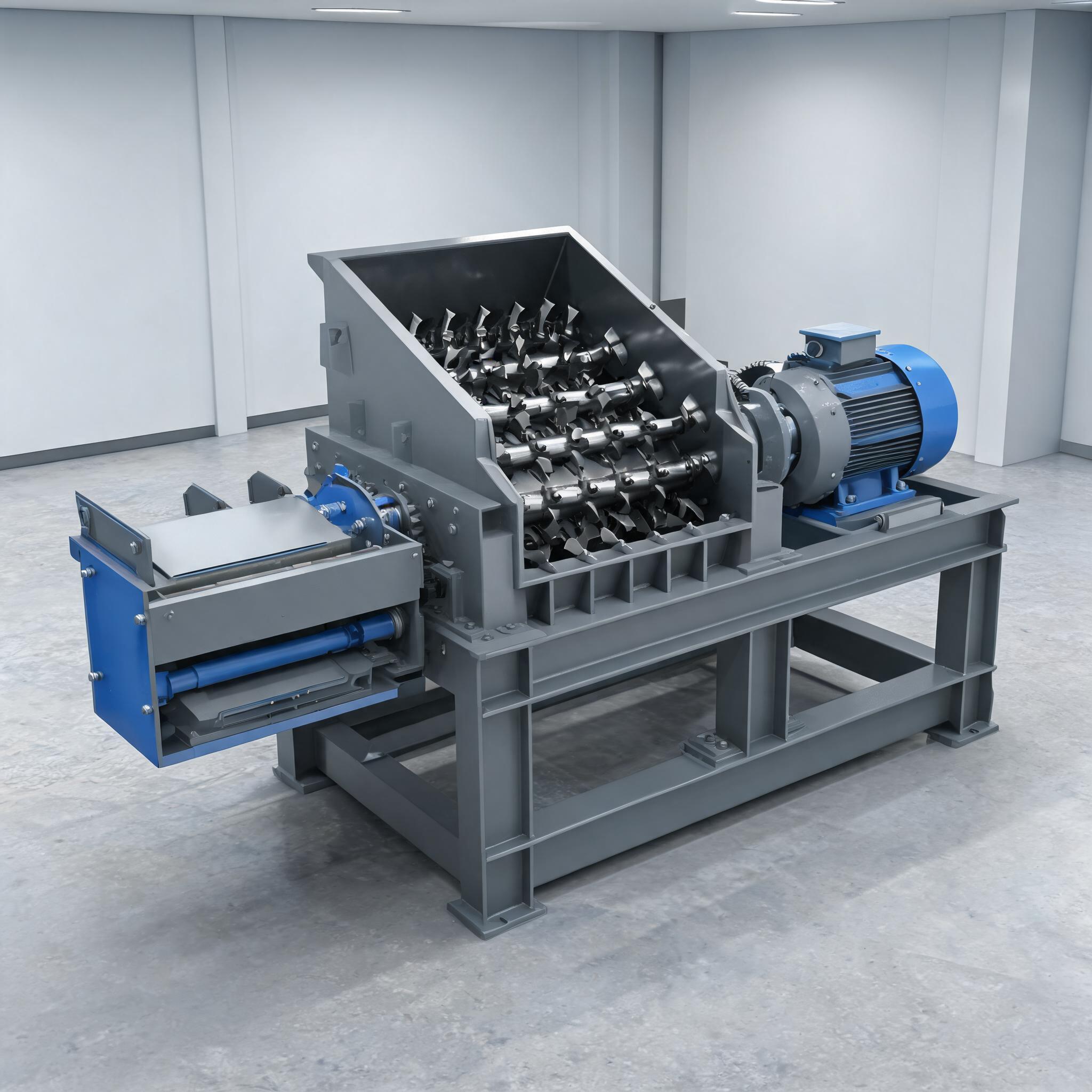
This guide walks through the three decisions that matter most: rotor design, screen size, and realistic capacity. All examples reference the TG-SingleShaft 200 single-shaft metal shredder, a 55 kW screened single-shaft machine built for non-ferrous and light-gauge metal streams.
Step 1: Define Your Material Before You Look at Any Machine
A single shaft shredder is not a universal grinder. Before comparing models, characterize your feed:
- Dominant material: aluminum profiles and extrusion offcuts, copper wire and cable bundles, brass turnings, thin sheet offcuts, or stamped skeletal waste.
- Maximum stock thickness and shape: solid blocks and thick-walled sections behave very differently from sheet and wire.
- Contamination: does the stream contain tramp ferrous (nails, bolts, steel fragments)?
- Target output size: what particle size does your downstream process — granulator, briquetting press or furnace charge — actually require?
- Required throughput: tonnes per hour, continuous or batch.
These answers determine rotor knife profile, screen perforation and ram settings. Skipping this step is the most common cause of buyer regret.
Step 2: Match the Rotor Design to Your Material
In a screened single-shaft shredder, a horizontal rotor carrying cutting knives rotates against a fixed bed knife, while a hydraulic ram pushes material into the cutting zone. Three rotor-related factors matter:
Knife profile and mounting
Hardened tool-steel knives in D-type or V-type profiles suit different materials: V-type profiles grip and pull long, stringy material such as wire; D-type profiles suit chunkier light metal. Bolt-on knives are essential for Southeast Asian operations — they let your team replace individual knife tips in the field without removing the rotor assembly, keeping downtime measured in hours rather than days.
Rotor speed and torque
Single-shaft metal shredders typically run at low speed with high torque — the TG-SingleShaft 200 operates at 80–120 RPM. Low speed shears rather than smashes: it produces less dust, reduces work-hardening of aluminum, and prevents copper smearing. If your material is tough and ductile, low speed with a controlled ram advance is the right combination.
Protection against wrapping and jams
Wire and cable bundles can wrap around a rotating shaft. Look for a PLC-controlled hydraulic ram with automatic reverse: when the motor load spikes, the machine reverses to release the tangle or jam before resuming forward feed. On the TG-SingleShaft 200 this auto-reverse cycle is standard, which matters enormously where operators cannot babysit the feed hopper all day.
Step 3: Screen Size — the Gatekeeper of Output Particle Size
The screen sits beneath the rotor and holds material in the cutting chamber until it is small enough to pass through the perforation. This is what gives a single-shaft shredder its key advantage over a twin-shaft machine: a narrow, controlled output fraction.
Choose perforation from your downstream requirement
Screens are available in discrete sizes — on the TG-SingleShaft 200, interchangeable perforated plates come in 10, 15, 20, 30 and 40 mm. Select the perforation based on what your next process stage needs, not on a generic "shredded" label. Changing the screen changes the output fraction without replacing any cutting tools.
Understand screen wear as an operating cost
The screen is a wear part, especially with abrasive feed. Bolted perforated plates are replaceable; factor spare screens into your operating budget and keep at least one spare on site. Ask the supplier for the standard wear-parts lead time — under 45 days is a reasonable benchmark for a China-based manufacturer shipping to Southeast Asia.
Step 4: Capacity — the Real Number, Not the Brochure Number
Manufacturers quote throughput for ideal material. Your real throughput depends on material density, moisture, contamination, target output size and machine availability. A credible supplier will not publish a single fixed capacity figure for a screened shredder — throughput genuinely varies by material and screen size, and should be confirmed against your feed at inquiry stage.
A practical sizing method:
- Calculate your required annual tonnage and divide by actual operating hours (not theoretical maximums).
- Add 20–30% margin for screen changes, knife maintenance and blockage clearing.
- Ask the manufacturer to confirm rated capacity against your material, maximum stock thickness and chosen screen size.
Also check the drive: a 55 kW class machine with soft-start as standard (VFD available for variable rotor speed) is appropriate for non-ferrous and light-gauge streams. If your plant power supply is 60 Hz — as in the Philippines, Thailand and Indonesia — confirm the machine is configurable for 50/60 Hz before ordering.
Know the Application Boundary
A screened single-shaft shredder is rated for non-ferrous and light-gauge material only. Dense ferrous stock — engine blocks, thick-walled structural sections — exceeds the rotor torque rating and will stall the machine or damage the knives. If your stream is mixed ferrous and non-ferrous, the correct architecture is a twin-shaft metal shredder such as the TG-2200 as the primary stage, with the single-shaft machine positioned downstream for final particle sizing. If ferrous contamination is possible in a non-ferrous stream, fit a magnetic separator upstream.
Quick Answers for Buyers
Single shaft vs. twin shaft — which do I need? Twin-shaft machines grip and tear mixed, irregular scrap without a screen, giving higher throughput but wider size variation. Single-shaft machines with a screen give a narrow, controlled particle size — the better choice when feeding granulators, briquetting presses or furnaces that need consistent charge geometry.
How often do knives need service? It depends entirely on material abrasiveness and operating hours. Check knife clearance weekly and reset after each sharpening cycle; bolt-on rotor knives and an adjustable bolted bed knife can be replaced without removing the rotor.
What should I send the supplier for a quotation? Feed material type and hardness, maximum stock thickness, target output particle size, required throughput, site voltage and frequency (50/60 Hz), and whether the feed may contain ferrous contamination.
Next Step: Test Against Your Actual Material
The most reliable way to de-risk this purchase is to have the manufacturer confirm rotor, screen and ram configuration against your real feed. Send us your material specifications and target output size and our engineering team will respond with a tailored configuration and capacity recommendation — including knife profile, screen perforation and ram settings matched to your material.