
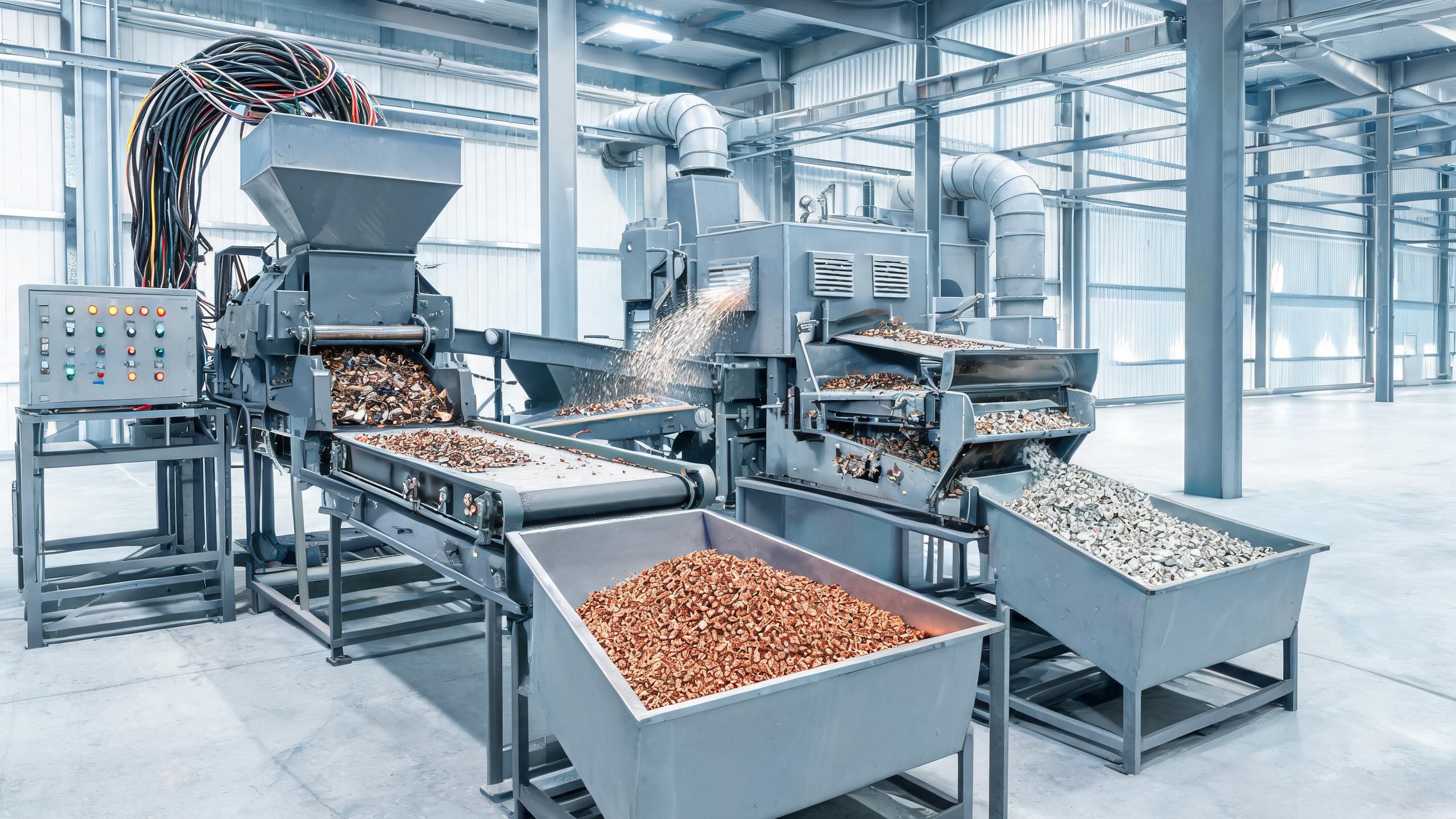
A Copper Wire Shredding Machine Is One Stage in a System — Buy the System, Not the Box
For cable recyclers across Southeast Asia, the search for a copper wire shredding machine usually starts with a model number and a price. That is backwards. A shredding machine on its own does not produce sellable copper — it is the first stage of a granulation line whose real revenue driver is the purity of the metal granule you output and the throughput you can sustain hour after hour. In a region where cable mixes vary widely — thin communication wire, building wire, automotive harnesses, power cable — the wrong equipment choice can turn a profitable operation into a costly one within months.
This guide explains the complete cable-to-granule process flow, the equipment configuration it requires, and how to choose a system that matches your cable types and target purity. The reference configuration throughout is the TG-CableLine 100 cable and wire recycling line, an integrated line designed for processors handling roughly 100 to 500 kg of cable per hour.
Step 1: Define Your Input Cable Before You Look at Any Machine
The most common buyer mistake is starting with machine specs instead of a material analysis. Categorize your feed first:
- Conductor material: copper, aluminum, or mixed. Mixed cable can be processed, but the metal fractions will come out mixed unless you pre-sort by conductor type or add a separation stage.
- Cable diameter range: from fine 1 mm communication wire up to roughly 50 mm aluminum conductor cable — feed geometry determines shredder and granulator setup.
- Insulation type: PVC, PE, XLPE and rubber are all processable without pre-sorting; the separation stage handles them by density difference.
- Armor and sheathing: steel-armored cable and lead-sheathed cable require pre-processing to strip armor or sheath before granulation. Fiber optic cable is not suitable at all — it contains glass fiber, not metal conductor.
Without this baseline you cannot evaluate any quotation, because recovery performance is always relative to the feed.
Step 2: Understand the Five-Stage Granulation Flow
A complete cable recycling line connects five stages into one continuous process:
- Primary cable shredder. A low-speed twin-shaft shredder reduces cable bundles to 20–40 mm strips. Low-speed shearing matters: it prevents copper smearing and insulation melting, both of which degrade downstream separation.
- Granulator. A high-speed knife granulator chops the strips into 3–8 mm granules, liberating conductor from insulation. Screen size controls the maximum granule size; knife clearance and blade quality directly affect output consistency and wear cost.
- Air separation. An air knife or density table separates light insulation from heavier metal granules. The physics is reliable: copper has a density of 8.96 g/cm³ and aluminum 2.70 g/cm³, while common insulation materials range from 0.9 to 1.4 g/cm³ — a large differential that air separation exploits effectively.
- Vibration separation table. A vibrating deck further purifies the metal stream, ejecting remaining non-metallic contaminants.
- Collection and optional baling. Clean copper or aluminum granules are collected in holding bins; an optional baling press compacts granules for transport.
If a supplier offers you only a standalone granulator, ask what the full flow looks like. A cheap machine that needs an expensive downstream separator to reach your target purity is a false economy.
Step 3: Match the Configuration to Your Operation
Throughput: plan for real operating hours
Rated capacity assumes ideal conditions. Real operations lose time to feeding, cleaning and blade changes, so size the line against your actual working hours and daily cable volume. The TG-CableLine 100 targets processors in the 100–500 kg/hour band — a common range for mid-sized recyclers in Vietnam, Indonesia and Thailand.
Purity: let your buyer set the target
Your target purity depends on who buys your granules. Be skeptical of any supplier who quotes a fixed purity percentage up front — real purity varies with cable type, feed consistency and granulator screen size. A credible manufacturer will confirm achievable purity against your cable mix at inquiry stage, and will offer a multi-stage separation design (air plus vibration table) that produces clean metal granules suitable for smelting.
Dust, noise and compliance
Cable granulation creates dust. An integrated dust collection system — cyclone plus filter — should be part of the line, not an afterthought. Check local environmental permitting requirements for recycling operations in your country before committing to a site layout.
Support and wear parts
Granulator knives and screens are consumables. Ask for the standard wear-parts lead time (under 45 days is a reasonable benchmark from a China-based manufacturer), whether a spare-parts kit ships with the line, and whether installation supervision and operator training are included. A 12-month warranty and ISO 9001-certified manufacturing are baseline expectations, not differentiators.
Common Buying Mistakes to Avoid
- Buying a shredder alone. Shredding reduces cable to strips but does not separate copper from insulation. Without granulation and separation, you have no sellable product.
- Ignoring mixed conductor streams. If you feed mixed copper and aluminum cable without pre-sorting, your output fractions will be mixed and sell at a discount.
- Feeding armored or lead-sheathed cable directly. Steel armor and lead sheathing must be stripped first, or you will damage knives and contaminate the metal fraction.
- Accepting theoretical recovery numbers. Always ask the supplier to confirm performance against a sample of your actual cable.
Quick Answers for Buyers
What is the difference between a cable shredder and a granulator? The shredder is the first stage — it reduces cable bundles to strips. The granulator liberates conductor from insulation at 3–8 mm, and the separation stages produce clean metal granules. You need all stages working together.
Can one line handle both thick and thin cables? Yes, within the line's diameter range (roughly 1–50 mm on the TG-CableLine 100), though extreme size variation in one batch reduces efficiency. Pre-sorting by size improves throughput.
What happens to the plastic insulation? It is separated by air and vibration table and collected separately. PVC, PE and XLPE can be sold to plastic recyclers or disposed of under local waste regulations.
Next Step: Get a Configuration Against Your Cable Mix
The fastest way to a correct purchase decision is a line configuration matched to your actual cable types, diameter range, volume and target purity. Send us your cable mix details — conductor material, diameter range, hourly volume, armor content and target purity — and our engineering team will specify the granulator knife profiles, screen sizes and separation parameters for your operation.