
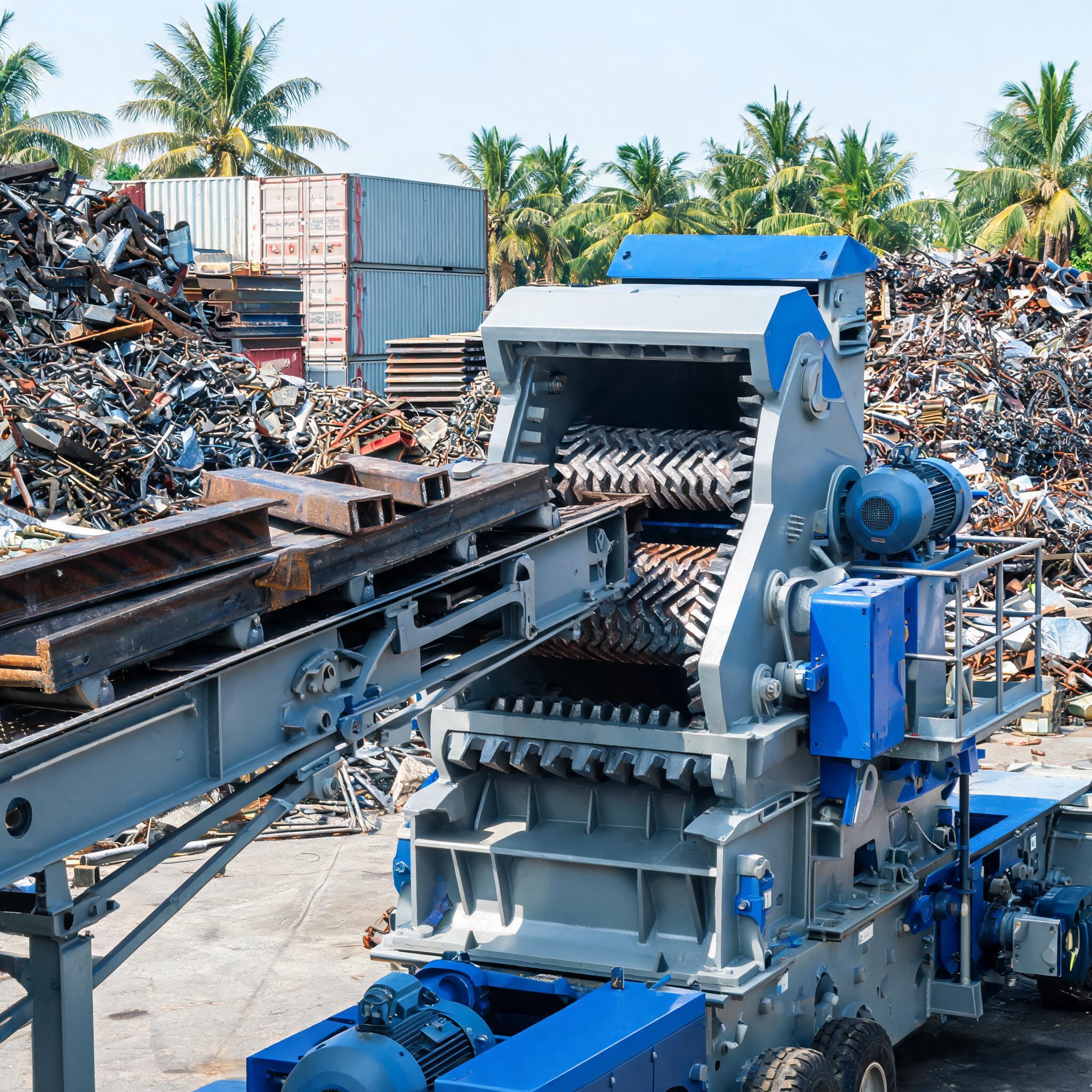
Choosing a Compact Metal Shredder: What to Match Before You Buy
If you run a small scrap yard, a machine shop, or a fabrication workshop in Vietnam, Indonesia, or the Philippines, space is tight and capital is limited. You need a machine that reduces metal waste — offcuts, light scrap, packaging, rejected parts — without taking over your floor or your budget. A China compact shredder can fit that role, but only if you match three things correctly: capacity, footprint, and price. This guide walks through each one so you can send a precise inquiry and get a machine that works for your actual operation.
Key Takeaways
- Match capacity to your real feedstock — not to a vague idea of "more is better." Over-sizing wastes money; under-sizing causes jams and downtime.
- Measure your floor space before you ask for quotes — include clearance for feeding, maintenance, and material removal.
- Understand what a compact shredder can and cannot process — light and small metal scrap is fine; heavy solid blocks are not.
- Price is not just the machine tag — motor power, blade design, control system, and after-sales support all affect the real cost over time.
What a Compact Metal Shredder Can and Cannot Process
Before comparing models, know the material limits. Compact and light-duty metal shredders are designed for thin, small, and loose metal waste: aluminum cans and profiles, light steel offcuts, copper wire (in small bundles), thin sheet metal, and mixed light scrap from workshop operations. They are not designed for solid blocks, thick steel plates, heavy castings, or large-diameter shafts. Feeding those will damage the blades or stall the motor.
If your feedstock is mostly light scrap, a China light-duty metal shredder is the right category. If you occasionally need to break down heavier pieces, you might need a double-shaft shredder instead, or a two-stage approach where you pre-cut heavy items before feeding the compact unit. Ask your supplier to confirm the maximum input size and material thickness for each model they offer.
How to Size Capacity to Your Feedstock
Capacity is usually expressed as throughput — tonnes per hour, or kilograms per hour. But the real question is: how much metal do you generate per day, and in what form?
- Estimate your daily volume — weigh a week's worth of scrap, then divide. This gives you a realistic daily target.
- Consider peak days — if you process scrap only on weekends, the machine needs to handle a larger batch in fewer hours.
- Think about operating hours — a machine that runs 2 hours a day can have a lower throughput than one that runs 8 hours. Match the hourly rate to your available time.
- Check the motor power — higher power generally means higher throughput, but also higher electricity consumption. For a small workshop, a modest motor may be more cost-effective.
When you inquire, give the supplier your daily scrap weight and the material type. They can recommend a model with the right throughput. Do not guess — a wrong estimate leads to a machine that is either too slow or too expensive to run.
Footprint: Planning Your Floor Space
Compact is relative. A "compact" shredder still needs space for the machine itself, plus room for feeding, discharge, and maintenance. Measure your available area before you compare models.
| Space Requirement | Why It Matters | Minimum Clearance to Plan |
|---|---|---|
| Machine footprint | The base dimensions of the shredder, including hopper and base frame. | As per supplier spec, plus 0.5 m on each side |
| Feeding area | Room to load scrap manually or with a small conveyor. | 1–2 m in front of the hopper |
| Discharge area | Space for a bin, conveyor, or container to catch shredded material. | 1–1.5 m below or beside the outlet |
| Maintenance access | Access to blades, motor, and screens for cleaning and blade changes. | 0.8–1 m on the service side |
Also consider the ceiling height if you plan to use a hoist for feeding. For most small workshops, a manual feeding setup is enough. Confirm the machine's total height and whether it needs to be bolted to the floor.
Price Considerations: What You're Really Paying For
Price is the most visible factor, but the cheapest quote is rarely the best value. Understand what drives the cost of a China compact shredder:
- Blade material and design — Hardened steel blades cost more but last longer. Ask about blade material and whether they can be re-sharpened or need replacement.
- Motor power and quality — A higher-rated motor costs more upfront but may be necessary for your throughput. Check the motor brand and warranty.
- Control system — Simple start/stop is cheaper; reverse and overload protection add safety and convenience. For a small operation, basic controls are often enough.
- Build quality and frame — Thicker steel frame and quality welding reduce vibration and extend machine life. You can't see this in a photo, so ask for the frame thickness and welding standards.
- After-sales support — Shipping, installation, spare parts availability, and warranty terms affect the total cost of ownership. A slightly higher price with good support can be cheaper in the long run.
When comparing quotes, ask each supplier to itemize: machine price, motor, blades, control panel, and any optional accessories. This makes it easier to compare apples to apples.
Single-Shaft vs. Double-Shaft: Which Configuration for Your Waste?
Compact metal shredders generally come in two configurations: single-shaft and double-shaft. Each suits different feedstock and output requirements.
| Feature | Single-Shaft Shredder | Double-Shaft Shredder |
|---|---|---|
| Shredding principle | One rotor with knives against a fixed counter-knife; often with a screen to control output size. | Two interlocking shafts that tear and shear material. |
| Best for | Uniform output size, finer shreds, plastics, light metals | Bulkier, tougher materials, mixed waste, larger pieces |
| Output control | Screen mesh determines particle size | Less precise; output size varies more |
| Maintenance | Knives may need more frequent sharpening | Blades are robust but harder to replace |
For a small scrap yard processing light metal waste, a single-shaft shredder often gives better control over output size, which can improve the value of your scrap. If you handle a mix of materials including some tougher items, a double-shaft might be more versatile. Discuss your material mix with the supplier to get the right recommendation. You can also read more about single-shaft shredder customization options to see what features can be adapted to your needs.
Practical Steps Before You Inquire
- List your materials — types of metal, typical sizes, and estimated daily weight.
- Measure your space — length, width, height, and where you'll put the machine.
- Define your output — do you need a specific particle size for resale or further processing?
- Set a budget range — include installation, shipping, and spare parts.
- Prepare questions — ask about blade material, motor power, warranty, spare parts availability, and lead time.
Then send a detailed inquiry to suppliers like Tiangong Technology Co., Ltd., who manufacture single-shaft and double-shaft shredders. They can help you match a machine to your specific conditions.
Frequently Asked Questions
Can a compact shredder handle steel pipes or rebar?
Not typically. Compact and light-duty shredders are for thin and small scrap. Pipes and rebar are usually too thick and will damage the blades. You may need a heavier-duty shredder or a pre-cutting step.
How much floor space do I need for a compact shredder?
It depends on the model, but plan for at least 2–3 meters in each direction when you include feeding and discharge areas. Always confirm the exact dimensions with the supplier.
What is the typical price range for a China compact shredder?
Prices vary widely based on motor power, blade quality, and features. There is no fixed range — request itemized quotes from several suppliers to compare.
Do I need a conveyor to feed the shredder?
For small volumes, manual feeding is usually enough. A conveyor becomes useful when throughput is high or when feeding is unsafe. Discuss your volume with the supplier.
What spare parts should I keep on hand?
Blades are the most common wear part. Also consider screens (if applicable), bearings, and belts. Ask the supplier for a recommended spare parts list and their availability.
Next Step: Ask the Right Questions
A compact metal shredder is a practical investment for a small scrap yard or workshop — but only when it's matched to your real needs. Start by documenting your feedstock, measuring your space, and understanding the price components. Then contact a reputable manufacturer like Tiangong Technology with those details. They can help you choose a China workshop metal waste solution that fits your operation without overpaying for capacity you don't need.