
Crusher Selection Guide
When you process coal, coke, or other brittle materials, the crusher you choose determines not just throughput but also the quality of your downstream product — particle shape, fines content, and how uniform the discharge really is. Jaw crushers and impact crushers are familiar workhorses, but for brittle feed, a double roll crusher often does the job with fewer headaches. This article compares the three on the criteria that matter most to buyers: material suitability, discharge uniformity, fines control, and the toothed vs smooth roll question.
What you will learn
Key takeaways
- Double roll crushers use compression and shear, giving more predictable discharge sizing than impact crushers on brittle feed.
- Jaw crushers are for primary reduction of large, hard feed; they are not ideal for producing a uniform, fine product in one pass.
- Impact crushers excel at shaping but generate more fines — a drawback when you need to minimize oversize and dust.
- Toothed rolls grip and shear; smooth rolls compress. The right choice depends on feed moisture and the target product size.
- For coal and coke, a double roll crusher with hydraulic gap adjustment gives you control over discharge size without changing rolls.
How each crusher type works
Before comparing, it helps to be precise about the mechanism. Each crusher reduces material differently, and that difference shows up in the product.
- Jaw crusher: A fixed jaw and a moving jaw form a V-shaped chamber. The moving jaw presses the rock against the fixed plate, fracturing it by compression. The discharge opening at the bottom sets the top size, but the product includes a wide range of sizes down to dust.
- Impact crusher: A rotor with hammers or blow bars flings the material against impact plates. Breakage happens by high-velocity impact, which is effective for shaping but also generates a significant amount of fine material.
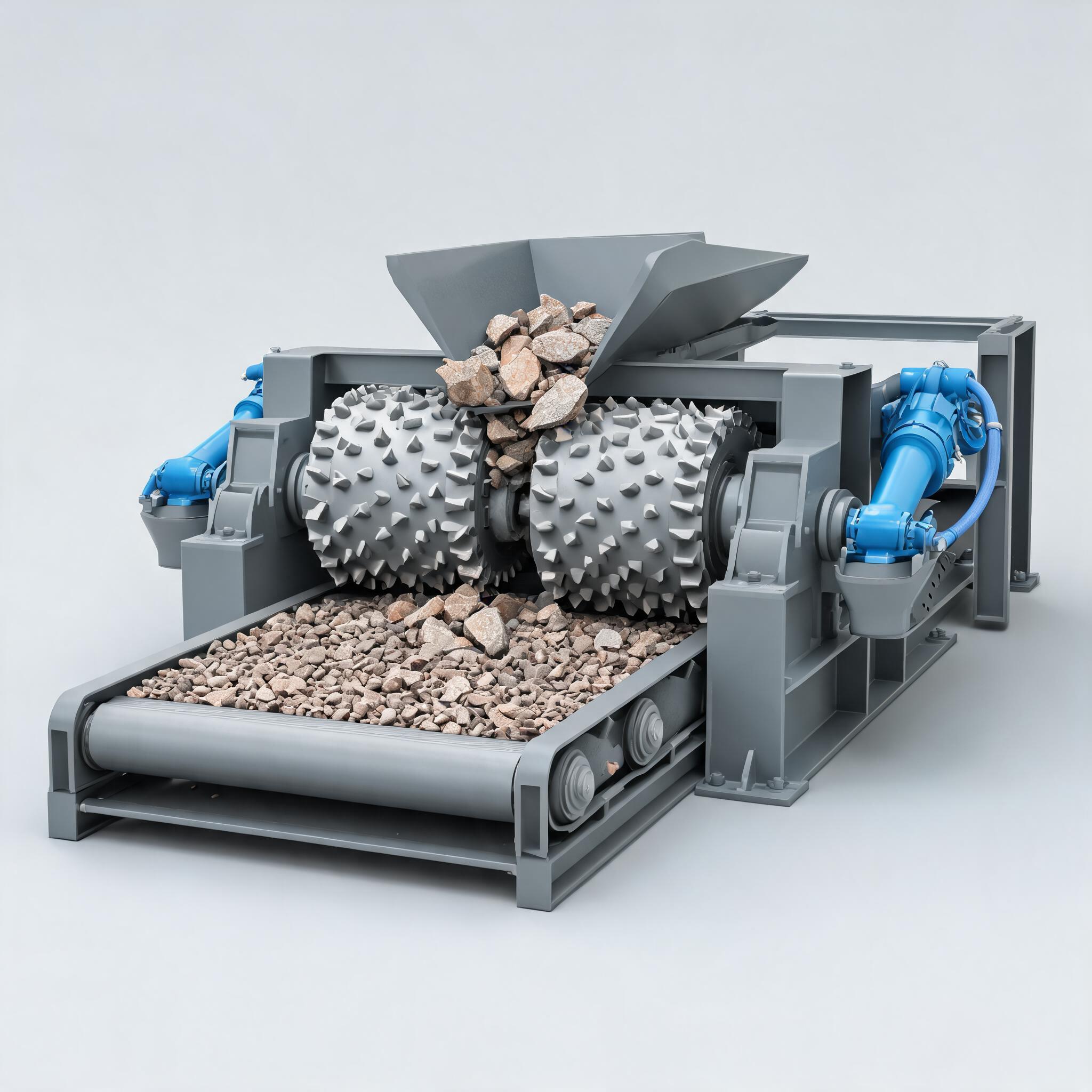
- Double roll crusher: Two counter-rotating rolls draw material into the gap between them. Breakage occurs by compression and shear as the rolls pull the feed through. The gap between the rolls controls the product top size, and the crushing action is gentler than impact, producing fewer fines.
For a closer look at specific equipment, see the TG-RollCrush 300 Double Roll Crusher, the TG-Jaw 600 Primary Jaw Crusher, and the TG-Impact 500 Horizontal Impact Crusher.
Material suitability: coal, coke, and brittle feed
Not all crushers handle all materials equally well. The mechanical properties of your feed — hardness, brittleness, moisture, and abrasiveness — should drive the decision.
Coal and coke: the brittle feed case
Coal and coke are brittle. They fracture easily under compression but also crumble under impact. This is where the double roll crusher has a natural advantage. Its compression-shear action breaks the material along natural fracture lines, producing a more controlled product. An impact crusher, by contrast, shatters the material, creating more fines than you may want.
For coke in particular, minimizing fines is often a priority because fines affect downstream processes like blast furnace operation. A double roll crusher gives you the control to reduce size without over-crushing.
Hard rock: where jaw and impact crushers earn their keep
If your feed is hard, abrasive rock like granite or basalt, a jaw crusher is the conventional primary choice. It can handle large, blocky feed and high compressive strength. Impact crushers are also used in secondary and tertiary stages for shaping, but they wear faster on abrasive materials and may require more maintenance.
Double roll crushers are not typically the first choice for very hard, abrasive rock — roll wear becomes a concern. They shine in the brittle, lower-abrasion segment: coal, coke, limestone, gypsum, and similar materials.
Discharge uniformity and fines control
Two product qualities matter most in coal and coke crushing: how uniform the discharge size is, and how much fine material you generate.
Discharge uniformity
A jaw crusher discharges a wide size distribution. The top size is set by the closed-side setting, but the product contains everything from that top size down to dust. If your process needs a narrow size range, a jaw crusher usually requires a secondary crushing stage.
A double roll crusher, by design, produces a more uniform product. The gap between the rolls acts as a consistent sizing orifice — material larger than the gap cannot pass through and is crushed until it fits. This gives you a tighter product size distribution in a single pass.
Impact crushers sit in between. They can produce a relatively uniform product, but the result depends heavily on rotor speed and the setting of the impact plates. They also tend to produce more elongated or flaky particles in some materials, which may or may not be acceptable for your application.
Fines control
Fines are the particles smaller than your target size — often considered waste or a downstream problem. The table below summarizes how each crusher type behaves.
| Crusher type | Fines generation | Why |
|---|---|---|
| Jaw crusher | Moderate | Compression fracturing creates some fines, but less than impact. |
| Impact crusher | High | High-velocity impact shatters material, producing significant dust and fine particles. |
| Double roll crusher | Low to moderate | Compression and shear break material along fracture lines with less shattering. |
If your process is sensitive to fines — for example, in coke breeze or coal feed for gasification — the double roll crusher's gentler action is a clear advantage.
Toothed vs smooth rolls: what changes
Within the double roll crusher category, you have a further choice: toothed rolls or smooth rolls. This is not a minor detail — it changes what the machine can do.
Toothed rolls
Toothed rolls have segmented teeth or corrugations that grip the feed and pull it into the crushing zone. The teeth also create localized stress concentrations that help fracture brittle materials. Benefits include:
- Better grip on slippery or slightly sticky feed
- Higher throughput for a given roll size because material is positively drawn in
- Effective on coal and coke, where the teeth can grab and shear the material
The TG-RollCrush 300 uses segmented toothed rolls, which also means individual segments can be replaced without changing the entire roll — a practical maintenance advantage.
Smooth rolls
Smooth rolls rely purely on compression. Material is crushed between the two roll surfaces. This works well for softer materials and produces a very uniform product. However, smooth rolls can struggle with feed that is slippery or has a high moisture content, as the material may not be drawn into the gap effectively.
The decision between toothed and smooth rolls depends on your feed and target product:
| Feed condition | Recommended roll type | Reason |
|---|---|---|
| Dry, brittle coal or coke | Toothed | Positive grip, effective shearing, good throughput. |
| Moist or sticky feed | Toothed (with appropriate profile) | Teeth help pull material in and prevent clogging. |
| Very uniform, fine product needed | Smooth | Pure compression gives the most consistent sizing. |
Decision boundaries: when to choose which
There is no universal "best" crusher — only the right tool for a specific job. Here are practical decision boundaries.
Choose a double roll crusher when:
- Your feed is coal, coke, or another brittle material with low to moderate abrasiveness.
- You need a uniform discharge size in a single pass.
- You want to minimize fines generation.
- You need to adjust the product size frequently — look for a hydraulic gap adjustment feature.
Choose a jaw crusher when:
- Your feed is hard, abrasive rock with large top size.
- You are doing primary crushing and a downstream secondary stage will handle the finer work.
- You need maximum reliability on the toughest feed.
Choose an impact crusher when:
- You need good particle shaping for aggregates.
- Your material is medium-hard and you can tolerate higher fines generation.
- You are working in secondary or tertiary stages where the feed is already reduced.
One more consideration: the ability to adjust the discharge gap. On a double roll crusher, hydraulic gap adjustment lets you change the product size on the fly, without stopping to swap parts. This is a practical feature if your product specifications change between batches.
Supplier evaluation: what to ask
When you evaluate a supplier, confirm the specifics that affect your operation. Do not assume — ask for details on the following:
- Roll dimensions and capacity: Confirm the roll diameter, width, and throughput for your specific material and feed size. These figures are application-specific.
- Gap adjustment range: Ask what discharge sizes the machine can produce and how quickly the gap can be changed.
- Roll material and wear life: Inquire about the roll material and expected wear life for your feed. Wear parts are a recurring cost.
- Drive power and speed: Confirm the motor power and roll speed match your duty cycle.
- Safety features: Check for spring relief or other overload protection to prevent damage from uncrushable objects.
A reputable supplier should be able to provide these details and, where necessary, test your material. Tiangong Technology Co., Ltd., founded in 2008, operates a 12,000 m² facility and offers a lead time under 45 days for standard models. Their equipment is CE marked and manufactured under ISO 9001. They also provide installation supervision and operator training, plus a 12-month warranty with spare-parts kits.
Frequently asked questions
Can a double roll crusher handle wet or sticky coal?
Toothed rolls are generally better for moist feed because the teeth help pull the material into the crushing zone and prevent clogging. For very sticky material, confirm the specific roll profile with the supplier.
Is a double roll crusher suitable for primary crushing?
It depends on the feed size. Double roll crushers are often used for secondary or tertiary crushing, but with a large enough roll diameter and appropriate tooth profile, they can handle primary duties on softer materials like coal. Confirm the maximum feed size the machine can accept.
How do I control the discharge size on a double roll crusher?
Look for a hydraulic gap adjustment system. This allows you to change the distance between the rolls, which directly sets the product top size. The TG-RollCrush 300 includes this feature.
What safety features should I look for?
Spring relief or hydraulic overload protection is important. These allow the rolls to yield when an uncrushable object enters the chamber, protecting the machine from damage.
Final recommendation
For coal, coke, and other brittle materials where discharge uniformity and fines control are priorities, a double roll crusher is often the best fit. Its compression-shear action produces a more predictable product than an impact crusher, and it does so with less fines generation. A jaw crusher remains the choice for hard, abrasive primary crushing, but it will not give you the same one-pass uniformity.
When you compare options, focus on the features that affect your daily operation: gap adjustability, roll type (toothed vs smooth), and overload protection. Confirm the capacity and wear characteristics for your specific feed. If you are evaluating a double roll crusher for your coal or coke line, ask the supplier for application-specific data — it makes the difference between a machine that works and one that works for you.