
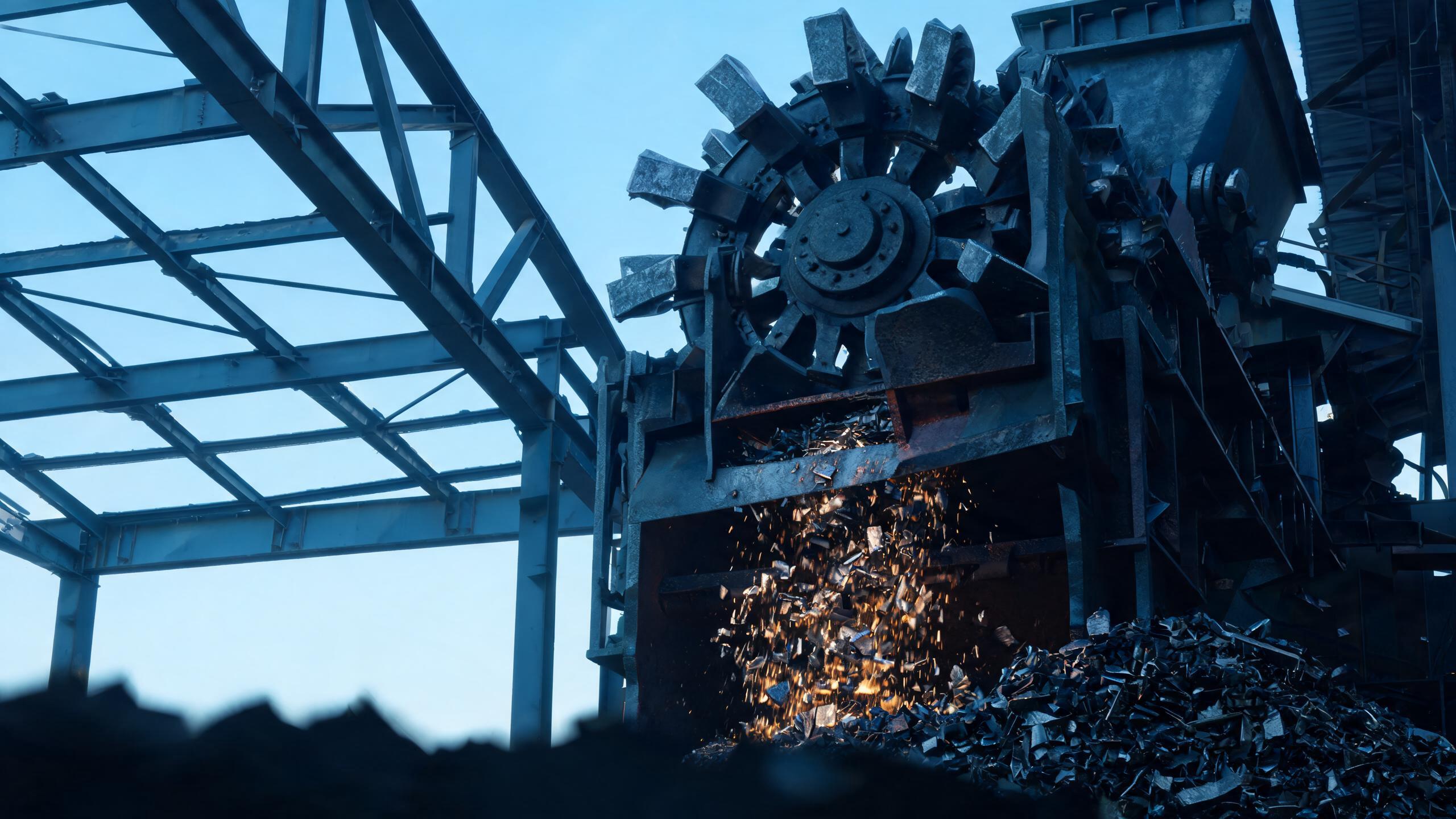
BUYER GUIDE
If you run a scrap yard or recycling plant in Southeast Asia, you have likely asked the same question: four shaft shredder vs double shaft — or single shaft, for that matter. Which one actually fits the material you process every day?
The honest answer: it depends on your waste stream. A tire recycling line, a metal scrap operation, and a municipal solid waste facility have different output requirements. Buying the wrong configuration means either overspending on capacity you do not need or ending up with material that still requires secondary processing.
This guide compares the three configurations across the applications you care about, then gives you a three-question method to narrow down your choice before you talk to a supplier.
- Four-shaft shredders give you the tightest particle size control thanks to a screen basket — ideal for materials that need to meet a downstream spec.
- Single-shaft shredders pair a hydraulic ram with an interchangeable screen for consistent sizing at moderate throughput; they are a workhorse for many mixed feeds.
- Twin-shaft shredders are built for high-volume, coarse reduction — think 80 TPH on mixed scrap — but output size is less controlled.
- Ask three questions before choosing: What is your target output size? What is your hourly throughput? What is the material's composition?
What Each Configuration Actually Does
Before comparing, it helps to understand the mechanical difference. All three use counter-rotating shafts with cutting tools, but they differ in how they control the output size and how much power they can apply.
Four-Shaft Shredder
A four-shaft shredder runs two pairs of counter-rotating shafts. The material is pulled in, cut repeatedly, and then has to pass through a screen basket before it exits. That screen is what gives you control: you choose the aperture, and the machine holds the output to roughly that size.
Take the TG-FourShaft 400 Four-Shaft Metal Shredder as an example. It uses two pairs of counter-rotating shafts and an interchangeable screen basket that you can swap between 20 mm and 60 mm apertures. The drive is 2×75 kW, it is CE marked, and it can be configured for 50 or 60 Hz to match local grid conditions. If your downstream process demands a consistent, relatively fine particle size, this is the configuration designed for that job.
Single-Shaft Shredder
A single-shaft shredder uses one rotor with bolt-on knives, and a hydraulic ram pushes the material against the rotor. Like the four-shaft, it has an interchangeable screen that sets the output size. The difference is in throughput and how the machine handles feed — the ram gives you steady, controlled feeding rather than relying on gravity alone.
The TG-SingleShaft 200 Single-Shaft Metal Shredder is a representative unit: a 55 kW drive, a hydraulic feed ram, an interchangeable screen, and bolt-on tool steel knives that can be replaced individually. It also has a PLC-controlled auto-reverse to clear jams. This is a mid-power configuration that suits plants wanting predictable sizing without the power demand of a large twin-shaft machine.
Twin-Shaft Shredder
A twin-shaft (or double-shaft) shredder has two counter-rotating shafts fitted with cutting discs. It tears and shears material into coarse pieces. There is no screen basket, so the output size is determined by the disc spacing and rotor speed, not by a sizing screen. This makes it fast and powerful, but less precise on particle size.
The TG-2200 Twin-Shaft Metal Shredder shows what this configuration is for: a 2000 HP (1492 kW) drive, rated at 80 TPH on mixed scrap, with counter-rotating shafts and bolt-on alloy cutting discs running at 12–22 RPM. It is CE certified. This is a high-throughput primary reduction machine, not a fine-sizing machine.
Comparing the Three Across Your Applications
Now let's map these configurations to the waste streams you actually handle.
| Application | Four-Shaft | Single-Shaft | Twin-Shaft |
|---|---|---|---|
| Tire processing | Good for producing fine, consistent rubber chips if downstream granulation needs a uniform feed. Screen aperture controls chip size. | Workable for tire pieces with the ram feeding material steadily; screen gives sizing control but throughput is moderate. | Good for primary tearing of whole tires into coarse chunks before a secondary step. Not for fine output. |
| Metal scrap | Effective for light metals and electronic scrap where you want a densified, uniform output. The screen prevents oversize pieces from leaving. | Suitable for light-gauge metal and mixed production waste where a 55 kW drive is enough. Not for heavy structural scrap. | The clear choice for high-volume mixed scrap. The TG-2200's 80 TPH rating and 2000 HP drive are aimed at this role. |
| Solid waste / MSW | Useful when you need a consistent particle size for downstream sorting, composting, or RDF production. | A practical mid-range option for pre-shredding mixed waste at a controlled size. | Ideal for bulky waste and large items that need to be reduced in volume quickly before sorting. |
Three Questions to Shortlist Your Configuration
Instead of comparing spec sheets side by side, start with these three questions. Your answers will eliminate at least one configuration immediately.
Question 1: What output size does your downstream process require?
If your next step — a granulator, a separator, a baler — needs a uniform feed of a specific size, you need a screen-controlled machine. That points to a four-shaft or single-shaft unit. If you only need volume reduction and the downstream step can handle coarse chunks, a twin-shaft machine is enough.
Question 2: What hourly throughput do you actually need?
Be honest about your tonnage. A four-shaft or single-shaft machine with a 55–150 kW drive will process far less per hour than a 2000 HP twin-shaft unit. If you are moving 80 TPH of mixed scrap, only the twin-shaft class is realistic. If you process a few tonnes per hour of production waste, a single-shaft unit is likely the economical choice.
Question 3: What is the material's composition and contamination level?
Hard metals, cables, and tramp metal will punish cutting tools differently. Twin-shaft machines with bolt-on alloy discs are designed to take that abuse. A four-shaft machine with a screen basket is more sensitive to oversize or very hard items — the screen can be damaged by material that cannot pass. If your feed is unpredictable and dirty, favor a twin-shaft for the primary reduction stage.
Why Configuration Choice Matters More Than Brand
In Southeast Asia, power availability and grid frequency vary by country. A machine that is CE marked and configurable for 50 or 60 Hz, like the TG-FourShaft 400, removes one compatibility headache. Similarly, a 12-month warranty and bolt-on cutting tools — which you can replace without replacing the whole rotor — affect your long-term operating cost.
Tiangong (天工), founded in 2008, builds all three configurations. That matters because it means you can match the machine to the waste stream rather than forcing your waste stream to fit one machine. Whether you need the precision of the four-shaft, the balanced output of the single-shaft, or the raw power of the twin-shaft, the right configuration is the one that answers your three questions.
Frequently Asked Questions
Can a four-shaft shredder handle metal scrap?
Yes, for light and medium metals. The screen basket gives you a controlled output size, which is useful for electronic scrap and light-gauge metal. For heavy structural scrap, a twin-shaft machine is the better fit because it can apply more torque without a screen to damage.
Is a twin-shaft shredder always more expensive to run?
Not necessarily. A 2000 HP machine consumes more power per hour, but if you need 80 TPH of throughput, it may be the most cost-effective way to get there. Compare the cost per tonne of output, not just the motor rating.
Do I need a screen for tire shredding?
If you are producing tire-derived fuel or crumb rubber feed, you likely need a screen-controlled machine — a four-shaft or single-shaft unit. If you are only reducing whole tires for transport or further processing elsewhere, a twin-shaft primary shredder is sufficient.
Next Step: Send Us Your Material Specs
The fastest way to get a reliable recommendation is to share what you are processing. Tell us your material type, the approximate hourly tonnage, and the output size you need. We will point you to the configuration — four-shaft, single-shaft, or twin-shaft — that matches your waste stream, and confirm the technical details you need for your plant.
Contact us with your material specs and throughput requirements to get a configuration recommendation.