
If you are comparing size-reduction equipment for a metal recycling line, you are probably asking a practical question rather than a theoretical one: how does an impact crusher actually break material, and can its output be adjusted to match your downstream requirements? This article walks through the working cycle of a horizontal shaft impact (HSI) crusher stage by stage, then explains how rotor speed and impact curtain settings shape the final product. Tian Gong has manufactured crushing equipment since 2008, with CE marking and an ISO 9001 facility, and the TG-Impact 500 horizontal impact crusher is a concrete example of the design discussed here.
Key takeaways
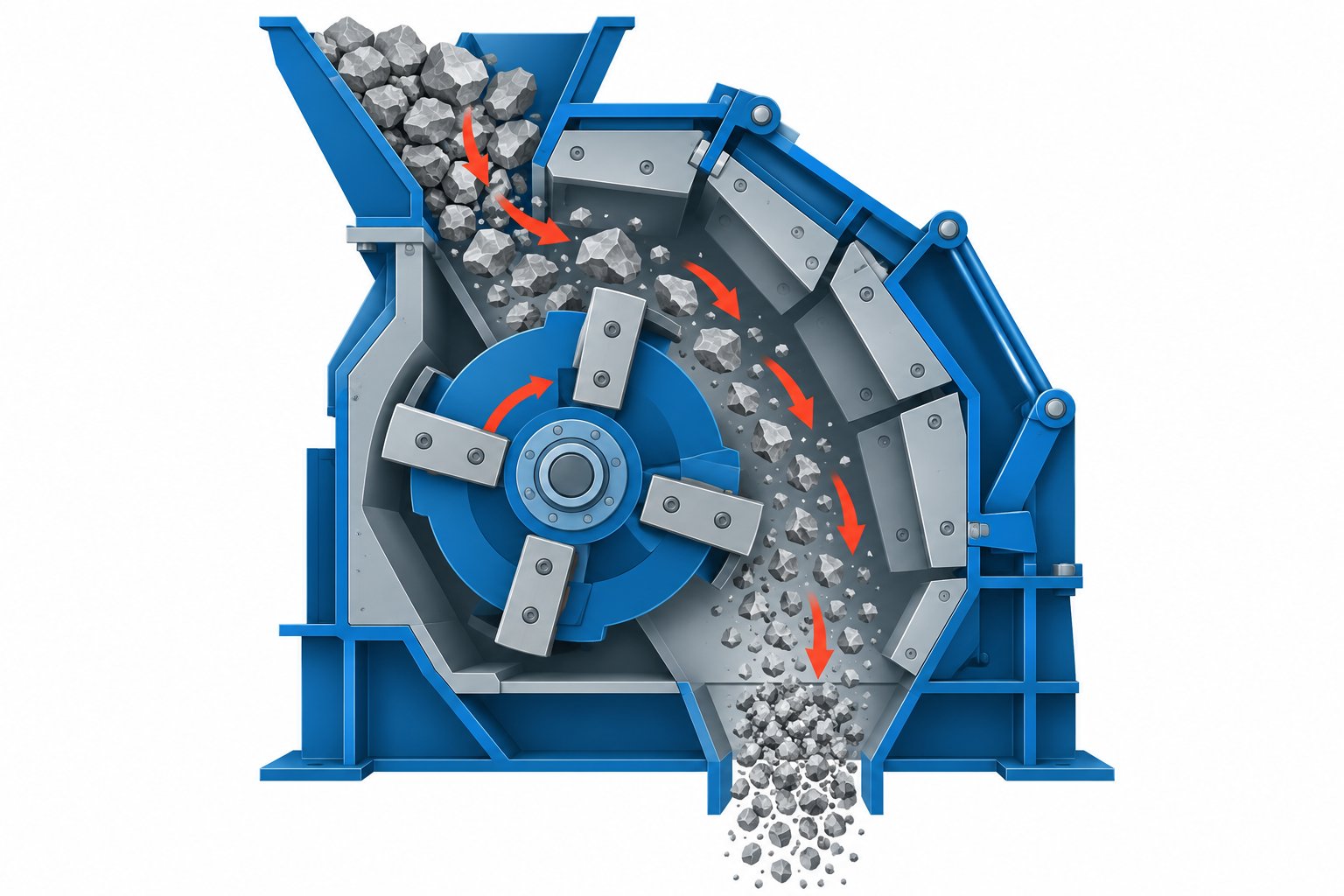
- An impact crusher reduces material by kinetic energy, not by squeezing it between two surfaces.
- The rotor spins blow bars at high speed; a single blow bar strike can fracture brittle material immediately.
- Adjustable impact curtains turn the chamber into a multi-stage breaking path, not a single hit.
- Rotor speed and curtain gap are the two main levers controlling product size and shape.
- Impact crushing suits brittle, pre-sized scrap better than very ductile or highly abrasive feed.
- Blow bar wear and curtain adjustment are the routine maintenance jobs that determine consistent output.
What an impact crusher does differently
Jaw and cone crushers compress rock between two surfaces until it cracks. A horizontal shaft impact crusher works on a different principle: it accelerates material to high velocity and lets it collide with hard steel and with other particles. The material breaks along its own weakness planes, which is why HSI machines are common where shape matters as much as size reduction.
When a recycling or processing line feeds pre-sized metal scrap, castings, or brittle non-ferrous material, the impact chamber gives a fast, controllable route from lump to saleable fragment.
The working cycle, step by step
Feed enters the chamber
Material is introduced through the feed opening, usually after some form of pre-sizing so that oversized pieces do not bridge at the inlet. The feed drops into the upper part of the crushing chamber, where the rotating rotor and the first impact curtain define the working volume. In practice, your feed preparation — shear, cut, or sort — determines how smoothly the crusher runs.
The rotor and blow bars accelerate material
The rotor is a horizontal shaft fitted with heavy, replaceable blow bars. In the TG-Impact 500, the rotor turns at high speed, and each blow bar sweeps the chamber and strikes the material as it falls. Because the blow bar moves much faster than the feed, the collision transfers kinetic energy quickly. A thin or brittle piece can fracture on first contact; thicker pieces are thrown downward or forward for further impacts.
First impact at the blow bar
This is the primary break event. The blow bar’s contact edge strikes the material, and the resulting stress usually exceeds the material’s strength. The break is not a cut — it is a shatter, so a single piece often becomes several fragments the moment it leaves the blow bar face.
Material is thrown against the impact curtains
After the blow bar strike, fragments are flung outward at speed into the adjustable impact curtains (also called aprons). Each curtain is a heavy replaceable wear plate positioned at a set gap from the rotor circle. When a fragment hits a curtain, the rebound and the impact stress break it further. The curtains are the second stage of size reduction and are the main surface that shapes the product.
Secondary impacts and the grind path
Fragments do not exit after one curtain hit. They bounce between the blow bars, the curtains and other particles. The lower section of the chamber often forms a grind path where fragments are repeatedly struck until they are small enough to pass the gap. This grinding zone is what separates an impact crusher from a single-blow machine: the material stays in the chamber until it satisfies the exit condition.
Exit through the curtain gap or grate
When a fragment is smaller than the gap between the rotor tip and the last curtain, it passes through and drops onto the discharge conveyor. Some configurations also use a grate to set the final size, though horizontal shaft impact crushers typically rely on the adjustable curtain gap. The rule is simple: the gap defines the exit size, and the machine keeps working a piece until it fits.
How rotor speed and curtain gap control output
Two adjustments dominate the product you ship to the next stage.
| Control | What it changes | Practical effect |
|---|---|---|
| Rotor speed | Blow bar tip speed and kinetic energy per strike | Higher speed increases break probability and produces finer, more cubical fragments; lower speed reduces fines |
| Curtain gap | Distance between rotor and curtain wear plate | Narrower gap holds material longer and produces a smaller top size; wider gap reduces residence time |
In the TG-Impact 500, the curtains are adjustable so the gap can be set to match your target fragment size without changing the whole rotor. In practice, the right combination is found by running a sample of your actual feed and checking the discharge: size distribution, shape and the proportion of fines. Rotor speed and gap are not independent; changing speed without checking the gap usually means re-adjusting both.
Why impact crushing suits brittle, pre-sized metal scrap
Impact crushing rewards brittleness. Material that breaks with little deformation — cast aluminum, brittle non-ferrous and similar pre-sized scrap — tends to shatter cleanly on the blow bars and curtains. Ductile material, by contrast, tends to bend rather than break, so it can consume blow bar life without reducing well. Highly abrasive feed also wears the wear parts faster than inert scrap.
Pre-sizing the feed matters for a second reason: a horizontal shaft impact crusher is a secondary-type machine in this role. It performs best when the feed has already been reduced to a size the rotor can accept. If your infeed contains tangled wire, long sections or mixed ductile material, consider whether an impact crusher or a different design is the better fit before sizing the unit.
Maintenance touches that keep output consistent
- Blow bar wear: Inspect the striking edge regularly. A worn or rounded edge loses the impact energy that does the breaking, and the product coarsens even though the settings have not changed. Replace or rotate blow bars as wear reaches the limit.
- Curtain adjustment and wear: Check the curtain gap and inspect the wear plates. As a curtain plate wears, the effective gap grows, and output drifts. Re-adjust after replacing plates.
- Fasteners and clearances: Loose rotor bolts or changed clearances affect the strike geometry. Follow the manufacturer’s torque and clearance schedule.
- Chamber inspection: Look for buildup or worn liners that change the impact path. The cycle is mechanical, so any change to the chamber geometry changes the result.
Routine inspection is not optional on an impact machine because the wear parts are the working surfaces. A planned inspection interval based on your actual throughput is more reliable than a calendar-based one.
How this compares with other crusher types
Impact crushing is not the right answer for every feed. In general terms:
- The TG-Hammer 800 heavy-duty metal crusher uses a 750 kW motor, 500-ton hydraulic compression and reversible manganese hammers, with stated throughput of 40–60 t/h. Hammer mills reduce by repeated hammer strikes and are often chosen for bulkier or more mixed scrap.
- The TG-Cone 350 cone crusher reduces by compression between a moving mantle and a concave. Cone crushing is typically preferred for hard, abrasive rock where impact wear would be excessive.
For brittle, pre-sized scrap where cubical shape and controllable top size matter, the impact chamber’s combination of rotor speed and adjustable curtains is the distinguishing advantage.
FAQ
Can I change the output size without replacing the rotor?
Yes. Rotor speed and curtain gap are the two primary adjustments. Confirm the acceptable range with the manufacturer for your specific model before running.
Does impact crushing work on wet or sticky feed?
Impact crushers handle many feeds well, but sticky material can build up in the chamber and reduce impact efficiency. Discuss your feed condition with the supplier when specifying the machine.
How often should blow bars be replaced?
There is no universal interval. It depends on feed abrasiveness and throughput. Set an inspection schedule based on your material and check the striking edge, not just the clock.
Next step for buyers
If you are sizing a crusher for a metal recycling line, start with your feed: material type, incoming size, target fragment size and throughput. Those four inputs determine whether an impact crusher is the right stage and which model fits. Tian Gong can discuss the TG-Impact 500 configuration and curtain adjustment range against your feed. Send your material details and target output size to begin the selection process.
Ready to specify an impact crusher for your scrap line? Send Tian Gong your feed material, incoming size and target fragment size, and ask about the TG-Impact 500 configuration. Request product details and selection support.