
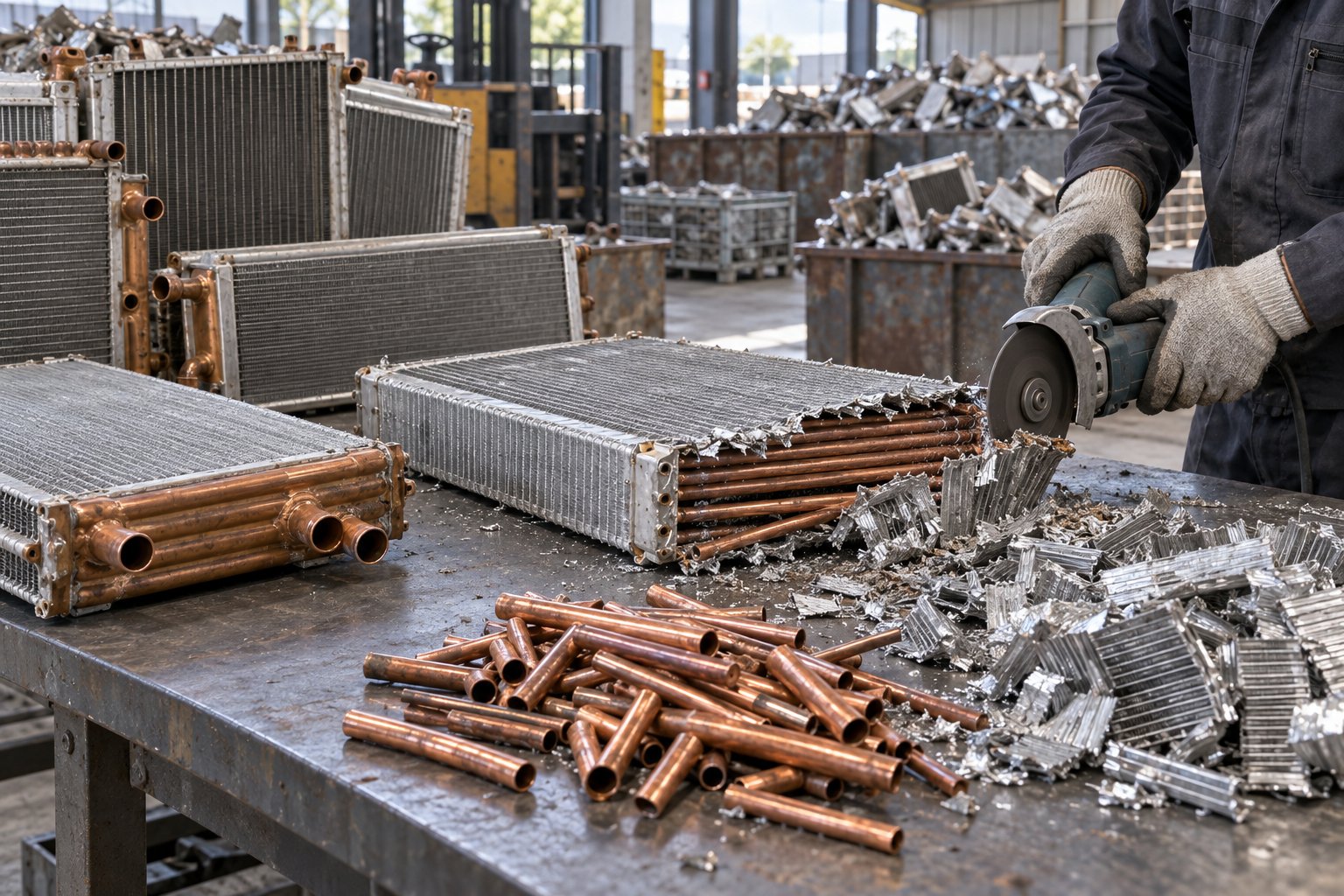
If you are clearing a renovation, replacing an old heating system, or buying radiators in volume for recovery, the question "how much is a house radiator worth in scrap" has no single answer. Scrap yards price radiators by metal composition and cleanliness, not by how much heat they once produced. Two radiators of similar size can be graded differently on the same day at the same yard.
This article breaks down the factors that actually move a home radiator's scrap value, so you can decide whether to sell it whole, dismantle it first, or send it to a separation process. It does not quote price figures — yard rates change constantly and vary by region — but it explains what the grader is looking at when your load is weighed.
Construction type comes first
Home radiators are not one material. The metal mix inside determines the base grade before anything else is considered. The three broad categories you will encounter are quite different from a recycler's point of view.
| Radiator type | Typical metal mix | Scrap relevance |
|---|---|---|
| Copper-tube and aluminum-fin (often called copper-aluminum) | Copper or brass tubes bonded to aluminum fins | Both metals are recoverable; copper content is the high-value part |
| Steel panel radiators | Predominantly mild steel, often with weld seams and brackets | Graded and paid as steel, which is the lower-value route |
| HVAC heat exchangers, fan-coil units, and fin-and-tube coils | Copper tubing through aluminum fin packs, sometimes with brass headers | Structurally similar to copper-aluminum radiators; treated as copper-aluminum scrap |
The copper-aluminum family is where the value sits. Copper carries a much higher per-kilogram rate than aluminum, and plain steel sits well below both. That is why a cast-iron or steel column radiator of considerable weight may bring less than a lighter copper-tube radiator after grading. When you evaluate a load, start by identifying what the tubes and fins are made of — not how heavy the unit feels by hand.
Cleanliness and contamination
Yards discount or reject loads with contamination, and the deductions can be significant. Before a radiator is graded, it should be free of anything that is not part of the metal value.
- Residual coolant or oil. Liquid left inside tubes or panel cavities adds weight that is not metal, and it creates handling and environmental concerns for the yard. Drain and flush where practical.
- Steel brackets, feet, and mounts. Wall brackets, floor stands, and mounting rails are usually steel. If they stay attached to a copper-aluminum radiator, they can pull the whole unit into a mixed grade instead of a copper-aluminum grade.
- Fittings, valves, and connectors. Brass valves have their own value if removed and sorted; left in place they may be counted as part of the radiator's weight at the radiator's grade, which is rarely to your advantage.
- Paint, plastic caps, and non-metallic trim. Thermostatic heads, plastic end caps, and heavy paint coatings are not payable metal. Remove them.
The principle is straightforward: every kilogram that is not copper, aluminum, or steel dilutes the value of the kilograms that are. A clean, sorted load is easier for the yard to grade and is less likely to attract a deduction.
Whole versus dismantled: the biggest single lever
This is where most sellers leave money on the table. A complete copper-aluminum radiator sold as-is is usually graded as mixed copper-aluminum — a single, blended rate that reflects the difficulty of separating the two metals at the yard. When you separate the copper tubes from the aluminum fins before selling, each metal is weighed and graded on its own merits, and copper's premium is paid on the full weight of the copper.
The difference is structural, not incidental. Mixed copper-aluminum scrap is priced with a built-in discount because the processor must still do the separation work. Pre-separated copper and pre-separated aluminum remove that discount. You are effectively paid for the same metal twice over — once as copper, once as aluminum — instead of once as a blend.
What separates cleanly, and what does not
- Copper tubing and aluminum fin stock that come apart cleanly can be sold as distinct grades.
- Brazed or welded joints, mixed fasteners, and bonded assemblies may not separate by hand and can force a mixed grade.
- Steel end panels and frame components should be pulled out and sold as steel.
Weight, quantity, and volume
Weight matters, but only after composition and cleanliness are settled. A yard pays by the kilogram or pound on a certified scale, so the heavier a load at a given grade, the more it returns — assuming the grade holds. Quantity also changes the logistics: a single domestic radiator is often not worth a dedicated trip, while a renovation clear-out or a dealer's stockpile changes the economics of transport and handling.
Two practical points follow. First, do not try to add weight with contamination; it is deducted or rejected. Second, when comparing loads, compare like with like — a copper-aluminum load and a steel load are not competing on the same scale.
How yards grade a load
Grading practice is not universal. Yards apply their own category definitions, inspection procedures, and contamination thresholds, and these can differ between regions and between buyers. What one yard calls clean copper-aluminum, another may split further. Because rates and rules shift with local demand and metal markets, the only reliable approach is to confirm the current grade definitions and requirements with the specific yard or buyer before you commit a load.
Ask what grade your radiators will be classified under, what contaminants trigger a downgrade, and whether pre-separated copper and aluminum are accepted as separate items. That conversation, not a published number, is what tells you how a given load will be treated.
Why separation before sale captures more value
Separation is the step that converts a discounted mixed grade into two full-value grades. It also improves the consistency of what you deliver: sorted copper tube, clean aluminum fin, and steel scrap each go to the buyer that values them most.
For a single radiator, hand tools and patience are enough. For a dealer, a scrapyard, or a processor handling HVAC coils and household radiators in volume, hand separation does not scale. The bottleneck is not the volume of metal; it is the labor required to free thousands of bonded copper tubes from aluminum fins without damaging either metal. This is the point at which mechanized separation becomes the practical route.
Doing the separation at scale: the TG-RadShred 90
The TG-RadShred 90 Radiator Shredder from Tian Gong is a low-speed shredder built specifically for this task. Its shear-and-peel action frees copper tubes from aluminum fins while keeping both metals sortable, rather than grinding them into an inseparable mix.
Key specifications of the TG-RadShred 90:
| Parameter | Specification |
|---|---|
| Drive configuration | 2 x 11 kW |
| Feed chamber | Wide, flat 600 x 400 mm |
| Action | Low-speed shear-and-peel — separates copper tubes from aluminum fins |
| Capacity | 0.6–1.2 t/h |
| Reverse | Automatic reverse function |
| Marking | CE marked |
The wide flat chamber accepts whole radiators and coil sections without pre-cutting, and the low-speed design is intended to separate rather than pulverize. The result is a stream of copper tube and aluminum fin that downstream sorting can handle. For operations weighing the cost of manual dismantling against throughput, this is the category of equipment that decides whether separation is worth doing in-house.
Tian Gong has manufactured recycling and shredding equipment since 2008, and its machines carry the CE mark. For buyers specifying a radiator shredder, the relevant questions are chamber size relative to the radiators being processed, drive power relative to the fin thickness, and whether the output separation matches the grades your downstream buyer accepts.
FAQ
Does a heavier radiator always mean more scrap value?
No. Composition and grade come first. A heavy steel radiator is paid as steel, while a lighter copper-tube radiator may grade as copper-aluminum at a higher metal value. Weight only multiplies a rate once the grade is set.
Can I sell a radiator with the wall brackets still on?
You can, but the steel brackets can pull the unit toward a mixed grade. Removing steel fittings and sorting them as steel generally gives a cleaner grading outcome for the copper-aluminum body.
Should I drain and flush the radiator first?
Yes. Residual coolant or oil is contamination, and it can trigger deductions or rejection. Drain, and flush where practical, before presenting the load.
Is it worth dismantling one household radiator?
It depends on your time and the distance to the yard. For a single unit, the gain from separation is real but small in absolute terms. The economics change significantly at dealer or processor volumes, where mechanized separation is the practical method.
How do I know what grade I will get?
Ask the yard or buyer directly. Grading categories, contamination limits, and acceptance rules vary by region and buyer and change with market conditions, so confirm current requirements before delivering a load.
Processing radiators or HVAC coils in volume?
Review the TG-RadShred 90 Radiator Shredder specifications and confirm chamber size, drive configuration, and throughput against the material you handle.