
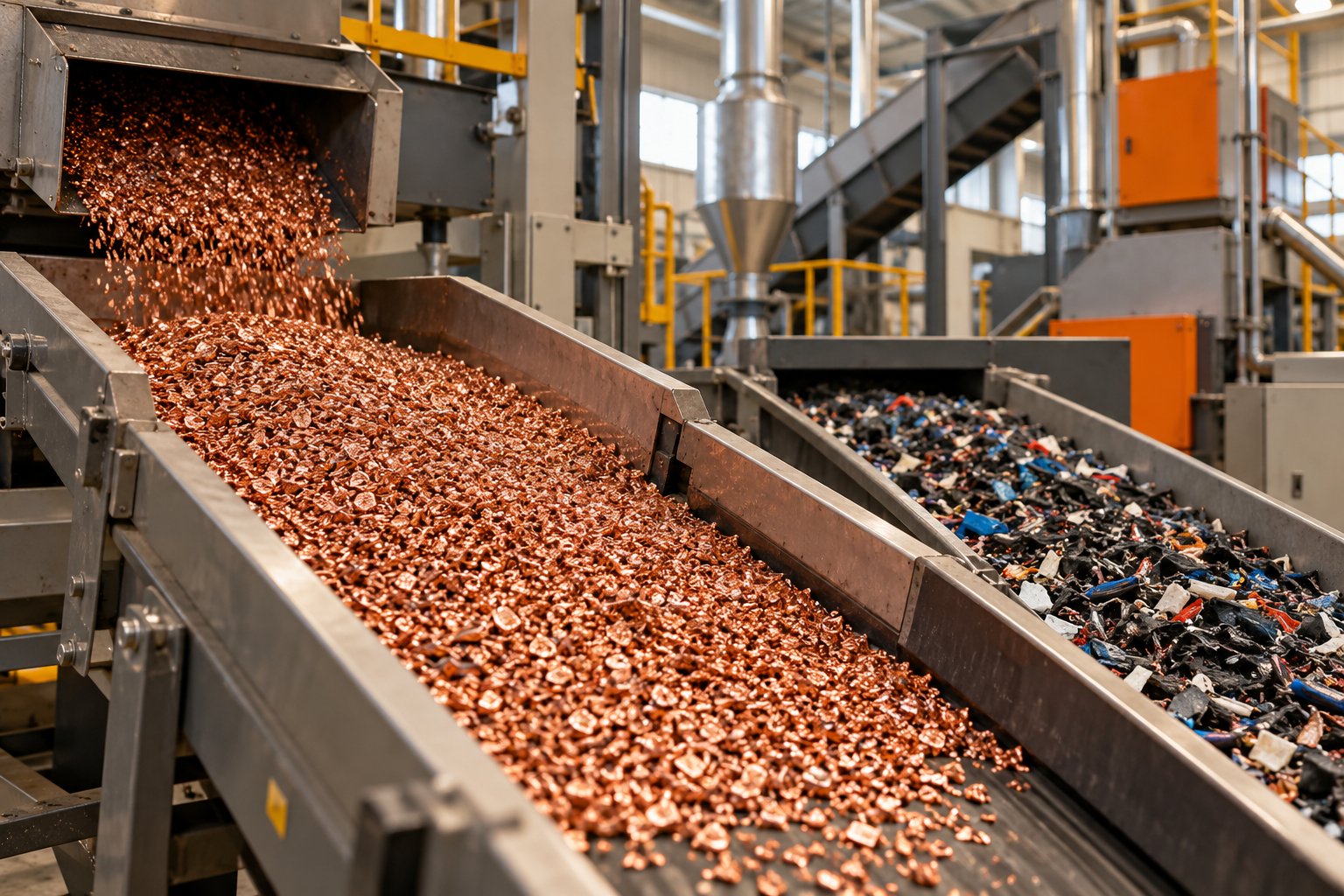
Copper Recovery & Cable Recycling
Coated copper wire is worth less per pound than stripped copper because you are selling insulation along with metal. The buyer pays for copper content, then deducts for the plastic or rubber that has to be separated and disposed of. In practice, the gap between insulated wire and bare bright copper comes down to one variable: insulation weight as a percentage of the whole.
- Insulated wire is priced on copper yield — the weight of recoverable conductor per pound of incoming material.
- A high insulation-to-copper ratio dilutes value; the same weight of stripped copper is worth more than coated wire.
- Hand stripping works for small volumes and thick conductors; granulation and chopping lines handle mixed, thin, or high-volume scrap.
- Mechanized recovery usually beats manual stripping once volume, labor cost, or conductor size make hand work uneconomical.
Why Coated Wire Pays Less Per Pound
When you sell insulated copper wire, the scale does not distinguish between metal and coating. A 100 lb bundle might contain 60–70 lb of copper and 30–40 lb of insulation, depending on the cable type and wall thickness. The buyer pays a price that reflects the copper content only — and then subtracts for the cost of separating and disposing of the insulation.
Stripped copper, by contrast, is nearly all metal. Bare bright copper — clean, uncoated, unalloyed wire — typically commands the highest price. The difference between the two is not a rip-off; it is a direct consequence of what is actually in the box.
The formula is straightforward:
- Copper yield (lb) = total weight × copper percentage
- Recovered value = copper yield × bare copper price − processing cost
If the copper percentage is low, the recovered value drops even when the total weight looks attractive.
How Insulation Weight Dilutes Copper Yield
Insulation thickness varies widely. A thin-walled automotive wire might be 10–15% insulation by weight. A heavily jacketed power cable can exceed 40%. The higher the insulation percentage, the more you are paying to ship and process material that is not copper.
For example, consider two 100 lb bundles:
| Bundle | Copper % | Copper lb | Insulation lb |
|---|---|---|---|
| Thin-walled wire | 85% | 85 | 15 |
| Heavy-jacketed cable | 60% | 60 | 40 |
The thin-walled bundle delivers 25 lb more copper for the same incoming weight. That is the dilution effect, and it is why insulated wire is often bought on a recovery basis rather than a flat per-pound price.
Stripping Options: Manual vs Mechanized
Once you decide to recover the copper yourself, the next question is how. Three common methods:
Hand Stripping
A manual or bench-mounted stripper cuts and peels insulation from the conductor. It is slow, labor-intensive, and best for short lengths or thick, single-conductor cable. Hand stripping makes sense when volume is low, when you need clean bare bright copper for a specific buyer, or when the cable is too large for a chopping line.
Chopping
Chopping reduces cable to short segments, often as a pre-step before granulation. It does not separate copper from insulation on its own, but it prepares material for the next stage. Chopping is useful for long lengths and mixed bundles that would otherwise be difficult to feed.
Granulation
Granulation shreds and separates cable into copper granules and plastic or rubber granules. A cable and wire recycling line combines chopping, granulation, and separation into a continuous process. The output is clean copper granules ready for sale, plus separated insulation that can be handled as a separate stream.
Granulation handles thin, mixed, and high-volume scrap that would be impractical to strip by hand. It also reduces labor exposure and can process material consistently.
When Mechanized Recovery Beats Manual Stripping
Manual stripping wins on very small volumes and simple, thick cable. Mechanized recovery — chopping and granulation — wins when:
- Volume is high enough that labor hours per pound become uneconomical.
- Conductor is thin or stranded, making hand stripping slow and inconsistent.
- Insulation is tightly bonded or cross-linked, so clean manual separation is difficult.
- You need a repeatable copper product with consistent granule size for resale.
- You want to recover both copper and insulation as separate saleable or disposable streams.
The decision is not about which method is “better” in the abstract. It is about matching the method to the material and the volume. A recycler processing mixed telecom or power cable at scale will typically find that a granulation line pays for itself in labor savings and improved yield, while a small shop stripping heavy cable by hand may not need one.
Choosing a Recovery Line
If mechanized recovery is the right fit, look for a line that separates conductor from insulation into clean granules. The TG-CableLine 100 cable and wire recycling line is designed to do exactly that — chopping and granulating cable so copper and insulation leave as distinct streams.
When evaluating a line, ask about throughput, the range of cable diameters it accepts, how it handles mixed feed, and how separation is achieved. These are the variables that determine whether the output copper meets your buyer’s specification.
Frequently Asked Questions
Is coated copper wire always worth less than stripped copper?
Yes, per pound of incoming material, insulated wire is generally worth less than stripped copper because part of that weight is insulation. The exact discount depends on the copper yield and current copper price.
How do I calculate the value of coated copper wire?
Estimate the copper percentage by weight, multiply by the total weight to get copper pounds, then apply the current bare copper price. Subtract any processing or disposal cost to arrive at a net figure.
Can hand stripping match granulation for value?
Hand stripping can produce clean bare copper, but it is limited by labor and cable type. For thin or mixed cable, granulation typically recovers more copper per hour and produces a more consistent product.
What happens to the insulation after granulation?
It is separated as plastic or rubber granules. Depending on the material and local regulations, it may be recyclable or require disposal. A well-designed line keeps the two streams clean.
Next Steps
If you are selling coated wire and want to understand the value gap, start by testing your material for copper yield. If you are processing enough volume to justify mechanized recovery, review the specifications of a cable and wire recycling line and compare its throughput and separation performance against your material mix. For specific yield, throughput, and configuration details, contact the supplier directly.