
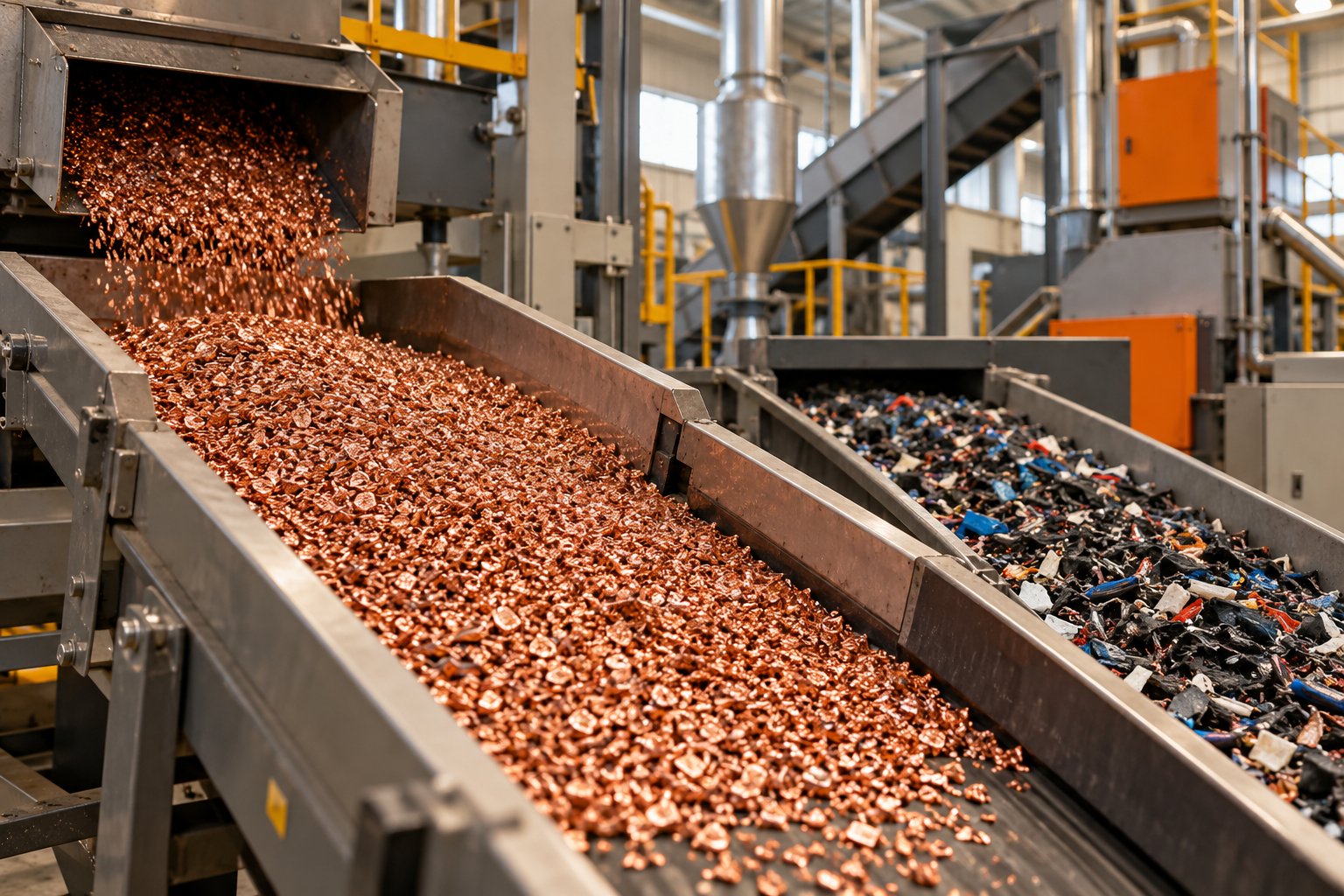
There is no single answer to how much scrap copper wire is worth, because copper wire is not one commodity. A yard prices every load on the copper it can actually recover, the cost of getting the insulation off, and what it can sell that copper into. Two loads with the same gross weight can pay out very differently.
Key takeaways
- Price is quoted per pound or per kilogram of the material you actually deliver, and the copper content sets most of that figure.
- Insulation ratio, contamination, and mixed grades are the three fastest ways a load loses value.
- Yard structure — volume, grade definitions, and downstream buyers — explains why two yards a few miles apart quote differently.
- Sorting and clean stripping are the preparation steps that most reliably raise a payout without changing the copper itself.
What this article covers
Grade and insulation content
The first thing a yard asks is what kind of wire is in front of it. Bare bright copper, stripped copper wire that still carries a light tarnish, and insulated wire are three different products to a yard, and they are handled on separate lines.
Insulated wire is priced around its copper yield. A cable that is 70 percent copper by weight is not the same product as the same cable at 40 percent copper, even though both are sold as "copper wire." The insulation is weight you pay to transport and weight the yard pays to remove or dispose of, so the copper-to-insulation ratio sits underneath every quoted figure.
| Material | What the yard assesses | Typical handling |
|---|---|---|
| Bare bright copper | Verifies no coating, solder, or mixed alloy | Weighed as-is, higher grade |
| Stripped wire with tarnish or solder | Checks oxidation, tin coating, and end treatments | Weighed as-is, mid grade |
| Insulated cable | Estimates copper yield and insulation type | Processed to separate copper from insulation |
| Mixed or unknown wire | Identifies alloys, connectors, and non-copper content | Often downgraded until sorted |
The recovery step matters here. Equipment such as the TG-CableLine 100 cable and wire recycling line recovers copper granules separated from insulation, which is how processors turn mixed cable into a copper product that can be graded and sold on its own terms rather than as unsorted scrap.
Cleanliness and contamination
Contamination is deducted in weight, in grade, or as a processing charge, and yards choose whichever reflects how the material behaves in their process. Common deductions come from:
- Plastic, rubber, or paper insulation and cable filler that will not be removed before weighing.
- Steel, aluminum, or brass connectors, terminals, and armour.
- Solder, tin coating, paint, tape, and adhesive residue.
- Water, oil, or dirt, which adds weight that is not copper.
- Attached fittings, clamps, and junction boxes.
A load that looks clean but contains a hidden proportion of non-copper metal can be downgraded to a mixed category. That single change in grade usually costs more than any negotiation over the time of day or the scale used.
Weight, sorting, and load size
Weight drives the total payout, not the unit rate. Small lots of loose wire attract more handling per pound than palletised or baled material, and some yards set a minimum quantity before they will quote a higher grade at all.
Sorting changes weight in a subtle way: separating grades does not add copper, but it stops high-grade wire from being absorbed into a mixed category. A mixed box of bright, tarnished, and insulated wire is typically valued as something close to the lowest grade in the box. Sorted boxes are valued grade by grade.
Market timing
Copper prices move on exchange markets, and yards re-price their buying sheets against those movements. The practical points for a seller are:
- Ask how often the yard updates its buying sheet — daily, weekly, or on each quote.
- Ask whether the price is locked at drop-off or at settlement, since those can fall on different days.
- For large or recurring volumes, ask whether the yard quotes against an exchange reference plus a stated deduction.
Timing cannot be controlled reliably, but the pricing mechanism behind a quote can be understood before material leaves your site.
Local yard structure
Two yards in the same region may quote different numbers for identical material because their downstream options differ. A yard feeding a local processor, a yard shipping to an export consolidator, and a yard with its own stripping or granulation capacity all carry different costs and different margins.
Grade definitions are also yard-specific. One yard's "No. 1 copper" may exclude material that another yard accepts, and terms like "birch/cliff" or "light copper" are applied with local interpretation. Before comparing quotes, compare the written grade definitions, the deduction rules for contamination, and whether processing is charged separately.
Preparation steps that raise payouts
- Separate by grade before loading. Keep bare bright, tarnished or coated, and insulated wire in separate containers. Do not let one bright offcut justify a mixed box.
- Remove non-copper attachments. Cut off steel armouring, connectors, clamps, and terminal blocks. These are deducted anyway, and removing them lets the copper be graded on its own.
- Strip where the economics support it. If insulation is thick and the volume is steady, stripping or granulating cable raises the sellable copper content. For thin or mixed cable, it may be more practical to sell as insulated wire and let the processor separate the two materials.
- Keep the material dry and free of filler. Water, oil, and paper filler add weight that will not be paid as copper.
- Consolidate into consistent loads. Baled or palletised material is easier to weigh and to grade than loose bags.
- Request the grade in writing on the ticket. Confirm which grade was applied, the net weight after deductions, and the pricing basis, so the next load can be prepared against a known standard.
Frequently asked questions
Does stripping wire always increase what I get paid?
Not always. Stripping raises the copper content you deliver, but it costs labour and time. It pays when the insulation is thick, the volume is repeatable, and the yard's stripped-wire grade sits well above its insulated-wire rate. For thin, mixed, or low-volume cable, selling it as insulated wire is often the more practical route.
Why did my quote drop after the load was inspected?
Most quotes are provisional until the material is inspected and weighed. A change usually points to a grade reassignment: contamination found inside the load, a mixed category applied instead of a single grade, or a moisture and filler deduction. Ask which line item changed.
Is it better to sell to a yard that processes cable itself?
A yard with stripping or granulation capacity can buy mixed and insulated cable that a pure trading yard may discount further, because the processor can recover the copper directly. The trade-off is that its grade definitions and deduction rules should still be checked against your material, rather than assumed to be more favourable.
No article can state what your wire is worth today. Ask your yard for its current grade definitions, its contamination and moisture deduction rules, and its pricing basis, then prepare the load against those specific terms.