
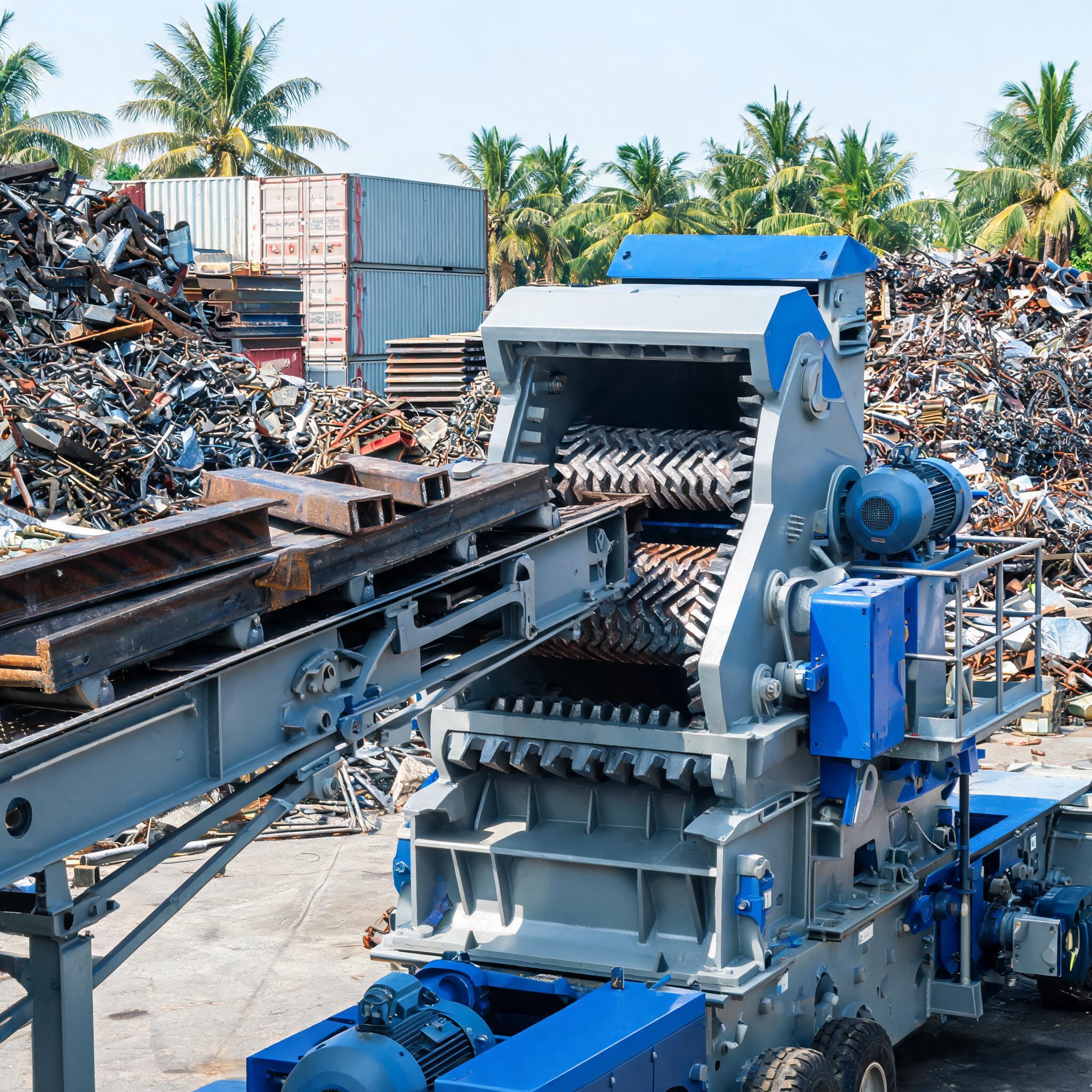
When you run a scrap yard in Ho Chi Minh City or a quarry in Central Java, the primary crusher is the first machine that takes the brunt of your material. It sets the tone for your entire processing line. Choosing the wrong jaw crusher means bottlenecks, excessive wear, and costly downtime. This guide walks you through the key selection criteria—feed opening, discharge size, capacity, and motor power—so you can make an informed decision for your operation in Southeast Asia.
In this guide
Why the primary jaw crusher matters
A primary jaw crusher is the first stage in size reduction. It takes large, irregular chunks—whether scrap metal or blasted rock—and breaks them down to a size that downstream equipment can handle. In scrap processing, you might feed cast iron, thick-walled steel sections, or hardened metal components. In mining and quarrying, you feed run-of-mine ore or coarse aggregate. In both cases, the jaw crusher must be robust enough to handle the toughest material without frequent breakdowns.
In Southeast Asia, where operations often run in humid, high-temperature conditions, reliability is critical. A machine that needs constant repairs will eat into your margins. That's why choosing the right primary crusher is not just about price; it's about total cost of ownership.
Key takeaways
- Feed opening must be 15-20% larger than your largest feed piece to prevent bridging.
- Discharge size is set by the closed side setting (CSS); hydraulic adjustment makes changes easier.
- Capacity should be based on your required tons per hour, considering material density and bulk weight.
- Motor power must match the crusher's duty to avoid overloading or underperformance.
- Always confirm specifications with your supplier—especially for custom applications.
Feed opening: match your largest piece
The feed opening (also called feed inlet) is the dimension of the top opening where material enters the crusher. It's usually given as width x length (e.g., 600 x 900 mm). This determines the maximum size of material you can feed. If a piece is too large, it won't fit through the opening, causing bridging and jams.
As a rule, the feed opening should be 15-20% larger than the largest piece you plan to process. For example, if your scrap chunks are typically 500 mm, a 600 x 900 mm opening gives you enough clearance. For quarries, consider the blast fragmentation size—if you have large boulders, you may need a bigger opening.
Here's a quick decision boundary:
- Scrap yards: Look for a feed opening that can accept the largest engine blocks, steel sections, or reinforced concrete pieces you handle.
- Quarries: Match the opening to your primary blast size; if you have variable fragmentation, err on the larger side.
If your feed material varies greatly in size, you might consider a pre-scalping screen to remove fines, but that's a separate consideration. For now, focus on the opening.
Discharge size: control your output gradation
The discharge size (also called closed side setting, CSS) is the smallest gap between the jaw plates at the bottom of the crushing chamber. It determines the top size of the crushed product. A smaller CSS gives a finer product but reduces throughput; a larger CSS increases throughput but gives a coarser product.
Most modern jaw crushers offer hydraulic discharge adjustment, allowing you to change the CSS quickly without manual shimming. This is especially useful when you need to switch between different product specifications. For example, a scrap yard might want a coarse output for shearing, while a quarry might need a finer product for further crushing.
Consider the following:
- Scrap processing: You want a discharge size that makes the material manageable for downstream separation or shearing. Too fine might cause excessive wear; too coarse might require secondary crushing.
- Mining/quarrying: The discharge size should match the feed size of your secondary crusher (like a cone crusher) or the product specification you need.
Hydraulic adjustment is a valuable feature—it saves downtime and lets you adapt to different materials quickly. When comparing crushers, check if the adjustment is hydraulic or manual. Manual adjustment is more labor-intensive and slower.
Capacity: match your tonnage goals
Capacity is the throughput the crusher can achieve, usually measured in tons per hour (t/h). It depends on several factors: the feed opening, discharge setting, material density, bulk density, and the crusher's design. A larger feed opening and wider discharge setting generally give higher capacity, but the actual number also depends on the material's characteristics.
When selecting a crusher, define your required capacity based on your production goals. For example, if you need to process 100 tons of scrap per day over an 8-hour shift, you need a crusher that can handle at least 12.5 t/h, but you should factor in downtime, so a bit more is safer.
Here's a practical approach:
- Estimate your daily or hourly tonnage requirement. Include peak periods if your feed varies.
- Consider the material's bulk density. Scrap metal is denser than rock, so the same crusher will have a different capacity for each.
- Check the crusher's capacity chart (provided by the supplier) for your specific discharge setting.
Remember, capacity is not a fixed number—it varies with CSS. A crusher that does 80 t/h at a 100 mm CSS might do only 50 t/h at a 50 mm CSS. Always ask for a capacity curve, not just a single number.
Motor power: balance efficiency and duty
The motor power (kW) drives the crusher's eccentric shaft, which moves the jaw. The power must be sufficient to crush the material without stalling, but not so high that it wastes energy. The right power depends on the material's hardness, the feed size, and the required capacity.
A crusher with a larger feed opening and higher capacity will typically require a more powerful motor. But you also need to consider the duty cycle—how continuous is your operation? A scrap yard that processes in batches might need a different motor rating than a quarry running 24/7.
Here are some guidelines:
- Hard rock and abrasive materials require more power and heavier construction.
- Scrap metal can be tough but may have varying shapes that cause impact loads; the motor should handle peak loads.
- Electricity costs in Southeast Asia vary by country; a more efficient motor might save money in the long run.
Always match the motor power to the crusher's specifications. Underpowering leads to stalling and damage; overpowering wastes energy. The supplier should provide a recommended power range based on your application.
Quality and supplier considerations
Once you've narrowed down the technical specs, you need to evaluate the supplier. A reliable supplier not only provides a quality machine but also supports you with installation, training, and after-sales service. Here's what to look for:
- Manufacturing capabilities: Does the supplier have in-house machining, welding, and electrical assembly? This often indicates better quality control.
- Certifications: Look for CE marking and ISO 9001 manufacturing standards, which show compliance with international norms.
- Lead time: For standard models, a lead time under 45 days is reasonable. Custom orders may take longer.
- Warranty and spare parts: A 12-month warranty with spare-parts kits is common. Ensure that spare parts are readily available.
- Installation support: Does the supplier offer installation supervision and operator training? This is crucial for a smooth startup.
For example, Tiangong Technology Co., Ltd., founded in 2008, has a 12,000 m² production facility with in-house machining, welding, and electrical assembly. They offer standard models with a lead time under 45 days, a 12-month warranty with spare-parts kits, and installation supervision and operator training. Their TG-Jaw 600 Primary Jaw Crusher is a heavy-duty compression jaw crusher designed for primary size reduction of cast iron, thick-walled steel sections, and hardened metal components. It features a 600 x 900 mm feed opening, manganese steel liners, hydraulic discharge adjustment, and is CE marked and ISO 9001 manufactured.
When evaluating a supplier, ask for references in your region—though note that customer cases should be verified. Also, confirm the availability of spare parts and the response time for service calls.
FAQ
What is the difference between a primary and secondary jaw crusher?
A primary jaw crusher is the first stage, handling large, coarse material. A secondary crusher (like a cone crusher or impact crusher) processes the output further to produce finer material. For example, after a primary jaw crusher, you might use a cone crusher for secondary reduction in mining, or a horizontal impact crusher for shaping.
How do I determine the right feed opening size?
Measure the largest piece you need to process and add 15-20% clearance. If your largest scrap piece is 500 mm, a 600 x 900 mm opening is suitable. For quarries, consider the blast fragmentation.
What is the role of hydraulic discharge adjustment?
It allows you to change the CSS quickly to control the output size without manual shimming. This is useful for switching between product specs or adjusting for wear.
Can the same jaw crusher handle both scrap and rock?
Yes, but the capacity and wear will differ. Scrap metal is denser and can cause impact loads, while rock is abrasive. Confirm with the supplier that the crusher is suitable for your specific material.
What should I check in the supplier's warranty?
Ensure the warranty covers parts and labor for at least 12 months, and that spare parts kits are available. Also, check if installation supervision and training are included.
Next steps
Choosing the right primary jaw crusher is a critical decision. Start by defining your material characteristics and production goals. Then, match the feed opening, discharge size, capacity, and motor power to those requirements. Finally, evaluate suppliers based on manufacturing quality, certifications, and after-sales support.
If you're processing scrap, consider an integrated system like the TG-Scrapline 150 Integrated Scrap Processing System, which may offer a complete solution. For mining, a primary jaw crusher followed by a cone or impact crusher is a common setup.
Contact us to discuss your specific application. We can help you select the right crusher and provide detailed specifications based on your material and capacity needs. Remember to confirm all technical details with our engineers before ordering.