Metal Separation Equipment Selection Guide
If you run a scrap yard or recycling plant in Vietnam, Indonesia, Thailand, Malaysia, or the Philippines, you have likely faced this question: Which separation technology do I actually need? Magnetic separator, eddy current separator, or air classification? The answer depends entirely on your input material. This guide compares the three core technologies, explains what each one removes, and shows how they work together in integrated recovery lines.
Key Takeaways
- Magnetic separation removes ferrous metals (iron and steel).
- Eddy current separation recovers non-ferrous metals (aluminum, copper, brass).
- Air classification separates light fractions (plastic, rubber, dust) from heavier metal.
- Most scrap streams need more than one technology; integrated lines combine all three for maximum recovery.
- Choose based on your feed: e-waste, end-of-life vehicles, aluminum scrap, or cable.
What Each Technology Removes
The three separation technologies target different fractions of a scrap stream. Understanding what each one can and cannot do is the first step in selecting equipment.
| Technology | What It Removes | Typical Feed | Output |
|---|---|---|---|
| Magnetic separator | Ferrous metals (iron, steel) | Shredded scrap, e-waste, ELVs | Clean ferrous fraction |
| Eddy current separator | Non-ferrous metals (aluminum, copper, brass) | Post-magnetic stream | Concentrated non-ferrous fraction |
| Air classification | Light materials (plastic, rubber, dust, insulation) | Shredded cable, e-waste, ELV residue | Heavy metal concentrate and light fraction |
Magnetic Separation
Magnetic separation is the most straightforward technology. It uses a magnetic field to pull ferrous metals—iron and steel—out of a mixed stream. In most recycling lines, it is the first separation stage because ferrous metals are easy to remove and represent a large portion of many scrap streams.
When do you need it? If your input contains any steel or iron—which almost all scrap does—you need a magnetic separator. For example, end-of-life vehicles are mostly steel. An ELV shredding line without a magnetic separator would lose the most valuable fraction.
Magnetic separators come in different designs: drum, overbelt, and crossbelt. The choice depends on the particle size and throughput. For integrated lines, an overbelt magnet is common after the shredder, pulling ferrous material off the conveyor before further processing.
Eddy Current Separation
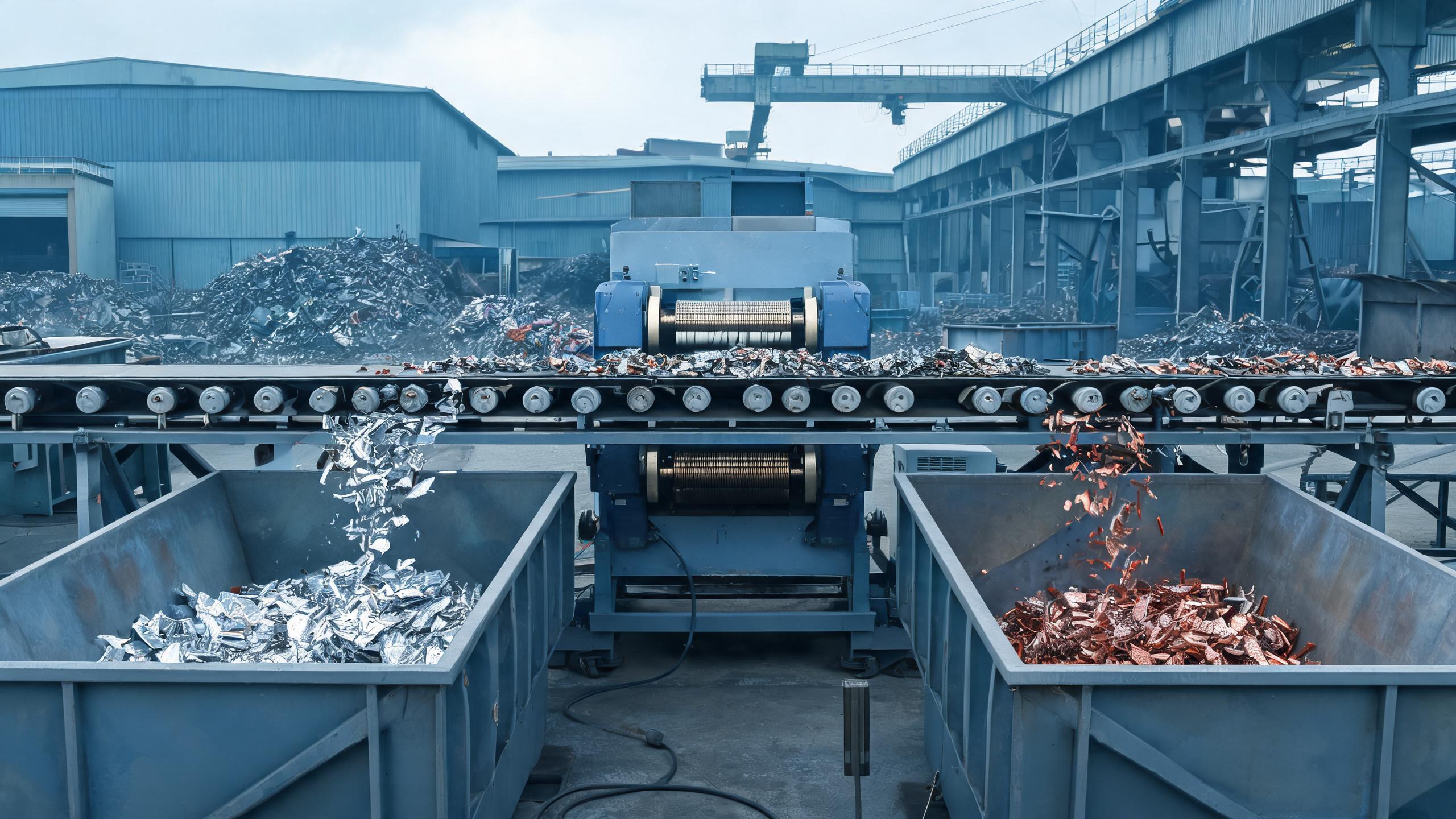
Eddy current separation is the key technology for recovering non-ferrous metals. It uses a rotating magnetic rotor to induce eddy currents in conductive non-ferrous metals, causing them to be repelled and thrown forward, while non-metals fall naturally. This separates aluminum, copper, and brass from plastics and other non-conductive materials.
Eddy current separators are essential for e-waste, aluminum scrap, and any stream where non-ferrous metals are mixed with non-metals. For example, after shredding aluminum scrap, an eddy current separator separates the aluminum from any remaining plastic or rubber.
It is important to note that eddy current separators work best on material that has already had ferrous metals removed. If steel remains in the feed, it can damage the belt or reduce separation efficiency. That is why magnetic separation almost always comes first.
Air Classification
Air classification uses an air stream to separate light materials from heavier ones. It is used to remove dust, plastic film, rubber, and insulation from shredded metal. The light fraction is blown away, while the heavier metal falls through.
Air classification is particularly useful for cable and wire recycling, where copper or aluminum conductors must be separated from plastic and rubber insulation. It is also used in e-waste and ELV lines to remove light residue before or after other separation stages.
Air classification does not separate metal from metal. It only separates by density and aerodynamic properties. Therefore, it is not a substitute for magnetic or eddy current separation, but it complements them by cleaning the stream.
Choosing by Input Material
The right technology depends on what you are feeding. Here is a practical breakdown for common scrap streams in Southeast Asia:
E-Waste (Discarded Electronics)
E-waste contains a mix of ferrous metals, non-ferrous metals (copper, aluminum), and plastics. After removing batteries, a complete line would use magnetic separation to pull steel, then eddy current separation to recover non-ferrous metals, and air classification to remove plastic and dust. This is exactly the configuration of Tiangong's TG-EWasteLine 150 E-Waste Metal Recovery Line, which combines a twin-shaft shredder, granulator, magnetic separator, eddy current separator, and air classification.
End-of-Life Vehicles (ELVs)
ELVs are mostly steel, but they also contain aluminum, copper, and plastics. After depollution, the hulk is shredded. A magnetic separator removes the steel, an eddy current separator recovers the non-ferrous metals, and air classification separates the light residue. Tiangong's TG-ELVLine 300 uses this exact combination.
Aluminum Scrap
Aluminum scrap, such as old window frames or cans, is often contaminated with steel fasteners and plastic or rubber parts. A magnetic separator removes the steel contaminants, and an eddy current separator isolates the aluminum. An air classification step can remove light materials before briquetting. Tiangong's TG-AluLine 200 includes magnetic contaminant removal, an eddy current separator, and a hydraulic briquetting press.
Cable and Wire
Cable scrap consists of copper or aluminum conductors with plastic or rubber insulation. The goal is to separate the conductor from the insulation. A granulator reduces the cable to small particles, and air classification separates the lighter insulation from the heavier metal. A vibration table can further refine the separation. Tiangong's TG-CableLine 100 uses twin-shaft shredder, granulator, air separation, and vibration table.
How Integrated Lines Combine Technologies
Real-world scrap is rarely homogeneous. That is why integrated recovery lines combine multiple separation technologies in sequence. Each stage removes a specific fraction, and the output of one stage becomes the input of the next.
A typical integrated line follows this order:
- Shredding – reduces the input to a manageable particle size.
- Magnetic separation – removes ferrous metals.
- Eddy current separation – recovers non-ferrous metals.
- Air classification – removes light materials and dust.
This sequence maximizes recovery of valuable metals while producing clean fractions that can be sold at higher prices. It also reduces the amount of residue sent to landfill. Tiangong's integrated lines, such as the TG-EWasteLine 150 and TG-ELVLine 300, are designed with this logic.
A Simple Decision Framework
To choose the right equipment, ask these questions:
- Does my feed contain ferrous metals? If yes, start with a magnetic separator.
- Does my feed contain non-ferrous metals mixed with non-metals? If yes, add an eddy current separator.
- Does my feed contain light materials like plastic or rubber? If yes, include air classification.
- Do I need to produce a clean, high-value metal fraction? If yes, combine two or more technologies.
| Input Material | Recommended Technology |
|---|---|
| Mixed scrap with steel and aluminum | Magnetic + Eddy current |
| E-waste (after battery removal) | Magnetic + Eddy current + Air classification |
| ELV hulks (depolluted) | Magnetic + Eddy current + Air classification |
| Cable and wire | Air classification + Vibration table |
| Aluminum scrap with contaminants | Magnetic + Eddy current |
FAQ
Can I use only a magnetic separator for all scrap?
No. A magnetic separator only removes ferrous metals. Non-ferrous metals and light materials will remain in the stream. For mixed scrap, you need additional technologies.
Which is better: eddy current or air classification?
They serve different purposes. Eddy current separates non-ferrous metals from non-metals. Air classification separates light materials from heavier ones. You may need both.
How do I know if I need an integrated line?
If your input contains multiple valuable fractions (ferrous, non-ferrous, and light materials), an integrated line will recover more value and reduce residue. For a single-material stream like clean cable, a simpler setup may suffice.
What about throughput?
Integrated lines from Tiangong are available in capacities from 2 to 30 t/h, depending on the model. Confirm the exact capacity for your application with the supplier.
Next Steps
Choosing the right metal separation equipment is a decision that affects your recovery rate, product quality, and profitability. Start by analyzing your input material and identifying which fractions you want to recover. Then, map each fraction to the appropriate technology. If you are unsure, discuss your feed composition with an equipment supplier—they can recommend a line that fits your needs.
Tiangong has been manufacturing recycling equipment since 2008, with a 12,000 m² facility, CE marking, ISO 9001 certification, and a 12-month warranty. Their integrated lines are designed to combine separation stages for maximum recovery. To learn more about how their systems can be configured for your scrap stream, contact their team with details about your material and throughput requirements.