In this article
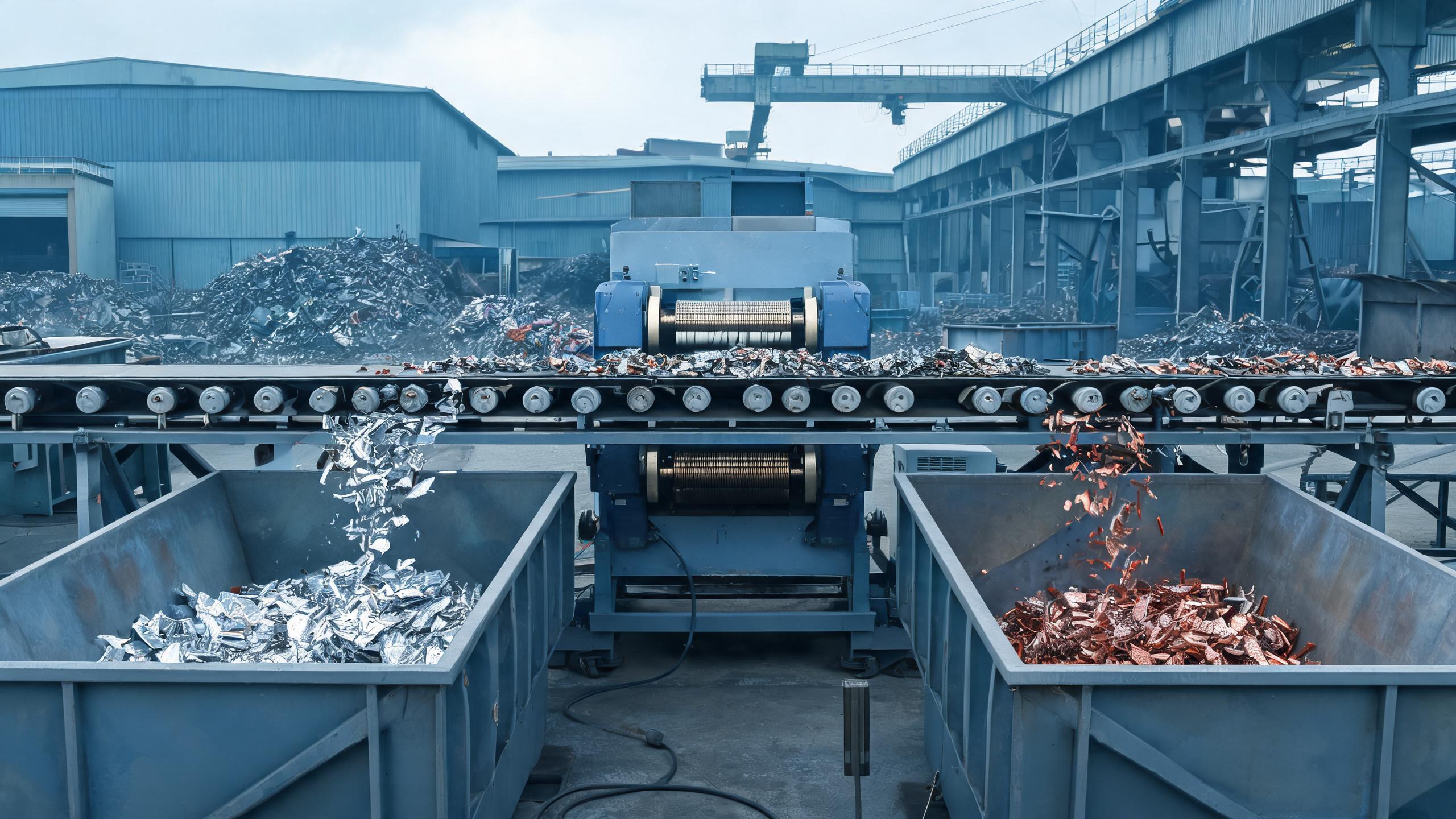
For a scrap yard owner in Southeast Asia, the decision to invest in a non-ferrous metal recovery line usually comes from a practical problem: the mixed scrap coming in contains valuable aluminum, copper, and other non-ferrous metals, but pulling them out by hand is slow and inconsistent. You know the value is there, but you need a process that can separate it reliably at scale.
This article explains what a complete non-ferrous metal recovery line looks like, stage by stage, and what to consider when choosing equipment for each step. It focuses on the process itself, not on comparing specific separator brands.
How a recovery line works: four stages
A typical recovery line follows a logical sequence designed to isolate non-ferrous metals from mixed waste or scrap. Each stage has a distinct job, and the output of one stage becomes the input for the next. The four main stages are:
- Shredding – reducing material size for effective separation.
- Ferrous removal – pulling out iron and steel with magnetic separation.
- Eddy current separation – ejecting non-ferrous metals from the remaining stream.
- Sorting and refining – further cleaning and grading the recovered metals.
Key takeaways
- A complete non-ferrous recovery line combines shredding, ferrous removal, eddy current separation, and sorting—each stage has a specific role.
- Magnetic separation always comes before eddy current separation, because ferrous metals can damage the eddy current rotor.
- Throughput requirements (measured in tonnes per hour) drive equipment sizing across all stages.
- Modular lines allow scrap yards to start with a shredder and separator, then add sorting or briquetting later.
Stage 1: Shredding
The first step in any recovery line is reducing the incoming scrap to a consistent, manageable size. Shredding serves two purposes: it liberates metals that are attached to other materials (such as copper wires embedded in plastic), and it creates a uniform particle size that allows downstream separation equipment to work effectively.
Two common types of shredders are used in this role:
- Twin-shaft shredders – these use two counter-rotating shafts with cutting discs to tear material apart. They are well-suited for general scrap, including mixed metals, plastics, and light industrial waste. The slow-speed, high-torque design handles bulky items without jamming.
- Hammer mills – these use high-speed rotating hammers to impact and break material. They are effective for brittle materials and for further reducing the output of a primary shredder. For end-of-life vehicles, a hammer mill is often the main size-reduction unit.
The choice between these depends on the feed material. For a general scrap yard handling mixed waste, a twin-shaft shredder is often the first stage. For a more specific application, such as processing entire vehicles, a hammer mill-based line is more appropriate. For example, the TG-ELVLine 300 End-of-Life Vehicle Shredding and Recycling Line uses a hammer mill as its primary size-reduction unit, followed by magnetic separation and air classification.
Stage 2: Ferrous removal
After shredding, the material stream contains a mix of ferrous metals (iron and steel), non-ferrous metals, and non-metallic waste. The next step is to remove the ferrous fraction using magnetic separation.
This is a critical step for two reasons. First, ferrous metals have commercial value and should be recovered as a separate product. Second, ferrous metals left in the stream can damage downstream equipment, particularly the eddy current separator, whose high-speed rotor is sensitive to large or sharp steel pieces.
Magnetic separation typically uses an overhead magnetic belt or drum magnet positioned above the conveyor. As the shredded material passes underneath, ferrous pieces are attracted to the magnet and carried away, dropping into a separate collection bin. The remaining material continues down the line.
Stage 3: Eddy current separation
The eddy current separator is the heart of a non-ferrous recovery line. It is the equipment that actually separates aluminum, copper, brass, and other non-ferrous metals from the remaining waste stream.
The working principle is based on electromagnetic induction. A rotor with alternating magnetic poles spins at high speed inside a shell at the head of a conveyor belt. As non-ferrous metal particles pass over the rotor, the changing magnetic field induces eddy currents within them. These eddy currents create their own magnetic field, which opposes the rotor's field, causing the non-ferrous particles to be repelled and ejected forward off the belt. Non-metallic materials (plastic, rubber, wood) simply fall off the end of the belt under gravity, creating a clean separation.
Because this is a physical process, the eddy current separator does not require chemicals or water, making it a low-operating-cost technology. It is also fast, capable of processing material at the same rate as the conveyor feeding it.
For a scrap yard, the eddy current separator is the key value-generating asset. It converts a mixed waste stream into a saleable non-ferrous concentrate. Many complete lines, such as the TG-AluLine 200 Aluminum Scrap Recycling Processing Line, integrate the eddy current separator directly after magnetic contaminant removal, so the non-ferrous fraction is extracted in a single pass.
Stage 4: Sorting and refining
The output of the eddy current separator is a mixed non-ferrous concentrate. Depending on the target market, this may be sufficient. But for higher value, further sorting is needed to separate aluminum from copper, or to remove remaining contaminants.
Several options exist at this stage:
- Air classification – uses air flow to separate light materials (dust, paper, plastic film) from heavier metal particles. This is often used earlier in the line, but can also refine the non-ferrous concentrate.
- Density separation – uses water or fluidized beds to separate metals by density. Aluminum floats while heavier metals like copper and zinc sink, allowing a split into different grades.
- Sensor-based sorting – uses X-ray or near-infrared sensors to identify different metal types and direct them to different bins via air jets. This is the most precise method but also the most capital-intensive.
For many scrap yards, a simpler approach is sufficient. After eddy current separation, the non-ferrous concentrate can be passed through a briquetting press to compress it into dense briquettes. This reduces volume, improves handling, and can command a better price from smelters. The TG-AluLine 200 includes a hydraulic briquetting press for this purpose, turning the separated aluminum into compact, transportable briquettes.
Equipment selection considerations per stage
When planning a non-ferrous metal recovery line, the most important factor is throughput—how many tonnes per hour you need to process. This determines the size of every component in the line. A line designed for 2 t/h will have a much smaller footprint and lower cost than one built for 30 t/h, and the difference is not just in the shredder; the conveyor widths, separator sizes, and collection systems must all be matched.
Here are the key considerations for each stage:
| Stage | Key selection criteria | Common pitfalls |
|---|---|---|
| Shredding | Feed material type (mixed scrap vs. vehicles vs. cables); output particle size required by downstream equipment; power consumption. | Choosing a shredder too small for the input volume, causing bottlenecks; not considering the need for pre-sorting to remove oversized items. |
| Ferrous removal | Magnet strength and belt width; ability to handle high volumes of ferrous material without clogging. | Placing the magnet too close to the shredder output, causing it to pull sharp steel pieces and damage the belt. |
| Eddy current separation | Rotor speed and magnetic strength (affects recovery of fine vs. large particles); belt width to match throughput; ability to adjust splitter position for different materials. | Feeding material that is too large or too small for the separator's optimal range; not protecting the rotor from ferrous contamination. |
| Sorting/refining | Target end product (mixed non-ferrous vs. separated aluminum and copper); acceptable moisture content; space availability for additional equipment. | Over-investing in precision sorting when the market pays the same for a mixed concentrate; ignoring dust control and ventilation. |
Modularity and after-sales support
Another consideration is whether the line can be expanded later. A modular approach—starting with a shredder and eddy current separator, then adding a briquetting press or air classifier—allows you to grow capacity as volumes increase. This is a practical strategy for scrap yards that are still building their supply network.
Supplier reliability is also part of equipment selection. Look for a supplier that can provide installation supervision and operator training, as this reduces the risk of commissioning delays. A 12-month warranty with spare-parts kits is a reasonable baseline to expect. Lead times matter too: for standard models, a lead time under 45 days allows you to plan your yard's operations without long downtime.
For example, Tiangong (天工), founded in 2008, operates a 12,000 m² facility and offers a range of recovery lines with throughput from 2 to 30 t/h depending on the material. Their equipment is CE-marked, and standard models ship in under 45 days. They also provide installation supervision and operator training as part of the package.
Frequently asked questions
Can a single eddy current separator handle all types of non-ferrous metals?
An eddy current separator can recover all non-ferrous metals, including aluminum, copper, brass, and zinc. However, it does not separate them from each other. The output is a mixed non-ferrous concentrate. Further sorting (density or sensor-based) is needed to separate aluminum from copper.
What is the typical throughput of a non-ferrous recovery line?
Throughput depends on the material being processed and the size of the equipment. Lines can range from 2 t/h for small operations to 30 t/h for large industrial facilities. The right throughput depends on your scrap intake volume and the capacity of your collection network.
Do I need a shredder before the eddy current separator?
In most cases, yes. Shredding ensures a consistent particle size and liberates metals from attached materials. Feeding unsorted, bulky scrap directly into an eddy current separator will result in poor recovery and potential equipment damage. The only exception is if your feed is already uniformly small and free of attached materials.
How does a cable recycling line fit into this process?
A cable recycling line is a specialized variant. It focuses on separating copper or aluminum from plastic insulation. The TG-CableLine 100 Cable and Wire Recycling Line is an example of a dedicated solution for this material, incorporating granulation and gravity separation rather than a general-purpose shredder and eddy current separator.
What should I ask a supplier before buying a recovery line?
Ask for the following: throughput range for your specific material, power consumption, floor space requirements, and what training and installation support is included. Also confirm the warranty terms and whether spare parts are stocked for quick delivery. If you plan to expand later, ask whether the line is modular.
Choosing a non-ferrous metal recovery line is a significant investment. Understanding the process stages—shred, remove ferrous, eddy current separate, and sort—helps you ask the right questions and select equipment that matches your scrap intake and target output. If you are planning a new line or upgrading an existing one, contact us to discuss your throughput requirements and material type.