There is no single best wire stripping machine. The best machine for your operation depends on three things: the cables you actually process, their insulation and conductor construction, and how much cable you handle per day. A manual stripper makes sense for a few kilos of clean copper cable a week; a bench-top machine suits regular mixed cable; and an integrated cable granulation line is the right answer when volume, mixed cable types, or small-diameter wire make hand stripping impractical.
This guide gives a decision framework by cable type, insulation type, and volume, and explains when granulation, not stripping, is the better process.
Start with the cable, not the machine
Wire stripping works when the conductor can be separated cleanly from the insulation and when the value of the recovered copper justifies the labor. That is why the first question is not "which machine" but "what is in my pile."
Cable types you are likely to process
- Single-core and household wire (1–3 mm): thin, hard to strip by hand at speed. Usually a granulation job.
- Multi-core flexible cable: many fine strands; hand tools are slow and often nick the copper.
- Armored or sheathed cable (e.g. SWA): an outer sheath, armor, bedding, and inner cores. Two-stage stripping may be needed.
- Large solid or stranded power cable: the best candidate for manual or bench-top stripping, because a single clean cut removes most insulation.
- Communication and data cable: often low copper content per meter; volume processing is needed for it to pay.
Insulation type matters more than color
PVC, XLPE, rubber, and similar materials behave differently under mechanical stripping. Thick, stiff insulation holds its shape and can be slit and pulled. Softer or thin insulation can deform, tear, or cling to fine strands. This is the single biggest reason a machine that works well on one cable can disappoint on another. Before buying, test your own cable samples on the candidate machine.
Match the machine class to your volume
There are three practical equipment classes. Each is best at a different point on the volume curve.
| Machine class | Typical use | Advantages | Limitations |
|---|---|---|---|
| Manual / hand stripper | Repair work, small batches, very thick single-core cable | Low cost, portable, no power supply | Slow; operator fatigue; risk of nicked copper; unsuitable for fine or mixed cable |
| Bench-top stripping machine | Regular mixed cable, small workshops | Faster than hand tools; consistent cut depth; compact | Requires feeding one cable at a time; output limited by the operator; not built for continuous volume |
| Industrial cable granulation line | Scrap yards, recyclers, high daily volume | Handles mixed and small-diameter cable; separates conductor from insulation into clean granules; continuous throughput | Higher capital cost; needs a power supply and floor space; better suited to steady volume |
Manual strippers
Use manual stripping for occasional jobs and for large single-core cable where a controlled cut exposes a long conductor. The economics are simple: if the time spent stripping exceeds what the recovered metal is worth, the method is wrong for that cable.
Bench-top machines
A bench-top machine gives a repeatable strip on a range of cable sizes and is a sensible step up for a workshop that processes a steady but modest quantity. The operator still feeds each cable, so the machine is only as fast as the person loading it. Buy one when your bottleneck is quality and consistency, not raw tonnage.
Industrial cable granulation lines
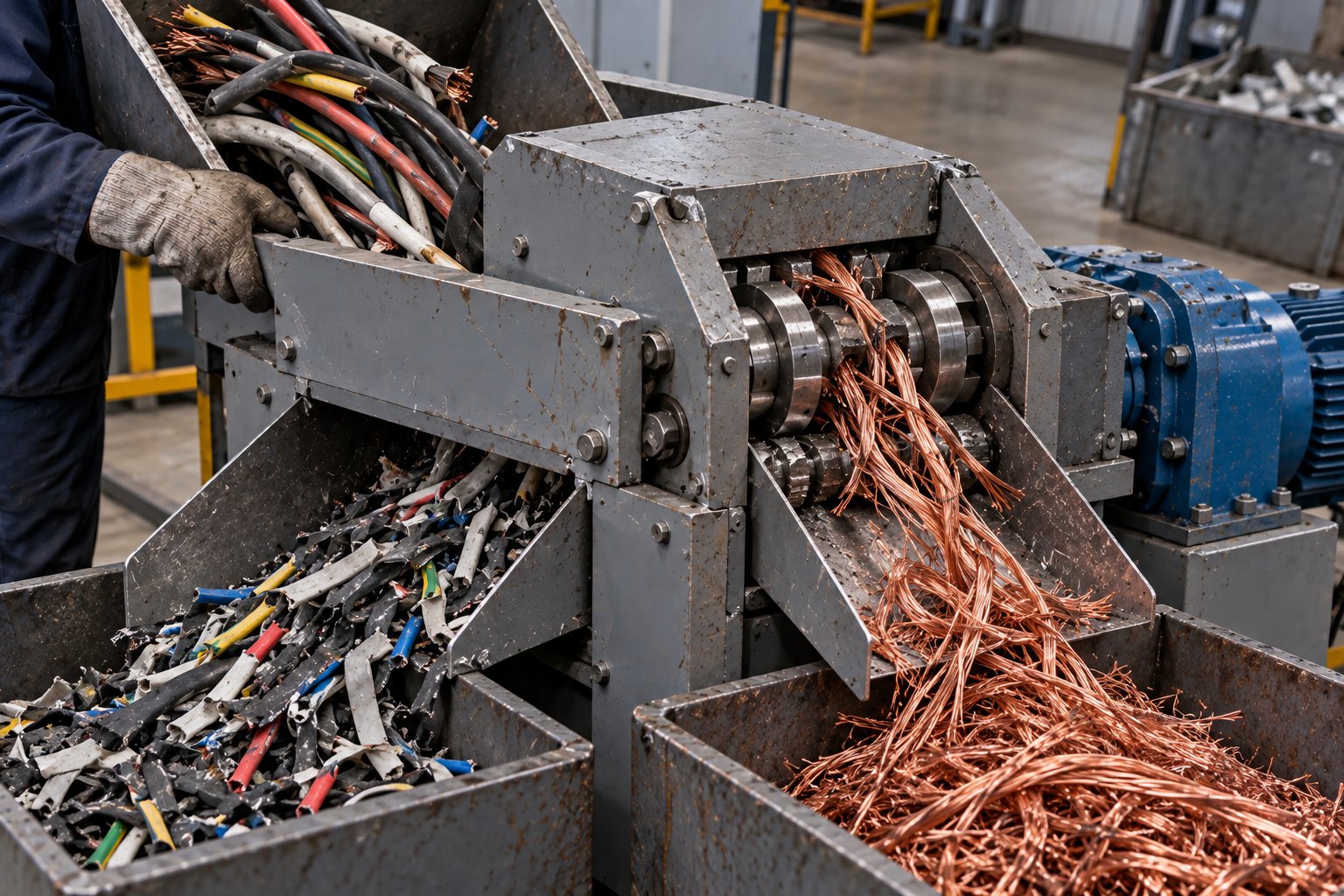
At high volume, or when your cable mix includes fine wire and mixed insulation, stripping becomes a labor problem. An integrated line solves it by size reduction and separation rather than cutting. For example, the TG-CableLine 100 Cable and Wire Recycling Line combines a twin-shaft shredder, a granulator, air separation, and a vibration table to separate copper or aluminum conductor from insulation into clean metal granules. This is the industrial end of the same job: it does not strip a cable, it recovers the metal inside it.
A decision framework you can apply in five minutes
Score your operation against the points below. The first question that fails usually points to the machine class you need.
- Cable diameter and type: Mostly thick single-core? Manual or bench-top. Mostly fine or mixed? Granulation.
- Insulation: Does it slit and pull cleanly? Test it. If it tears or clings to strands, plan for granulation or a pre-shredding step.
- Daily volume: Estimate kilograms per day, not per month. Small and irregular volume favors manual or bench-top; steady volume favors a line.
- Staffing: How many operators can you assign? A bench-top machine consumes one operator continuously. A granulation line runs as a process, freeing labor for sorting and selling.
- Output quality: Do your buyers want clean granules, or intact stripped conductor? Granulation gives clean metal granules; stripping gives intact conductor lengths.
- Space and power: Confirm floor area and power supply before ordering. A granulation line needs more of both.
When granulation wins over stripping
Granulation is the better process in four situations:
- Mixed and small-diameter cable. Hand and bench-top stripping cannot keep up with thin wire; granulation does not care about cable shape.
- High daily tonnage. When volume is steady, a continuous line converts cable into saleable metal granules with predictable labor.
- Fine-strand conductor. Stranded and flexible cable is difficult to strip without nicking; size reduction and air separation handle it more reliably.
- Labor constraints. If skilled strippers are hard to hire or retain, automation removes the bottleneck.
Supplier questions worth asking before you buy
- Can you test my cable samples and report what the machine recovers?
- What is the machine's expected throughput on my cable mix, and under what conditions?
- What maintenance and wear parts are required, and how often?
- Is the equipment CE-marked, and is the factory ISO 9001 certified?
- What warranty and after-sales support are included?
Tian Gong has manufactured metal shredders, crushers, and integrated scrap processing lines since 2008, with CE-marked equipment produced in an ISO 9001 facility and a 12-month warranty. If you are evaluating the industrial end of the framework, the TG-CableLine 100 is one reference point for an integrated cable recycling line.
Frequently asked questions
What is the best wire stripping machine for a small scrap yard?
It depends on volume and cable mix. A bench-top machine is usually the practical choice for modest, regular volumes of strippable cable; a granulation line becomes economical when volume is steady and the mix includes fine or mixed cable.
Can one machine strip all cable types?
No. Different diameters and insulation types behave differently. Always test samples on the candidate machine before committing.
Is granulation better than stripping?
For mixed, fine, or high-volume cable, yes. For thick, clean single-core cable in small quantities, stripping is simpler and cheaper.
What should I prepare before requesting a quote?
Prepare cable samples, an estimate of daily volume in kilograms, the insulation types you process, and your available floor space and power supply.
Next step
The best machine is the one that fits your cable mix, volume, and staffing. Write down your three numbers — cable type, daily kilograms, and operators available — and use them to compare options. For industrial-scale cable processing, review the TG-CableLine 100 product page or contact Tian Gong with your sample details to confirm the right configuration for your material.