Buyer Planning Guide
When you search for a “turnkey metal recycling line from China,” you are not looking for a single shredder or baler. You want a complete system that takes scrap in at one end and delivers clean, sorted metal fractions at the other. For mid-size recyclers in Vietnam, Indonesia, Thailand, Malaysia, and the Philippines, the appeal is clear: one supplier, one scope, one contract. But “turnkey” means different things to different suppliers. This guide explains what a typical Chinese turnkey line includes, how to plan your timeline and plant layout, and which questions to ask before you sign.
Key Takeaways
- A turnkey metal recycling line generally covers feeding, primary shredding, magnetic separation, eddy-current separation, and optional sorting or baling.
- Timeline planning depends on site readiness, permits, equipment production, shipping, and installation—confirm each stage with your supplier.
- Plant layout should follow material flow: receive, shred, separate, sort, store. Leave room for maintenance and future expansion.
- Always ask the supplier for a detailed scope of supply, performance parameters, and what is excluded from the turnkey price.
What a Turnkey Metal Recycling Line Typically Includes
A true turnkey line is more than a collection of machines. It is an integrated system where each stage is matched to the others in capacity, particle size, and material handling. While every supplier configures differently, most lines follow a similar sequence:
Feeding and Conveying
Scrap enters the system via a feed hopper, vibrating feeder, or conveyor. This stage controls the flow rate into the shredder and prevents overloading. For mixed scrap, a pre-sorting station may be included to remove large contaminants that could damage downstream equipment.
Primary Shredding
The core of the line is a heavy-duty shredder that reduces scrap to a uniform size. Chinese suppliers like Tiangong Technology (tgcrusher.com.cn) offer shredders designed for metal scrap, with different rotor configurations and power levels depending on the material type and throughput. The shredder determines the line's overall capacity, so this is where you should focus your technical review.
Magnetic Separation
After shredding, a magnetic separator removes ferrous metals (iron and steel) from the stream. This is essential for producing clean steel scrap that fetches a better price from mills. The separated ferrous fraction can be baled or sold directly.
Eddy-Current Separation (Non-Ferrous)
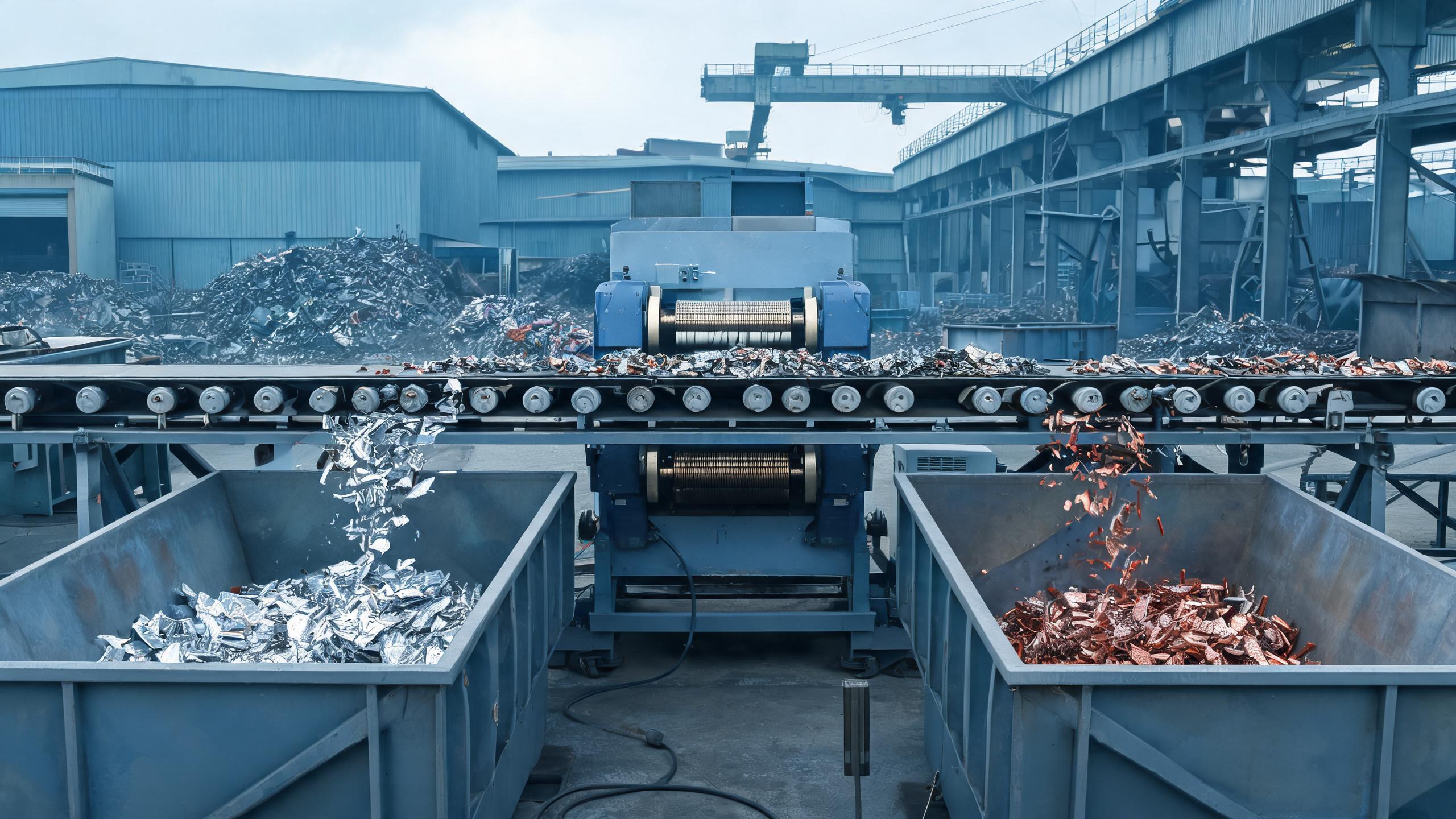
For mixed scrap, an eddy-current separator uses a rotating magnetic field to repel non-ferrous metals like aluminum, copper, and brass. This stage is critical if you process end-of-life vehicles, electronics, or mixed demolition scrap. It separates the non-ferrous stream from non-metallic materials such as plastics and rubber.
Sorting and Cleaning
Depending on your output specifications, the line may include air classifiers, screens, or manual sorting stations to remove remaining impurities. Some suppliers integrate sensor-based sorting for higher purity, but this adds cost and complexity.
Baling or Packaging
Finally, a baler compacts the cleaned metal fractions into dense bales for transport and sale. Baling reduces shipping costs and makes the product easier to handle. Some lines also include weighing and loading conveyors.
A reputable Chinese supplier can provide the full line as a turnkey package, including the shredder, separators, conveyors, and control system. For example, Tiangong Technology supplies complete solid waste processing equipment, including turnkey solid waste treatment lines, which often incorporate metal recovery stages. If you are also interested in recovering non-ferrous metals from mixed waste, you can refer to our article on non-ferrous metal recovery lines for more detail.
Timeline Planning: What to Expect (and What to Confirm)
Every buyer wants to know: “How long until I can process scrap?” The honest answer is: it depends. A realistic timeline has several stages, each with its own lead time. Instead of giving you fixed weeks, here is a framework to plan with your supplier.
Stage 1: Site Preparation and Permits
Before equipment arrives, your site must be ready: concrete foundations, electrical supply, drainage, and environmental permits. This is often the longest and most underestimated stage. Discuss with your supplier what site conditions they require—such as floor load, ceiling height, and power capacity—and start these tasks early.
Stage 2: Equipment Design and Fabrication
Once you place an order, the supplier will finalize the engineering design and begin fabrication. For a complete line, this involves multiple machines, so production time can be substantial. Ask your supplier for a production schedule that shows when each component will be ready.
Stage 3: Shipping and Customs
Shipping from China to Southeast Asia typically takes days to weeks by sea, but customs clearance and inland transport can add unpredictable delays. Plan buffer time and clarify who handles export documentation and which Incoterm applies.
Stage 4: Installation and Commissioning
Installation may be done by the supplier's engineers or by your team under their supervision. The complexity of the line determines the time needed. Commissioning includes testing with actual scrap material to verify throughput and separation efficiency.
Stage 5: Operator Training
Your staff must know how to operate and maintain the line. Good suppliers include training as part of the turnkey package. Confirm the training scope: classroom, on-site, or remote?
What to ask your supplier:
- Can you provide a detailed project timeline with milestones?
- What site preparation is required before installation?
- Who is responsible for permits and compliance in my country?
- What is the delivery time for each major component?
- Do you provide installation supervision? How many engineers and for how long?
Planning Your Plant Layout
Your plant layout directly affects operational efficiency, safety, and future expansion. A good layout minimizes material handling, reduces bottlenecks, and keeps operators safe.
Start with Material Flow
Draw the path from scrap intake to finished bales. The ideal flow is linear: receive scrap at one end, process it through the line, and load out at the other end. Avoid cross-flow or backtracking, which wastes time and increases the risk of accidents.
Key Zones to Design
- Receiving area: Space for trucks to unload and for scrap to be staged. This area should be large enough to handle peak incoming volumes.
- Processing area: The main line. Allow clearance around each machine for maintenance and for operators to move safely. Consider the height of the shredder—some require elevated platforms.
- Sorting and storage: After separation, you need separate bins or bays for each metal fraction. Plan for enough storage to accumulate sellable quantities without blocking the line.
- Baling area: If you bale, ensure there is space for the baler, the bale handling equipment, and loaded bales awaiting shipment.
- Maintenance and spare parts: A small workshop area for routine maintenance and a locked storage for spare parts will save downtime.
Consider Safety and Compliance
Metal recycling involves heavy machinery, dust, and noise. Design your layout with safety in mind: clear walkways, emergency stops, dust collection if needed, and fire suppression for any flammable materials. Also, check local regulations on noise levels and waste handling—your supplier can advise on best practices, but local compliance is your responsibility.
Plan for Future Expansion
Your business will likely grow. When laying out the line, leave space for adding a second shredder, an extra separator, or more storage. It is much cheaper to plan for expansion now than to relocate equipment later.
What to ask your supplier:
- Can you provide a general arrangement drawing showing the line's footprint and clearances?
- What are the power and foundation requirements for each machine?
- Do you offer layout design services as part of the turnkey package?
- What is the recommended distance between machines for maintenance access?
Questions to Ask Every Chinese Turnkey Supplier
Before you compare quotes, make sure you have the answers to these questions. They will help you avoid hidden costs and mismatched expectations.
| Question | Why It Matters |
|---|---|
| What exactly is included in the turnkey price? | Some quotes exclude conveyors, control panels, or installation. Get a detailed list of components and services. |
| What is the line's capacity for my specific scrap type? | Capacity varies by material. Ask for a performance test or a guaranteed throughput based on your feedstock. |
| What is the power consumption per ton? | Energy costs are a major operating expense. Ask for estimated consumption figures. |
| How do you handle after-sales support and spare parts? | You need quick access to spare parts and technical support. Ask about response times and warranty terms. |
| Can you provide references of similar lines in my region? | References give you confidence. If they cannot, ask why not. |
| What is the payment schedule and delivery timeline? | Understand the milestones and what triggers each payment. |
Why China for Turnkey Lines?
China has become a major source for metal recycling equipment because of its manufacturing scale and cost advantage. Chinese suppliers like Tiangong Technology offer a wide range of shredders and complete solid waste processing lines, including turnkey solutions. For buyers in Southeast Asia, proximity reduces shipping time and costs, and many suppliers have experience exporting to the region.
However, the quality and completeness of “turnkey” packages vary. The key is to define your requirements clearly and verify every detail with the supplier. A well-planned turnkey line can transform your scrap yard into a profitable processing facility, but the planning starts before you sign the contract.
Ready to Start Your Project?
If you are planning a metal recycling line, begin by documenting your scrap types, target output, and site constraints. Then contact suppliers with a clear request for quotation. Ask for a line drawing, a list of included equipment, and a project timeline. A reliable supplier will be happy to provide these details.
For more on separating non-ferrous metals from mixed scrap, see our guide on non-ferrous metal recovery lines. And when you are ready, reach out to Tiangong Technology to discuss your turnkey metal recycling project.