
Technical guide for B2B buyers
When you need to produce manufactured sand or reduce brittle metal chips and castings, a vertical shaft impact (VSI) crusher is often the key machine in the line. It works differently from a jaw or cone crusher, and choosing the right rotor and configuration depends on your feed material and product goals. This article explains how a VSI crusher works, what to consider when selecting the rotor or impeller, and where it fits alongside jaw and cone crushers in a complete crushing circuit.
What is a VSI crusher and how does it work?
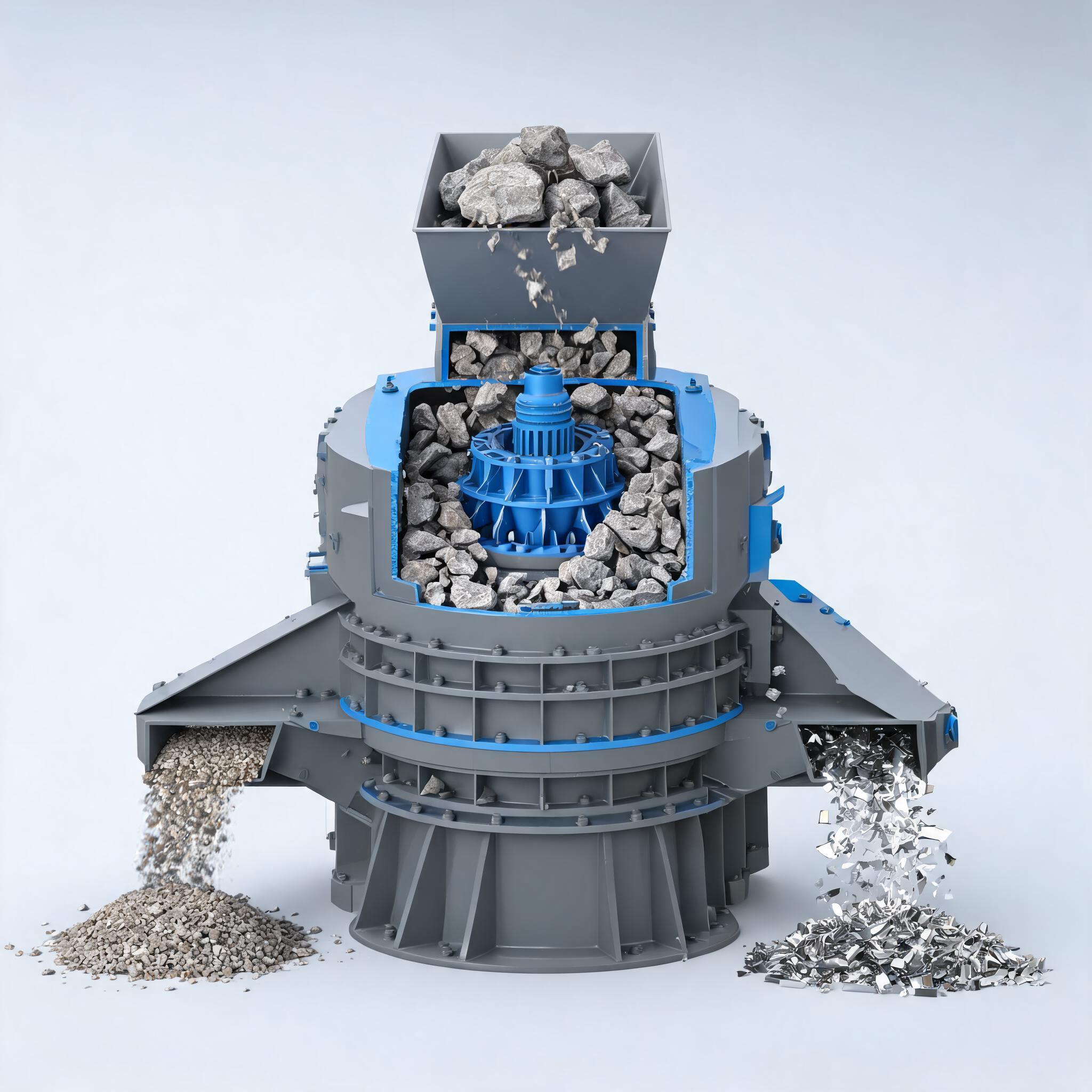
A VSI crusher is a centrifugal impact crusher. The material enters the top, falls onto a vertical rotor, and is accelerated outward by centrifugal force. The rotor, also called an impeller, throws the material at high speed against a stationary anvil ring or, more commonly, against a bed of material that has already accumulated inside the crushing chamber. This is called rock-on-rock autogenous crushing: the material breaks itself by impact, rather than being crushed between two metal surfaces.
The key components are:
- Vertical rotor (impeller) – accelerates the feed material outward.
- Crushing chamber – where the accelerated material impacts the rock bed or anvils.
- Self-renewing chamber lining – the rock bed that forms on the chamber walls and is continuously rebuilt by the material itself, reducing wear on metal parts.
Because the material is crushed by impact with itself, wear on the machine's metal parts is relatively low compared with compression crushers. This makes the VSI particularly suited for abrasive materials and for producing a cubical, well-graded product.
Rotor types and impeller selection: what to consider
The rotor is the heart of the VSI. Different rotor designs affect throughput, product shape, wear life, and the size of feed you can accept. When evaluating a VSI, ask your supplier about the rotor configuration and how it matches your material.
Open vs. closed rotors
Rotors can be broadly classified as open or closed. An open rotor has a large central opening, allowing larger feed sizes and higher throughput. A closed rotor has a smaller or covered inlet, which gives more control over the acceleration path and is often used for finer products or when a narrower particle size distribution is needed. Your choice depends on the feed size and the product specification you need to meet.
Rotor diameter and speed
The rotor diameter and the operating speed determine the velocity at which material is thrown. Higher speed increases the impact energy, which is useful for breaking harder or more brittle materials, but it also increases wear and power consumption. Lower speed produces less fines and is often preferred for sand making where you want to minimize oversize and control the gradation. The optimal speed depends on the material's hardness, abrasiveness, and the desired product curve. There is no one-size-fits-all setting; it must be adjusted based on your feed. Ask the supplier for guidance on speed ranges and how to adjust them for your material.
Rotor wear parts and serviceability
Wear parts in the rotor, such as tips, distributor plates, and anvils (if used), are consumables. Their life depends on the abrasiveness of the feed. A well-designed rotor should allow quick and safe replacement of these parts. Check how easy it is to access the rotor and whether the supplier provides spare parts kits and training for maintenance. A supplier that offers installation supervision and operator training can help your team get the most from the machine.
How a VSI fits in a crushing line with jaw and cone crushers
A VSI is usually not a primary crusher. It is most effective when fed with material that has already been reduced to a manageable size. A typical line for manufactured sand might be:
- Primary jaw crusher – reduces run-of-mine or large feed to a size the downstream equipment can handle.
- Secondary cone crusher – further reduces the material to a finer size, often producing a product that is still not ideal for sand due to its flaky shape.
- VSI crusher – used as a tertiary or quaternary crusher to shape the material into cubical particles and to produce the fine fractions required for concrete sand or other specifications.
The VSI's role is twofold: it improves particle shape (cubicity) and it can increase the proportion of fine material. If you are producing sand, the VSI is often the final crushing stage before screening. If you are recycling brittle metal chips or castings, the VSI can reduce them to a more uniform size for further processing or remelting.
For example, a complete line might include a primary jaw crusher to do the initial breakage, a cone crusher for secondary reduction, and a VSI crusher for final shaping. This is a common configuration in aggregate and sand production.
Choosing the right VSI: key selection criteria
When you are evaluating a VSI crusher for your project, consider these factors. Some will depend on your specific material and requirements, so be prepared to discuss them with the supplier.
| Selection factor | What to check | Why it matters |
|---|---|---|
| Feed size and capacity | Maximum feed size the rotor can accept; throughput in tonnes per hour | Must match your upstream equipment and production requirements |
| Material properties | Hardness, abrasiveness, moisture content, and brittleness of your feed | Determines rotor type, speed, and wear life |
| Product specification | Desired particle size distribution, shape (cubicity), and fines content | VSI speed and rotor configuration affect these outcomes |
| Wear parts and maintenance | Availability of spare parts, ease of replacement, and expected wear life | Affects operating cost and downtime |
| Power and drive | Motor power, drive type (direct or belt), and electrical requirements | Must be compatible with your site's power supply and control system |
| Automation and safety | Control system, monitoring features, and safety interlocks | Improves efficiency and protects operators |
| After-sales support | Installation supervision, operator training, and warranty terms | Reduces commissioning risk and helps your team run the machine effectively |
For example, the TG-VSI 200 Vertical Shaft Impact Crusher from Tiangong Technology Co., Ltd. is a centrifugal impact crusher that uses rock-on-rock autogenous crushing. It is designed for brittle metal chip and casting reduction, and it features a vertical rotor with impeller, a self-renewing chamber lining, and CE marking. It is manufactured under ISO 9001 quality management. If your application is similar, this machine could be a fit, but you should confirm the specific capacities and rotor options with the supplier.
Working with a supplier: what to ask
Before you finalize a purchase, make sure you have clear answers to these questions. This will help you avoid surprises later.
- What is the maximum feed size the VSI can accept in my application?
- What rotor configurations are available, and which is recommended for my material?
- What is the expected wear life of the rotor tips and other wear parts for my feed?
- What is the power consumption at the required throughput?
- What kind of after-sales support is included, such as installation supervision or operator training?
- What are the warranty terms and what does the spare parts kit include?
Tiangong Technology Co., Ltd., founded in 2008, operates a 12,000 m² facility. For standard models, the lead time is under 45 days, and they offer a 12-month warranty with spare-parts kits. They also provide installation supervision and operator training. These are practical details to consider when planning your project timeline and budget.
If you are also looking at other types of crushers, you might compare the VSI with a horizontal impact crusher, which has a different crushing action and may be better for certain materials. The choice depends on your feed and the product you need.
Conclusion
A VSI crusher is a versatile machine for producing manufactured sand and for reducing brittle metal chips and castings. Its rock-on-rock autogenous crushing principle gives a cubical product and relatively low wear. When choosing a VSI, focus on the rotor type, speed, and how the machine fits into your existing crushing line. Always confirm the specific performance data with the supplier, as capacities and wear life depend on your material.
If you are planning a new sand-making or metal-recycling line, start by defining your feed and product requirements, then work with a supplier that can offer the right machine and support. With the right equipment and proper operation, a VSI can be a reliable and efficient part of your process.