What Is a Cone Crusher?
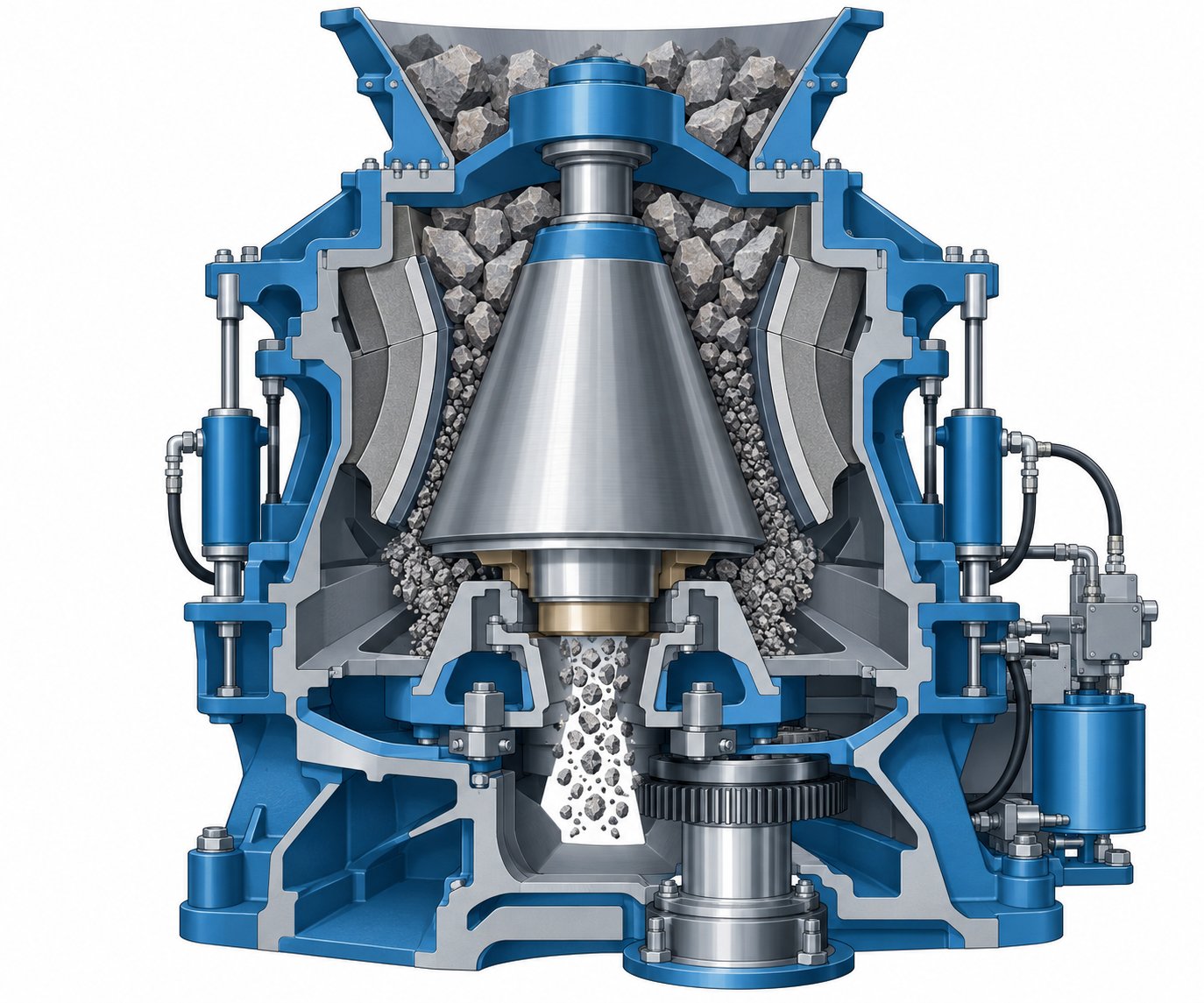
A cone crusher is a gyratory compression crusher. Material enters the top of a crushing chamber and is reduced between a rotating mantle and a stationary concave liner. The gap between the two narrows toward the bottom, so as material descends it is compressed repeatedly until it fits through the discharge opening. In metal recycling, that makes the cone crusher a secondary or tertiary reduction tool for dense or brittle metal fractions that need a tighter, more consistent top size than a primary shredder or jaw crusher can deliver.
The Working Principle
The main shaft is suspended or supported so that the mantle can gyrate inside the concave. The eccentric motion changes the open-side and closed-side settings continuously: on one side of the chamber the gap is wide, on the opposite side it is narrow. Feed material is therefore crushed in cycles rather than in a single hammer-like strike. Discharge size is governed mainly by the closed-side setting, and on a modern cone crusher that setting is adjusted hydraulically. Hydraulic bowl adjustment lets an operator change the closed-side setting without a full mechanical tear-down. Hydraulic tramp release protects the machine when un-crushable material enters the chamber, allowing the mantle to back off and the piece to pass.
What a Cone Crusher Is Used For
The cone crusher's role is controlled size reduction, not bulk breaking. It is selected when the output needs a defined top size, a relatively cubical particle shape, and a consistent gradation rather than a wide spread of lumps and fines. Typical uses include:
- Secondary reduction after primary shredding, shearing, or jaw crushing, where the material is already reduced to a manageable feed size.
- Tertiary reduction to a tighter top size for downstream separation, briquetting, or furnace feed.
- Processing dense metal fractions such as castings, engine blocks, and heavy scrap that resist impact-style reduction.
- Producing a more uniform product where downstream equipment is sensitive to oversize.
The key benefit for a recycling line is repeatability: once the closed-side setting is fixed, the machine tends to hold that discharge size across a run, which simplifies screening and downstream handling.
Where a Cone Crusher Fits in a Recycling Circuit
A metal recycling circuit usually starts with a primary stage that opens up the material and reduces the largest pieces. A cone crusher belongs after that stage, not before it. The feed must already be small enough to enter the chamber without bridging, and it should be reasonably clean.
| Circuit stage | Typical machine | Purpose |
|---|---|---|
| Primary | Shredder or primary jaw crusher | Open the material, reduce the largest pieces |
| Secondary | Cone crusher | Reduce to a defined top size, improve shape and consistency |
| Tertiary | Cone crusher or impact crusher | Tighten the product size for downstream separation or feed |
A secondary gyratory cone crusher such as the TG-Cone 350 is built around manganese steel mantle and concave liners, with hydraulic bowl adjustment and tramp release. In a circuit, that configuration is normally placed after a primary machine such as the TG-Jaw 600, where the feed has already been broken down to a size the cone chamber can accept.
When a Cone Crusher Does Not Fit
A cone crusher is the wrong tool in several common situations, and recognizing them early saves both capital and downtime.
- Sticky or muddy feed. Wet, clay-like, or heavily contaminated material can pack in the chamber and reduce throughput. Compression crushing does not clear a sticky chamber the way an impact rotor can.
- Very large primary reduction. A cone crusher is not a primary breaker. If the feed contains pieces far larger than the chamber opening, a jaw crusher or shredder should come first.
- Very abrasive, fine, or highly variable feed. Where the feed changes constantly or is dominated by fine abrasive material, liner wear and setting control can become harder to manage, and an impact crusher may be the more practical choice.
If your material is sticky, contains large uncrushable pieces, or needs only coarse primary reduction, the circuit should be reconsidered before a cone crusher is specified.
How a Cone Crusher Differs from Jaw and Impact Crushers
The three compression and impact families overlap in some duties, but each has a natural place.
| Machine | Reduction method | Best fit |
|---|---|---|
| Jaw crusher | Compression between a fixed and a moving jaw | Primary reduction of large, hard feed |
| Impact crusher | High-speed impact against hammers and breaker plates | Less abrasive feed, good shape, high reduction ratio |
| Cone crusher | Compression in a gyrating chamber | Secondary and tertiary reduction to a controlled top size |
For dense metal fractions that need a consistent top size and a shape suitable for downstream processing, the cone crusher is generally the more controllable option. An impact crusher such as the TG-Impact 500 can handle higher reduction ratios in less abrasive feed, but it is more sensitive to wear and to the nature of the material.
Buyer Checklist: Specifying a Cone Crusher
Before sizing a cone crusher into a recycling circuit, confirm the following with the supplier:
- Feed size range and maximum lump size the chamber can accept.
- Required product top size and the closed-side setting needed to reach it.
- Material type: density, abrasiveness, moisture, and whether it is sticky.
- Target throughput and how it changes with the closed-side setting.
- Liner material and the wear parts available for your feed.
- Hydraulic adjustment and tramp release features, and how they are controlled.
- Certification and manufacturing standards relevant to your market.
Tian Gong has manufactured crushing equipment since 2008. Its production facility is ISO 9001 certified, and its crushers carry CE marking. These facts matter because they indicate a documented quality system and conformity with applicable European requirements, which many buyers need before approving a supplier.
Matching the Machine to the Circuit
A cone crusher is not a universal substitute for a primary shredder or a jaw crusher. It is a secondary or tertiary machine best used when the feed is already reduced, reasonably clean, and the goal is a tighter top size with a shape that downstream equipment can handle. If that describes your material, a cone crusher can be the most controllable stage in the line. If the feed is sticky, muddy, or dominated by very large pieces, the circuit should be revised before the crusher is selected.
If you are sizing a circuit and want to confirm whether the TG-Cone 350 fits your feed and target top size, request product details and share your material type, feed size, and required output. That information is what determines the right chamber configuration and closed-side setting.