
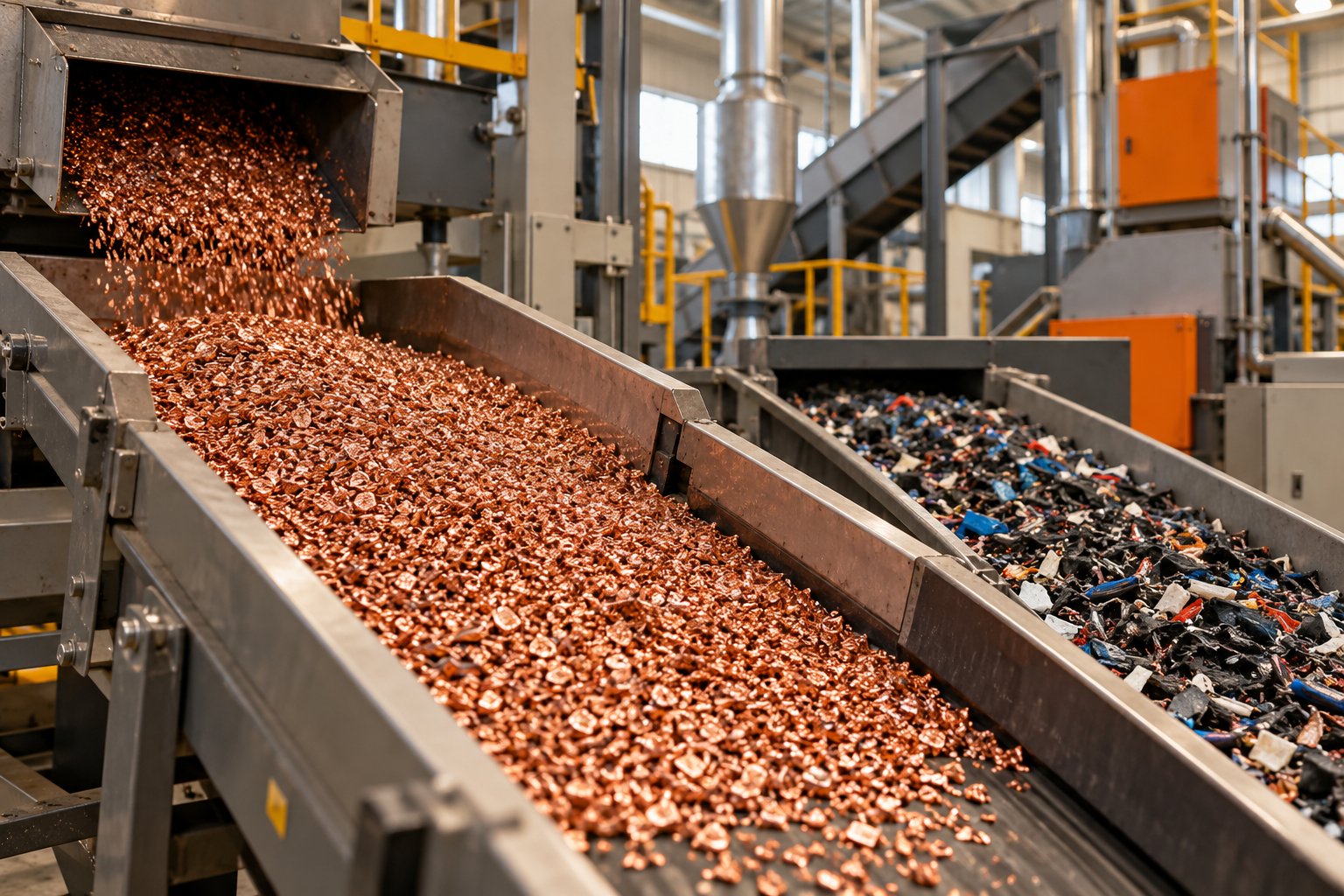
Cable Recycling Equipment
A granulator is a size-reduction machine that cuts pre-shredded material into granules of a controlled top size. In cable recycling, it sits after the shredder and before separation: the shredder opens up cable bundles and reduces length, while the granulator cuts the mixed copper-and-plastic pieces down to a size the separation stages can handle. The working principle is a rotating rotor carrying cutting blades, working against fixed bed knives, with a screen or perforated plate around the rotor that holds material in the cutting chamber until it passes through the holes.
Key takeaways
- A granulator is defined by its job: reducing material to a controlled granule size, not just breaking it into random pieces.
- The rotor-and-screen pair sets the output size, often described as a “defined infeed → rotor cutting → screen metering” flow.
- In cable recycling, granulation is a middle stage: after pre-shredding and before air separation and density separation.
- On the TG-CableLine 100, the granulator works after a twin-shaft shredder; air separation and a vibration table then produce clean metal granules.
What a granulator does, in plain terms
Granulation is size reduction to a controlled granule size. That word “controlled” is what separates a granulator from a shredder. A shredder’s output is often described by approximate piece size; a granulator’s output is governed by the screen around the rotor, which physically limits how large a particle can be when it leaves the chamber.
In day-to-day cable recycling language, people use “granulator” and “granulating machine” freely. The important question is not the name but the duty: what goes in, what screen is fitted, and what comes out. A machine sold as a granulator that is fed whole cable bundles and asked to do the shredder’s job is being misapplied.
The rotor-and-screen principle
Inside the cutting chamber, the rotor turns at speed. The rotor carries blades; the chamber has fixed bed knives. Material is caught between the moving and stationary edges and is cut rather than torn. Around the lower part of the rotor sits a screen or perforated plate. Particles small enough to pass the holes drop out; larger particles stay in the chamber and are cut again.
That recirculation is the mechanism behind controlled output: the screen acts as a size gate, and the rotor keeps working on whatever has not yet passed it. Two practical consequences follow.
- Screen choice sets the nominal granule size. Change the screen and you change the output range. The right screen depends on the downstream separation equipment and on what the buyer wants to sell or feed onward.
- Overfeeding does not make the machine cut faster. If material enters faster than the rotor can reduce it, the chamber loads up, heat and fines rise, and output quality drops. Granulators work best when the feed rate matches the cutting capacity.
Screen condition matters too. A worn or damaged screen lets oversized pieces through and undermines the whole point of granulation.
Why granulation follows pre-shredding in cable recycling
Cable is a composite: a metal conductor inside plastic or rubber insulation, sometimes with additional layers, fillers, or armouring. To recover the metal cleanly, the insulation has to be opened and the metal freed. That happens in stages, and each stage has a different job.
- Pre-shredding. A shredder, often twin-shaft, reduces whole cable, coils, and bundles into manageable pieces. It is built to accept bulky, awkward infeed and to open the structure of the cable.
- Granulation. The granulator cuts those pieces down further, to a granule size set by the screen. Smaller, more uniform particles separate better in the stages that follow.
- Separation. Air separation uses an air stream to divide lighter insulation from heavier metal. A vibration table (also called a shaking table or density separator) then separates particles by density, producing a metal concentrate and a plastic fraction.
The logic is straightforward: a granulator cannot do a shredder’s job well, and a shredder alone does not produce the uniform granules that separation stages need. The two machines are matched, not interchangeable.
What “clean metal granules” means in practice
“Clean” in copper cable recycling is a relative term, and buyers should treat it as such. No dry mechanical line removes every trace of insulation; the goal is to reduce the plastic content in the metal fraction to a level the buyer’s downstream process or buyer specification accepts. The final cleanliness depends on the combined performance of granulation, air separation, and table separation, plus the feed material itself.
This is why a complete line is usually described as a system rather than a single machine. The granulator sets the particle size; the air separator and vibration table do the cleaning. Adjust one stage without regard for the others and the output changes.
TG-CableLine 100: granulation inside a complete line
The TG-CableLine 100 from Tian Gong is a cable and wire recycling line in which the granulator works after a twin-shaft shredder. Air separation and a vibration table follow, and the line is intended to produce clean metal granules from cable and wire scrap.
Because the granulator is one stage in a defined sequence, its output size and the separation settings can be considered together rather than in isolation. Buyers evaluating the line should ask about the intended feed material, the granule size range they need, and how the separation stages are set for that material.
For full details of the line, see the TG-CableLine 100 cable and wire recycling line.
Tian Gong manufactures shredders and crushers and has been building this type of equipment since 2008. The company’s equipment is CE-marked.
How granulators are specified for cable recycling
When comparing granulators or complete cable recycling lines, these are the questions that actually change the answer:
| Specification area | What to establish |
|---|---|
| Feed material | What cable types and sizes will be processed, and whether they are already pre-shredded to a compatible size. |
| Granule size | The screen or perforated plate that sets the nominal output size, and whether that matches the downstream separation stage. |
| Rotor and knives | Rotor type and knife configuration, and how the machine is maintained as knives wear. |
| Drive and power | The installed power required for the intended throughput, and whether local supply conditions match. |
| Separation train | Whether air separation and a vibration table are included, and how their settings relate to the granulator’s output. |
| Output quality | What the expected metal fraction and plastic fraction look like for the specific feed, and how that is checked. |
These are selection criteria, not a fixed rulebook. Two recyclers processing the same cable type can choose different screen sizes if their downstream processes differ.
Frequently asked questions
Is a granulator the same as a shredder?
No. Both reduce size, but a shredder is generally built to accept bulky, mixed infeed and open up material, while a granulator is built to produce a controlled granule size, with the screen governing what leaves the chamber. In cable recycling, the shredder comes first and the granulator second.
Does a granulator separate copper from plastic?
No. The granulator reduces and opens the cable structure; separation is done by downstream equipment such as air separators and vibration tables. The granulator’s role is to prepare material in the size range that separation needs.
What determines the granule size?
The screen or perforated plate around the rotor, together with rotor speed and knife configuration. Material stays in the chamber until it passes the screen.
Can I run a granulator without pre-shredding?
Some granulators accept certain feed directly, but feeding large or bundled cable without pre-shredding typically reduces throughput and output consistency. In a cable recycling line, the twin-shaft shredder is there to prepare the feed for the granulator.
Next step
If you are specifying cable recycling equipment, start with two pieces of information: the cable types you process and the granule size your separation stage or downstream buyer needs. Those two answers determine the granulator screen and the line configuration around it. If you want to discuss those parameters for the TG-CableLine 100, contact Tian Gong with your feed material details.
Note: performance depends on feed material, screen selection, and separation settings. For project-specific figures, confirm with the supplier.