
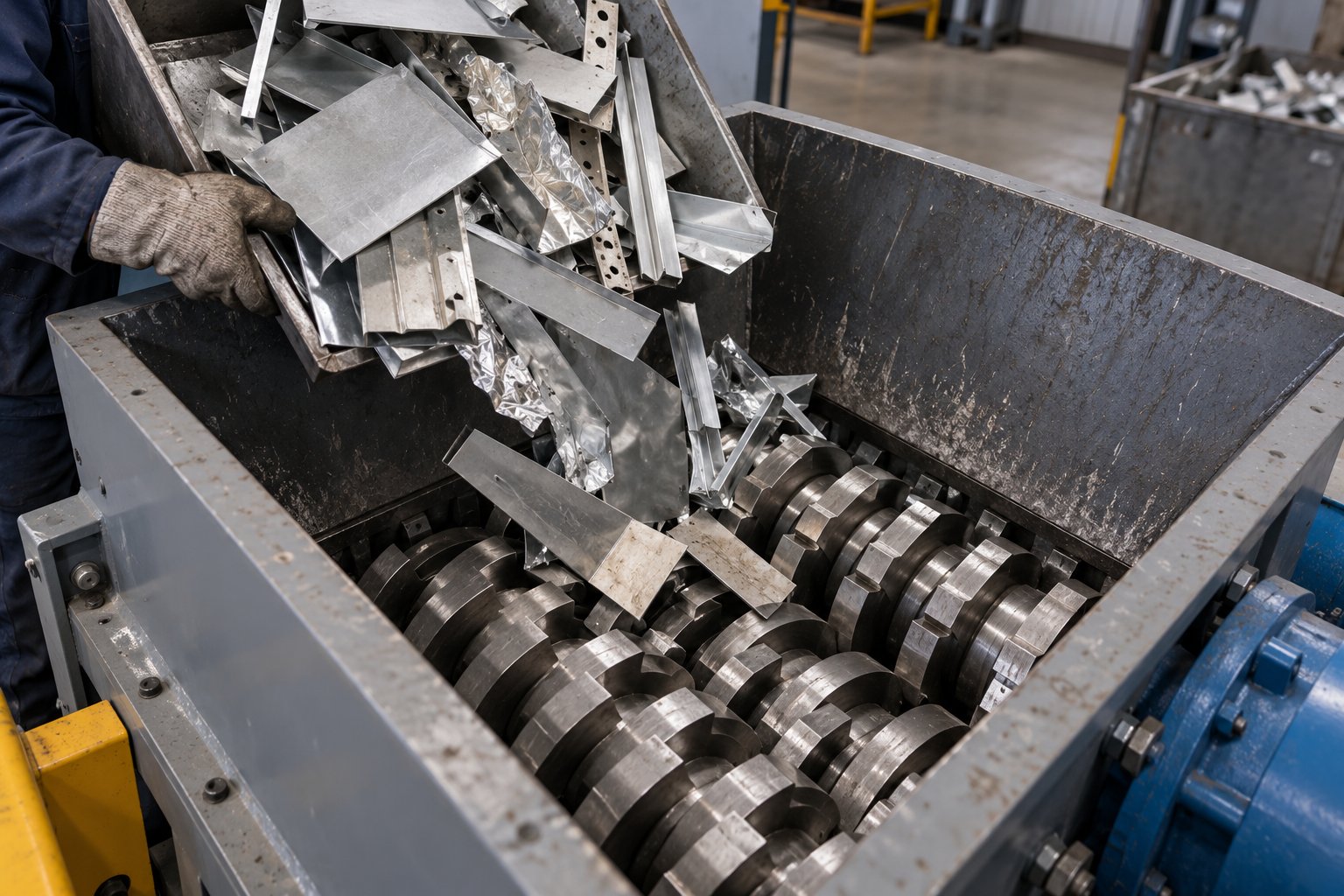
Equipment anatomy
A granulator machine is a size-reduction machine that cuts scrap into small, roughly uniform granules rather than tearing it into bulky pieces. Its working parts are a spinning rotor fitted with knives, stationary bed knives mounted in the cutting chamber, a screen that sets the maximum granule size and holds material in the cut zone until it fits through, and — in recycling lines — downstream separation equipment that sorts the granulated mix into streams such as metal and insulation or plastic. If you are comparing a granulator with a shredder, the practical difference is the target output: a shredder produces a coarse, irregular bulk size, while a granulator produces a controlled small particle size.
In this article
Granulator vs. shredder: two different jobs
Both machines reduce size, but they are usually chosen for different stages and different output requirements. A shredder handles bulky, mixed or contaminated feed and breaks it down to a coarse size that is easy to handle and convey. A granulator takes that pre-sized material further and cuts it to a much smaller, more consistent granule. In a recycling line the two are often used in sequence: the shredder does the rough reduction, and the granulator produces the smaller particles that air separation, vibration tables or magnetic separators need in order to work effectively.
Choosing between them is not a matter of one being better. It is a matter of what the next step in your process requires. If downstream separation depends on liberating one material from another, the granulator is the stage that does the liberation.
Key takeaways
- A granulator cuts material to a controlled small granule size using a rotor, bed knives and a sizing screen.
- A shredder does coarse reduction; a granulator does finer, more uniform reduction.
- The screen controls the maximum granule size and the residence time in the cutting chamber.
- Granulation is usually followed by separation — air, vibration or magnetic — to produce clean material streams.
- In integrated lines such as the TG-CableLine 100, granulation sits between shredding and separation.
Inside the cutting chamber: rotor, knives and screen
Most granulators used in scrap and cable recycling share the same basic anatomy. Understanding these four parts explains almost all of the machine's behaviour.
The rotor
The rotor is the rotating shaft assembly that carries the rotating knives. It is the part that does the cutting work. Rotor design affects how the machine bites into material, how it handles difficult shapes such as cable bundles or light sheet, and how consistently it presents material to the knives. A rotor that spins freely without a screen would simply throw material around; the rotor becomes useful when combined with the stationary knives and the screen.
The knives
A granulator has two knife groups. The rotating knives are mounted on the rotor and sweep past the stationary bed knives, which are fixed to the cutting chamber. Material is sheared between the two. Knife geometry, count and clearance affect granule shape and how much fine dust or powder is generated. Knives are a wear item and are part of routine maintenance planning for any granulator.
The screen
The screen, also called a sizing screen or screen mesh, surrounds part of the rotor's path. Material stays in the cutting chamber until it is small enough to pass through the screen openings. The screen therefore does two things at once: it sets the upper limit on granule size, and it determines how long material is exposed to the knives. A tight screen gives a finer output but reduces throughput; a more open screen gives higher throughput with a coarser output.
The cutting chamber and discharge
The cutting chamber houses the rotor, bed knives and screen. Once granules pass through the screen they fall or are conveyed to the discharge, which feeds the next stage — often a separation step rather than a finished product bin.
How the output size is set
Buyers often ask what granule size a granulator produces. The honest answer is that the machine does not have a single fixed output size; it has a size range that is set by the screen and influenced by the material and the knives. The same machine will behave differently on rigid copper cable, on soft aluminium conductor, and on mixed light scrap.
The screen is the primary control. Changing the screen changes both the size range and the capacity. This is why granulator specifications should always be read together with the screen that was used to generate them. A throughput figure quoted without a screen size is incomplete.
| Variable | Effect on output | What it means for selection |
|---|---|---|
| Screen opening size | Smaller openings give finer granules and lower throughput; larger openings give coarser granules and higher throughput | Match the screen to what your downstream separation step can handle |
| Knife condition and clearance | Worn or poorly set knives produce inconsistent granule shape and more fines | Ask about knife material and the recommended maintenance interval |
| Rotor speed and design | Affects how aggressively material is pulled into the cut | Confirm the rotor type suits your feed — cable, sheet, or mixed scrap |
| Feed material | Hard, brittle material granulates differently from soft or ductile material | Test with your actual material rather than a generic sample |
Downstream separation: turning granules into sellable streams
Granulation on its own produces a mixed granule pile. The value comes from what happens next. Because the granulator has reduced material to a small, fairly uniform size, separation equipment can now distinguish the components reliably.
- Air separation uses an air stream to separate light insulation or plastic from heavier metal granules. In cable recycling this is the step that lifts plastic away from copper or aluminium.
- Vibration tables use a vibrating deck to separate materials by density, polishing the split between metal and residual insulation.
- Magnetic separators pull ferrous metal out of a mixed stream. An overband magnetic separator is a common configuration for removing steel from granulated scrap.
The separation step is what turns granulated cable into clean copper or aluminium granules. If separation is weak, the granulator's work is wasted, because the output does not meet the cleanliness that a metal buyer expects.
Where a granulator sits in an integrated line
Most buyers do not purchase a granulator as a standalone box. They purchase it as one module in a line, and the lines are configured around the material.
Cable and wire recycling
For cable and wire, the granulator is the middle stage. The TG-CableLine 100 Cable and Wire Recycling Line is an integrated line that combines a twin-shaft shredder, a granulator, air separation and a vibration table. The line separates copper or aluminium conductor from insulation into clean metal granules. In this layout, the shredder opens up the cable, the granulator cuts the conductor and insulation into small particles, and air separation plus the vibration table split the two materials into separate streams.
Mixed scrap processing
For broader scrap streams, the granulator may be part of a larger system with different separation priorities. The TG-ScrapLine 150 Integrated Scrap Processing System is a turnkey line rated at 15 t/h that combines a twin-shaft shredder, a magnetic separator and a hydraulic briquetting press, with PLC control and CE certification. The overband magnetic separator in this line removes ferrous material from the processed stream. Where a granulator is included in such a line, its role is the same: reduce the material to a controlled granule size so that separation and densification can work efficiently.
Machines from Tian Gong, founded in 2008, are manufactured in an ISO 9001 facility and are CE-marked, with a 12-month warranty.
Frequently asked questions
What is a granulator machine used for?
It reduces scrap — including cable, wire, plastic and mixed light scrap — into small, fairly uniform granules. It is typically used before a separation step, because separation works much better on small, consistent particles than on bulky, irregular pieces.
Is a granulator the same as a shredder?
No. A shredder performs coarse size reduction and produces irregular bulk pieces. A granulator performs finer reduction and produces a controlled granule size, set mainly by the screen. They are often used together in the same line.
What determines the granule size?
The screen opening is the primary control. Knife condition, rotor design and the material being processed also affect the result. Because output size and throughput are linked to the screen, a capacity figure should always be read with the screen it was measured on.
Does a granulator separate copper from plastic by itself?
No. The granulator liberates the materials by cutting them into small pieces, but separation is done by downstream equipment such as air separators, vibration tables and magnetic separators. The granulator prepares the material for those stages.
Next step
If you are specifying a granulator or a complete recycling line, the useful starting point is your material: what you are feeding in, what granule size your downstream separation or buyer requires, and what throughput you need. Tian Gong builds shredders, crushers and integrated scrap processing lines, and can help match a configuration to your material. Share your material type and target output, and the line can be specified around it.