End-of-life vehicle basics
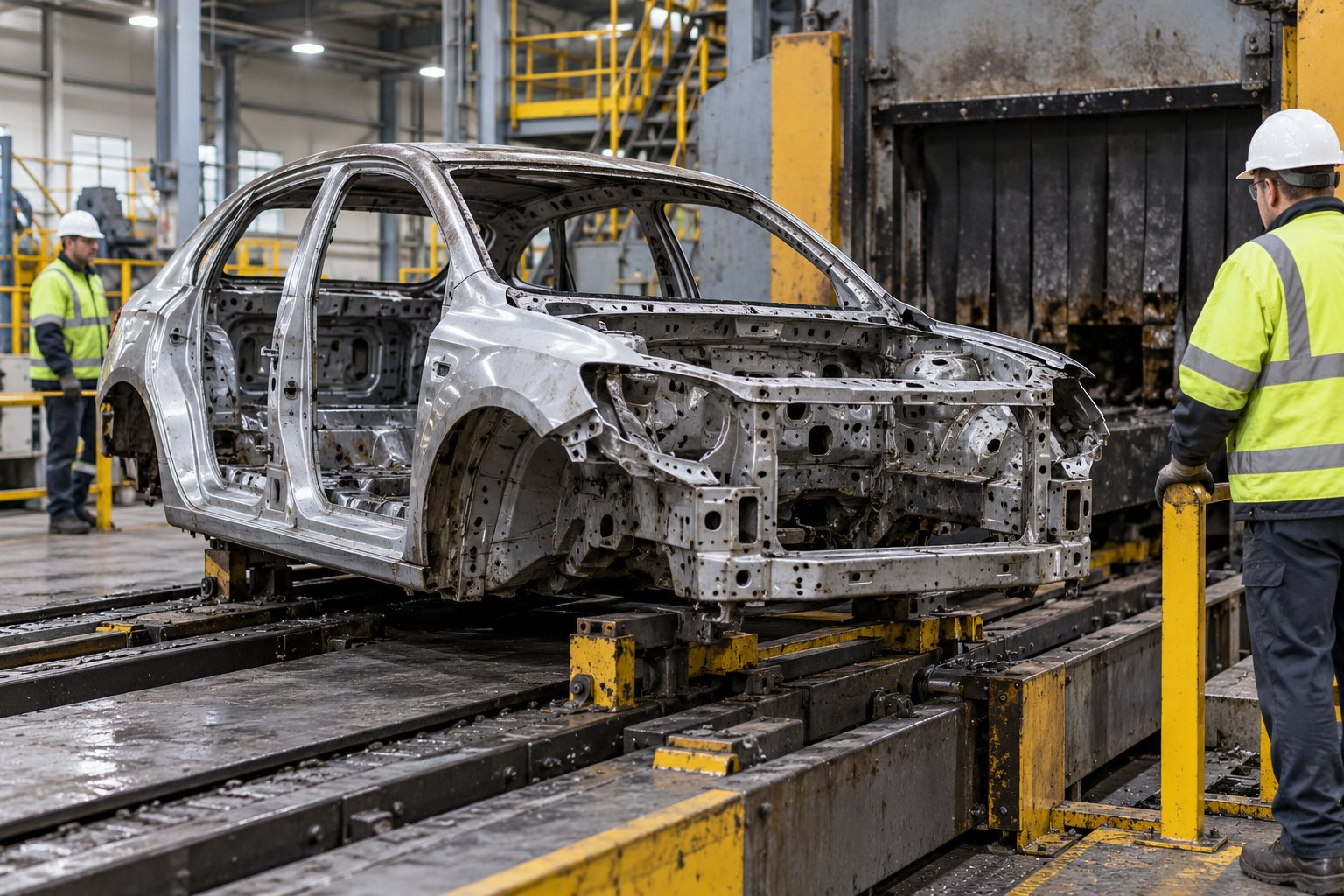
A scrap car is an end-of-life vehicle (ELV): a car that is no longer roadworthy or no longer economical to repair, and that is instead sold for the value of the materials it contains. That single definition covers two very different situations, and the difference matters to anyone buying, towing, dismantling or shredding vehicles at volume.
Key takeaways
- A scrap car is defined by condition and economics, not by age alone: it cannot be returned to the road at a cost the owner is willing to accept.
- The two main categories are accident or insurance write-offs and aged vehicles retired through mechanical failure.
- Depollution comes before shredding: fluids are drained, and the battery, tires and hazardous components are removed.
- What remains is mainly ferrous metal from the body shell, plus non-ferrous metals such as aluminum and copper.
- At a recycling facility, a depolluted hulk is shredded and separated into ferrous, non-ferrous and residue fractions.
On this page
What makes a car a scrap car
A vehicle becomes a scrap car when two conditions meet. It is no longer roadworthy in a practical sense, and the cost of bringing it back to a safe, legal and usable condition is higher than the vehicle is worth to its owner. Repair cost is not the only factor; structural damage, failed major components, corrosion in load-bearing areas and the cost of inspection or re-registration all push the same decision.
This is why a scrap car is not simply "an old car." A well-maintained vehicle of the same age can stay in service, while a younger vehicle written off after a collision can be scrapped immediately. The label describes the vehicle's end state, not its calendar age.
The term end-of-life vehicle, usually shortened to ELV, is the formal counterpart. It is the point at which a vehicle leaves active use and enters the waste and recycling stream. In practice, the words "scrap car" and "end-of-life vehicle" are used for the same object: a machine that still contains a large amount of recoverable metal and a smaller amount of material that must be handled carefully before that metal can be recovered.
The two main categories of scrap car
Scrap cars arrive at yards through two broad routes. The handling sequence is similar, but the condition of the vehicle and the reason for scrapping differ.
Accident and insurance write-offs
These vehicles are removed from use after a collision, fire, flood or other incident. An insurer may classify the vehicle as a write-off when repair is uneconomical, when the structure is damaged beyond repair limits, or when the vehicle is recovered as salvage. Accident cars tend to retain useful parts: doors, engines, transmissions, lights, interior components and electronics may be intact and can be removed for reuse before the shell is processed. They also carry the fluids and safety components that depollution must address, including fuel, brake fluid, coolant, oil and the battery.
Aged vehicles retired through mechanical failure
These cars reach the end of their working life through accumulated wear rather than a single event. High mileage, failed engine or transmission, chronic electrical faults, corrosion and the simple economics of repeated repairs all lead to the same outcome. Aged vehicles often yield fewer reusable parts, and their body shell makes up a larger share of the recovered value. Both categories end up as the same input material once the reusable parts and fluids are removed.
| Factor | Accident / insurance write-off | Aged mechanical failure |
|---|---|---|
| Trigger for scrapping | Single incident or insurer decision | Accumulated wear and repair economics |
| Typical condition | Localized or structural damage; much of the vehicle intact | Worn drivetrain, corrosion, mixed faults |
| Reusable parts | Often a significant share of the vehicle | Usually fewer usable components |
| Depollution needs | Full: fluids, battery, tires, hazardous components | Full, with more attention to contaminated fluids |
| Main residual value | Parts plus body shell metal | Mainly body shell and component metal |
The share of reusable parts varies widely by vehicle and damage; it is determined at inspection rather than by category alone.
Depollution: what is removed and why
Depollution is the step that separates responsible ELV processing from simply crushing a car. Before a hulk can be shredded, the materials that would contaminate the metal stream, create fire risk or release hazardous substances must be removed and routed to the correct disposal or recovery channel.
- Fluids. Fuel, engine oil, transmission fluid, brake fluid, coolant, power steering fluid and refrigerant are drained or recovered. Fluids mixed into shredded scrap reduce the quality of the recovered metal and can contaminate the residue fraction, so draining is normally done at dedicated collection points.
- Battery. The lead-acid starter battery is removed and sent to a battery recycling stream. Batteries are heavy, contain lead and acid, and cannot enter a shredder.
- Tires. Tires are removed and directed to tire processing. They are also a fire risk in storage and add material that does not belong in the metal fraction.
- Hazardous components. Catalytic converters, oil filters, mercury-containing switches, airbag modules and other pyrotechnic or hazardous components are removed and handled separately according to their own recovery routes.
- Reusable and high-value parts. Where a market exists, serviceable components and wiring are removed before the shell is processed, which also concentrates the remaining metal in the hulk.
The output of a properly executed depollution step is a drained, de-energized shell with no free liquids, no battery and no tires. Only this depolluted hulk is suitable for shredding.
What is still recoverable from a scrap car
Once depollution is complete, the hulk is still a dense package of metal. Recovery focuses on separating those metals by type.
- Steel. The body shell, frame, doors, hood and most structural parts are steel. This ferrous fraction dominates the recovered mass and is the main reason a scrap car has material value.
- Aluminum. Wheels, engine blocks, cylinder heads, transmission housings, heat exchangers and some body panels contribute aluminum, which is separated from steel for a cleaner, higher-value non-ferrous stream.
- Copper. Wiring harnesses, alternators, starters, motors and radiators carry copper. Copper is a small share of the vehicle by weight but a valuable one, so harness removal before shredding is common where labor and market conditions support it.
- Other non-ferrous metals. Brass, zinc and stainless-steel components appear in smaller quantities and are recovered within the non-ferrous stream.
- Residue. Plastics, glass, rubber, foam, textiles and other non-metallic material remain after separation. This fraction is managed as residue rather than sold as metal.
From depolluted hulk to sorted metal fractions
The final stage converts a bulky shell into saleable, sorted material. The vehicle body is fed to a shredder, where rotating hammers reduce it to fist-sized fragments in a single pass. Downstream separation then divides those fragments by physical property.
- Stage 1Depolluted hulk fed to the shredder
- Stage 2Hammer mill reduces the body to fragments
- Stage 3Magnetic separator pulls out ferrous metal
- Stage 4Eddy current separator recovers non-ferrous metal
- Stage 5Air classification removes light residue
A continuous line such as the TG-ELVLine 300 End-of-Life Vehicle Shredding and Recycling Line combines a hammer mill shredder, a magnetic separator, an eddy current separator and air classification in one pass, producing sorted ferrous, non-ferrous and residue fractions. Yards that need a dedicated body-shredding stage ahead of separation can use the TG-VehShred 800 Vehicle Body Shredder to reduce complete vehicle bodies before the material moves on to sorting.
The result is three streams with different destinations. Ferrous scrap goes to steel mills and foundries. Non-ferrous scrap goes to smelters and refiners, where aluminum and copper are recovered. Residue goes to further processing, energy recovery or disposal according to local rules. The cleaner the depollution and separation steps, the more of the vehicle ends up in the two metal streams and the less in residue.
Equipment supply and CE marking
Tian Gong has supplied size-reduction and separation equipment since 2008 and offers CE-marked equipment for ELV shredding and sorting lines. Exact capacity, configuration and downstream separation options depend on the vehicle mix and the fractions a yard intends to sell, so they are confirmed per project.
Frequently asked questions
Is a scrap car always an old car?
No. A newer vehicle can become a scrap car after a serious accident if repair is uneconomical, while an older vehicle can remain in service if it passes inspection and is worth maintaining. Age is a common factor, not the defining one.
Can a scrap car be shredded without depollution?
It should not be. Fluids, batteries, tires and hazardous components must be removed first. Shredding a vehicle that still contains these materials contaminates the metal and residue streams and creates avoidable safety and environmental risk.
What is the most valuable material in a scrap car?
By weight, steel from the body shell is the dominant recovered material. By unit value, copper and aluminum in wiring, radiators, wheels and drivetrain components are more valuable, which is why harness and component removal is often done before shredding.
What is left after shredding and separation?
Three outputs: a ferrous fraction, a non-ferrous fraction and a residue fraction of plastics, glass, rubber, foam and textiles. Each goes to a different downstream channel.
If you are planning an ELV shredding and separation line, describe your vehicle mix, expected throughput and the fractions you intend to sell, and the equipment configuration can be matched to those requirements.