
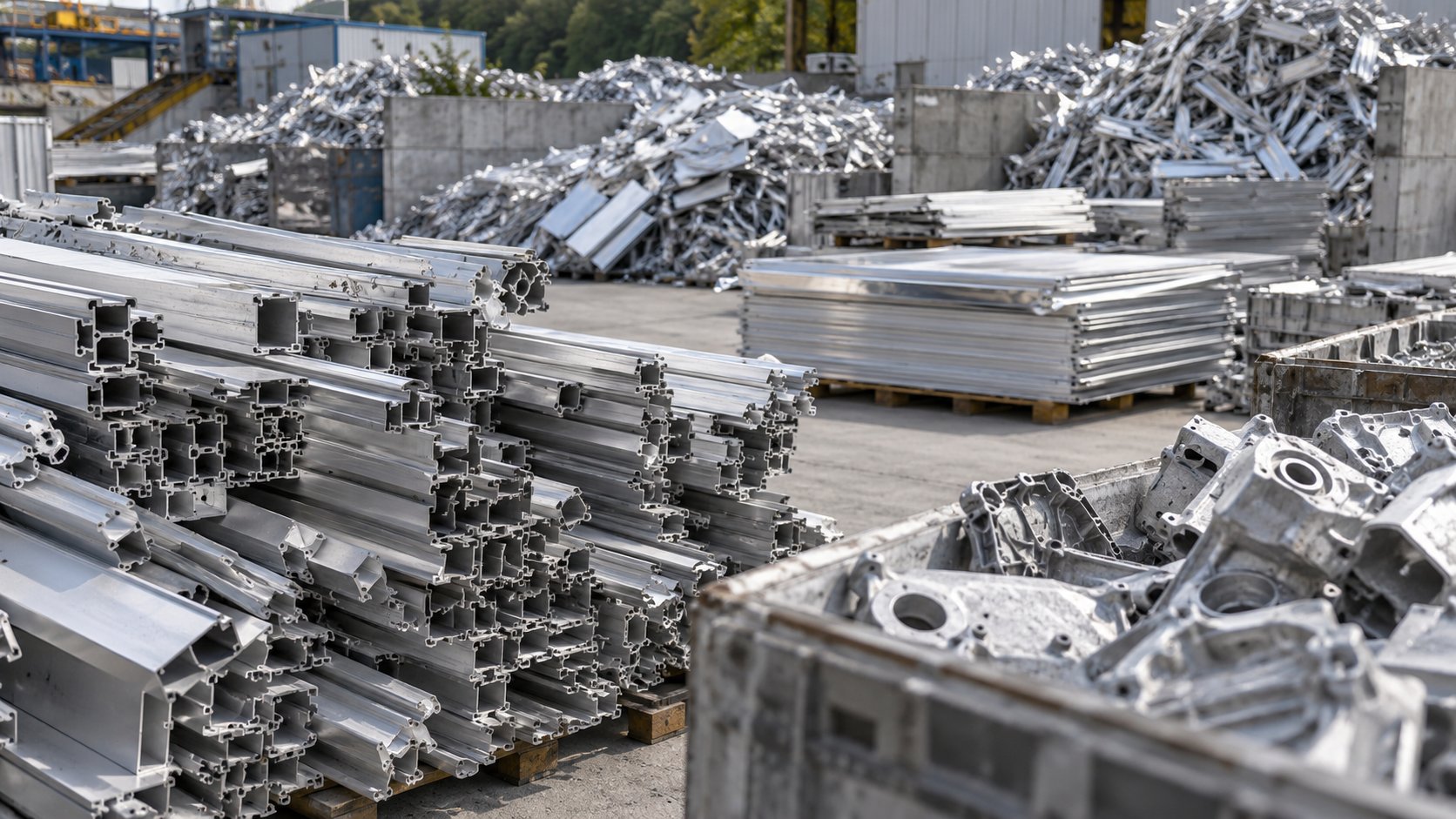
Aluminum scrap is any aluminum-bearing material recovered from manufacturing or from end-of-life products and sold for remelting. The term covers a wide range of material — from clean extrusion offcuts to oily machining swarf and used beverage cans. What separates one load from another is not the word "scrap" but the form, the alloy, and how much non-aluminum material is still attached.
Key takeaways
- "Aluminum scrap" describes a category, not a single product. Form and alloy decide where a load can be used.
- The main forms are sheet, extrusions, castings, foil, and swarf. Each has different handling and processing needs.
- Commercial grades come from a combination of alloy family, form, and preparation level — not from appearance alone.
- Buyers check four things first: alloy identity, attachments, cleanliness, and form or density.
- Swarf and used beverage cans (UBC) usually need shredding, separation, or briquetting before they can be charged efficiently.
On this page
What counts as aluminum scrap
Aluminum scrap is generated at two points in the material's life. Process scrap — also called new scrap or prompt scrap — is created during manufacturing: stamping skeletons, extrusion butt ends, machining turnings, trimming waste. Its alloy is usually known because the producer knows what it ran. Post-consumer scrap — old scrap — comes from products that have reached the end of their service life: window frames, radiators, wheels, cans, cookware, and electrical components.
Both streams are sold for remelting, and both are traded internationally. The difference matters to a buyer because process scrap tends to be more consistent in alloy and cleaner in form, while post-consumer scrap usually needs sorting, dismantling, or separation before it can be melted to a known specification.
It helps to separate two ideas that are often confused:
- Material identity — what alloy the aluminum is. This determines which secondary alloy it can become and, in some cases, whether it can be used in a higher-value application.
- Preparation level — how much the load has been sorted, cleaned, and densified. This determines how easily a furnace can handle it and how much metal is lost to oxidation or dross.
A load can be a well-known alloy but poorly prepared, or a mixed alloy that is exceptionally clean and well-sized. Buyers evaluate both dimensions, which is why a single "aluminum scrap" label tells them very little on its own.
The five main forms
Form is the first thing a buyer sees and the first thing that shapes handling. These five categories cover most of what moves through the trade.
Sheet and plate
Sheet scrap comes from stamping, blanking, cladding, and fabrication. It is typically thin, flat, and relatively clean, which makes it easy to bale or shear. Common sources include automotive body panels, appliance housings, and architectural cladding. Sheet is often alloy-known when it comes from a single production line, but mixed sheet from dismantling operations may carry coatings, sealants, or laminated layers that need to be removed.
Extrusions
Extrusion scrap includes profiles, tubes, and rods from window and door systems, heat sinks, structural framing, and transport components. Extrusions are usually the easiest form to identify by alloy family because the profile itself often indicates the application. They also tend to be long and dense, which helps with loading, though attached hardware such as screws, thermal breaks, and rubber gaskets must be removed or accounted for.
Castings
Cast aluminum appears in engine blocks, transmission housings, wheels, pump bodies, and many consumer durables. Castings are often heavier and more complex in shape than sheet or extrusions, and they frequently contain steel inserts, bearings, or fasteners. Because casting alloys differ from wrought alloys, mixing castings into a wrought load changes the chemistry of the melt — a point buyers check carefully.
Foil
Foil scrap is thin, high-surface-area material from packaging, insulation, and heat exchangers. Its light gauge means a high ratio of surface to volume, which increases oxidation loss during melting and makes it awkward to charge without densifying. Foil is also often contaminated with paper, plastic film, or food residue, so cleaning and separation steps matter more than with heavier forms.
Swarf and turnings
Swarf is the material removed by machining — chips, turnings, and filings. It is typically mixed with cutting fluid or coolant and has a very high surface area relative to its weight. In a furnace, loose swarf can be difficult to charge efficiently and can oxidize quickly. This is the form that most often needs shredding, degreasing, and briquetting before it becomes furnace-ready. A twin-shaft shredder such as the TG-AluShred 120 is built for this kind of material, using low-speed shearing to reduce turnings without work-hardening them, and it includes sealed bearings and a discharge screen to control output size.
How grades are set
There is no single global grading system for aluminum scrap, but trade practice converges on three variables: alloy family, form, and preparation level. The table below shows how those variables combine into the loads buyers typically discuss.
| Form | Typical source | What usually defines the grade | Common preparation |
|---|---|---|---|
| Sheet | Stamping, cladding, appliances | Alloy family; coating or lamination present | Baling, shearing, removal of non-metal layers |
| Extrusions | Windows, framing, heat sinks | Alloy family; attached hardware | Cutting to length, removing screws and gaskets |
| Castings | Engine parts, wheels, housings | Casting alloy; free iron and inserts | Dismantling, breaking, magnetic separation |
| Foil | Packaging, insulation | Residue level; gauge | Cleaning, separation from paper or film, densifying |
| Swarf | Machining, turning | Oil or coolant content; alloy consistency | Degreasing, shredding, briquetting |
In practice, a buyer will often describe a load by a shorthand that combines all three elements — for example, "clean mixed extrusion" or "shredded UBC." That shorthand is not a standard, so it is worth confirming exactly what is meant before assuming a load matches a specification.
What buyers actually look for
When a buyer opens a quotation, four questions come up in roughly this order.
Alloy identity
The buyer wants to know what alloy or alloy family the load contains, and whether it is consistent. A known alloy can be routed to a specific secondary alloy; a mixed load may only be usable in a lower-grade application. Where the alloy is not documented, buyers may ask for a sample analysis or treat the load as a mixed grade, which affects how it can be used. This is the single most important variable and the one that is hardest to fix after shipment.
Attachments and free iron
Screws, brackets, bearings, rubber seals, plastic clips, and insulation are the most common sources of contamination. Some can be removed by hand sorting or magnetic separation; others require dismantling. Buyers pay close attention to free iron because it is easy to detect and easy to penalize. A load described as "clean" but carrying visible steel fasteners will usually be reclassified.
Cleanliness
Cleanliness covers coatings, paint, oil, coolant, dirt, and moisture. It affects both recovery rate and furnace emissions. For swarf, the oil or coolant content is a central question; for painted sheet, the coating may need to be tolerated or removed depending on the melt route. Buyers generally prefer to know the contamination level rather than discover it at the scale.
Form and density
Form affects how the material can be handled and charged. Long extrusions may need cutting; loose sheet may need baling; swarf may need briquetting. Density matters because furnaces are charged by volume as well as by weight, and a low-density load takes up space without delivering equivalent metal. Buyers often ask whether material can be supplied in a densified or sized form, because that reduces handling and improves melt efficiency.
Processing before shipment
For many loads, processing is what turns mixed material into a saleable grade. A complete line can combine size reduction, contaminant removal, and densification into one flow. The TG-AluLine 200 is an integrated line that brings together a twin-shaft shredder, magnetic contaminant removal, an eddy current separator, and a hydraulic briquetting press. Its role is to take loose swarf, profiles, and sheet offcuts and turn them into dense, furnace-ready briquettes — a form that is easier to charge and easier to describe consistently to a buyer.
Where the main need is can-sized or light aluminum, a dedicated can shredder is often used instead. The TG-CanShred 200 is designed for UBC and light aluminum, reducing bulky light material to a more manageable and more uniform form. The choice between an integrated line and a single-purpose shredder usually depends on the mix of forms a site handles and on whether densification is part of the requirement.
Preparing a load for sale
If you are preparing to sell aluminum scrap, a few practical steps make the conversation with a buyer much shorter:
- Record the source. Note where the material came from and what it was used for. This is the basis for any alloy claim you make.
- Separate by form. Keep sheet, extrusions, castings, foil, and swarf in separate lots where possible. Mixed loads are harder to price and easier to dispute.
- Remove what you can. Pull out visible steel fasteners, rubber, plastic, and obvious non-aluminum items. Even partial removal improves the description you can give.
- Describe preparation honestly. Say whether the material is loose, baled, shredded, or briquetted, and whether it contains oil, coolant, or coatings.
- Confirm the unknowns before shipping. If alloy is not documented, say so. Buyers can work with an unknown alloy if they know about it in advance.
One point worth stating plainly: this article deals with the material itself, not with price. Market prices move with alloy, form, cleanliness, and freight, and any quotation depends on the specifics of the load. For pricing questions, it is better to speak with a buyer directly than to rely on a general description.
FAQ
Is aluminum scrap the same as recycled aluminum?
Not exactly. Aluminum scrap is the raw material — the recovered aluminum-bearing material that is bought and sold. Recycled aluminum is the output after that scrap has been melted and refined into a usable alloy. Scrap is the input to the recycling process; recycled aluminum is the result.
Which form of aluminum scrap is easiest to sell?
Clean, single-form, alloy-known material is generally the easiest to place, because the buyer can route it with minimal processing. Extrusions and clean sheet offcuts from a known production line usually fall into this group. Swarf, foil, and mixed post-consumer material often need preparation such as shredding, separation, or briquetting before they reach the same level of acceptance.
Why does oil or coolant in swarf matter to a buyer?
Oil and coolant add weight that does not become metal, and they can affect furnace emissions and handling. Buyers account for this either through an agreed deduction or by requiring the material to be degreased before shipment. Because swarf has a high surface area, it holds more fluid than solid forms, which is why processing steps such as shredding and briquetting are commonly used.
Can mixed aluminum scrap still be sold?
Yes. Mixed loads are traded, but they are usually routed to applications that can tolerate a wider chemistry range, and they may be described as mixed rather than by a specific alloy. If you are not sure what alloys are in a load, say so when offering it — the buyer can then advise whether a sample analysis or further sorting is needed.
Form, alloy, and preparation are the three variables that decide where an aluminum scrap load can go. If you are preparing swarf, extrusions, sheet offcuts, or UBC for sale, describe those three points as precisely as you can, and confirm anything you are unsure about with your buyer before the material ships.