Crushing Technology Explained
Buyers who already run a shredder often reach the point where the output is still too coarse for a downstream buyer, furnace charge, or density-based sorting step. That is usually where the question "what is an impact crusher" comes from. The answer is not the same as it is in a quarry, because in metal recycling the machine is not the first stage. It is a secondary unit working on material that has already been broken down once.
Key takeaways
- An impact crusher fragments material by strike and collision, not by squeezing it between two surfaces.
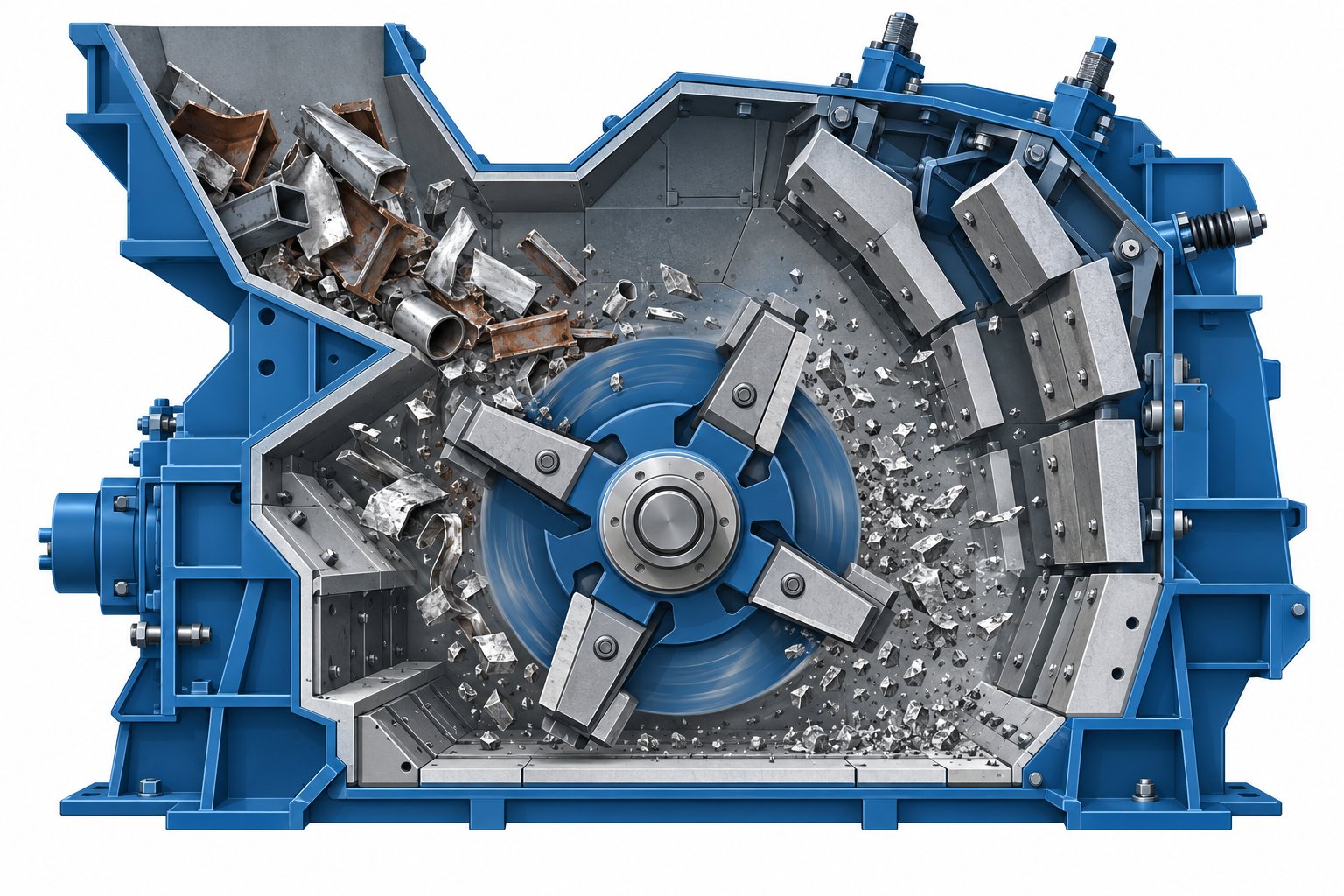
- A horizontal shaft rotor carries blow bars that hit the feed and throw it against adjustable impact curtains.
- Rotor speed and curtain gap are the two settings that govern output top size and particle shape.
- In a metal recycling circuit it normally runs as a secondary stage, after primary shredding has already reduced the scrap.
- It suits pre-sized, medium-hard metal scrap; very large or very abrasive feed is usually handled differently.
In this article
- What an impact crusher is
- How the crushing action works
- What controls output size and shape
- Where it sits in a metal recycling line
- Feed material it suits
- Impact vs jaw vs cone crushers
- Buyer checklist before you specify one
What an impact crusher is
An impact crusher is a crushing machine that reduces material by applying a sudden, high-energy strike rather than a slow compressive squeeze. Inside the housing, a fast-rotating rotor carries heavy blow bars. Feed enters the crushing chamber, is struck by those bars, and is thrown at speed against impact plates set around the rotor. Fragmentation happens through impact and the collisions that follow, and the material keeps breaking until it is small enough to pass out of the chamber.
For metal recycling, the most common configuration is the horizontal shaft impact crusher, often abbreviated HSI. The rotor turns on a horizontal axis and the impact curtains sit above and beside it, so the material follows a repeated strike-and-rebound path through the chamber.
How the crushing action works
The sequence inside an HSI is straightforward once you picture the geometry.
- Feed entry. Material drops or is fed into the crushing chamber above the rotor. At this stage the pieces still need to be within the size the machine can accept, which is why impact crushing is rarely the first step in a scrap line.
- Strike. The rotor spins, and the blow bars mounted on it hit the falling material. Energy is transferred to the piece almost instantly rather than gradually.
- Throw and rebound. The struck piece accelerates away from the bar and hits the impact curtains. It then rebounds back into the rotor path and is struck again. Depending on the model, the material may go through several of these cycles before it clears the chamber.
- Discharge. Once a fragment is small enough to pass the gap between the rotor and the lowest curtain, it leaves the machine as finished product.
Because the mechanism depends on energy transfer rather than a fixed compression stroke, the machine reacts differently to different materials. Brittle and medium-hard scrap fractures cleanly. Very ductile pieces tend to deform rather than shatter, and very abrasive feed wears the wear parts faster. Those are the practical boundaries a buyer should keep in mind rather than treating impact crushing as a universal size-reduction answer.
What controls output size and shape
Two adjustments determine what comes out of the machine.
Rotor speed
Higher rotor speed means a harder strike and more kinetic energy per hit, which generally produces finer output. Lower speed gives a coarser product with fewer fines. Speed is the setting to change when you want to shift the overall size distribution rather than trim the top end.
Curtain gap
The clearance between the rotor path and the impact curtains sets the largest fragment that can exit. Narrowing the gap lowers the top size of the discharge; opening it lets larger pieces through. This is the more direct control over the maximum particle size in the finished product.
Together, these two settings let an operator tune the machine toward a target specification instead of accepting whatever the first pass produces. The output also tends to be more cubical and less slab-like than compression crushing, because the material is broken by impact from multiple directions rather than flattened between two jaws.
On a purpose-built secondary unit such as the TG-Impact 500 horizontal impact crusher, the adjustable impact curtains are part of the standard configuration, which is what makes this kind of size tuning possible in day-to-day operation.
Where it sits in a metal recycling line
In a metal recycling circuit, the impact crusher is a secondary stage. The typical order is primary shredding first, then secondary crushing, then whatever separation or densification step the operation needs.
- Primary shredding reduces whole items and bulky scrap into a manageable feed. This stage does the rough work of tearing and opening material.
- Secondary impact crushing takes that pre-sized output and reduces it further, bringing the top size down and improving consistency so the material meets a downstream buyer's specification or feeds a sorting line evenly.
- Downstream processing may include magnetic separation, eddy current separation, screening, or baling, depending on what the recovered fractions are destined for.
The reason the impact crusher belongs in the second position rather than the first is mechanical. The crushing chamber is designed around a controlled feed size. Oversized, irregular scrap that has not been opened up yet will not be struck efficiently, and the wear on the blow bars and curtains rises sharply. Feeding a shredder product into an impact crusher keeps the machine working within the size range it was built for.
Feed material it suits
The machine performs best on pre-sized, medium-hard metal scrap. In practice that means material that has already been through a primary shredder and is consistent enough to enter the chamber without bridging or stalling.
What does not suit it is just as important to know. Solid, very large castings, thick plate, and heavily abrasive material are better handled by compression crushers or by other means. Ductile scrap that bends instead of breaking also tends to pass through with less size reduction than expected. If a large share of the feed falls into those categories, the impact crusher may not be the right second stage at all.
Tian Gong has manufactured metal shredders and crushers since 2008 from a 12,000 m² facility, with CE-marked equipment and ISO 9001 manufacturing. Typical throughput across the range runs from 2 to 30 tons per hour depending on the material and the machine. That range is wide because the same model can behave very differently on thin sheet scrap compared with dense, medium-hard metal.
Impact vs jaw vs cone crushers
The three machine types are often listed together in specifications, but they break material in fundamentally different ways. Knowing the difference prevents specifying the wrong machine for a given stage.
| Machine type | Breaking mechanism | Typical role in a metal line |
|---|---|---|
| Impact crusher (HSI) | High-speed strike and rebound against impact curtains | Secondary crushing of pre-sized, medium-hard scrap; improves top size and shape |
| Jaw crusher | Compression between a fixed and a moving jaw | Coarse primary reduction of hard, bulky feed |
| Cone crusher | Compression between a gyrating mantle and a concave bowl | Fine reduction of hard, abrasive material under high load |
Both jaw and cone crushers work by compression. The impact crusher is the only one of the three that relies on kinetic energy transfer.
The practical consequence is that compression crushers are better suited to very hard and very abrasive feed, while impact crushers offer more control over particle shape and top size and are easier to adjust on the fly. In a metal recycling circuit where the goal is a consistent secondary product rather than primary breakage, that adjustability is usually the deciding factor.
Buyer checklist before you specify one
A few points decide whether an impact crusher is the right secondary stage for a given line.
- Feed size and consistency. Confirm what the primary shredder actually delivers, not what it is rated for. The impact crusher's chamber is sized around that input.
- Target output. State the maximum particle size and the rough size distribution your downstream buyer or sorting equipment needs. Rotor speed and curtain gap must be able to reach it.
- Material hardness and abrasiveness. Medium-hard, brittle scrap is the comfortable zone. Highly abrasive feed shortens wear-part life and needs a realistic maintenance plan.
- Wear parts and access. Blow bars and curtains are consumables. Ask how they are replaced and what the access arrangement is, because downtime is the real cost.
- Throughput expectation. Set it against the actual material, not a single headline figure. Output varies with feed density and target size.
- Documentation. For export buyers, ask for the CE documentation and manufacturing quality evidence that applies to the specific model being quoted.
Frequently asked questions
Is an impact crusher the same as a shredder?
No. A shredder is normally the primary stage that tears and opens bulky scrap. An impact crusher is a secondary stage that reduces already-shredded material to a controlled top size. They do different jobs in the same line.
Can an impact crusher be used without primary shredding?
Only if the feed is already within the machine's acceptance size. Feeding whole or oversized scrap directly usually results in poor reduction and rapid wear on the blow bars and curtains.
How is the final particle size set?
Primarily by the curtain gap, which caps the largest fragment that can exit, and secondarily by rotor speed, which shifts the overall size distribution and fines content. Both are adjustable, which is what makes the machine practical for meeting a downstream specification.
What throughput can be expected?
Tian Gong machines typically run from 2 to 30 tons per hour, but the actual figure depends heavily on the material being processed and the target output size. The right way to size a machine is to give the supplier your real feed and target specification.
Next step
If you are adding a secondary crushing stage after an existing shredder, the useful information to send a supplier is the feed size and material type coming out of that shredder, plus the maximum particle size and throughput you need downstream. With those three figures, a machine can be matched to the line rather than guessed at.