
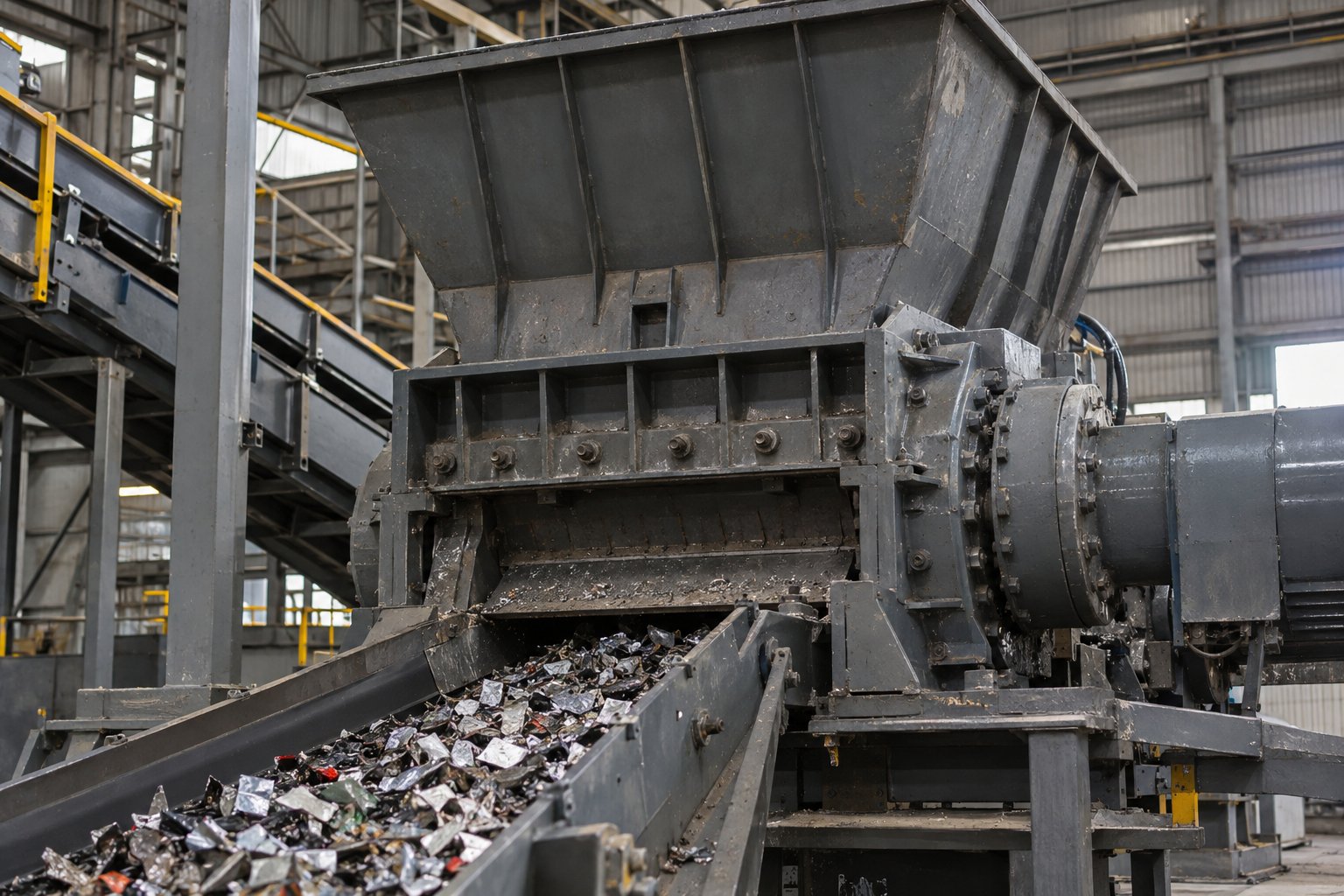
Technical Explanation
A yard that handles baled white goods, mixed light iron and cable scrap usually meets the same problem: the material is too bulky or too tangled for the next process, and it arrives in unpredictable shapes. An industrial shredder is the machine that turns that irregular feed into a controlled size. What it is not is a hammer mill or a granulator, even though suppliers and buyers often use the words interchangeably.
- The defining mechanism is low-speed, high-torque shear, not high-speed impact.
- In a twin-shaft shredder, two counter-rotating hex shafts shear material between interlocking cutters.
- Machine class follows material and throughput, not brand or price bracket.
- Output size is set by cutter configuration, screen and hopper, all of which can be specified at order.
Definition: what makes a shredder a shredder
An industrial shredder is a size-reduction machine that uses rotating cutters to shear, tear and split material into smaller pieces. It runs at low shaft speed and high torque, which is the opposite of a hammer mill. That single difference explains most of the behaviour buyers notice in the yard.
In a twin-shaft design, two hex cutter shafts rotate in opposite directions. Material is pulled between the interlocking cutters and sheared rather than struck. Because the shafts turn slowly, the machine tolerates mixed and contaminated feed: painted sheet, cable with insulation attached, small appliances, aluminium profiles. A hammer mill, by contrast, relies on fast impact and needs more uniform feed to perform consistently.
That is why the phrase “industrial shredder” describes a family of machines rather than one unit. Capacity, cutter size and drive power vary widely across the class. Manufacturers typically build machines covering a throughput range from around 2 t/h up to roughly 30 t/h, which is wide enough to include both a light-duty line for sheet metal and a heavy unit for whole appliances.
How a shredder differs from a crusher or granulator
Buyers searching for an industrial shredder often arrive from a crusher search, so the boundary matters. The three terms overlap in the yard but describe different principles.
| Machine | Reduction principle | Typical feed | Output character |
|---|---|---|---|
| Industrial shredder (twin shaft) | Low-speed shear between counter-rotating cutters | Mixed, bulky or contaminated scrap; whole appliances; cable | Coarse to medium; size set by cutters and screen |
| Hammer mill crusher | High-speed impact from swinging hammers | More uniform, brittle or friable material | Finer, less uniform when feed varies |
| Granulator | High-speed cutting against a screen | Pre-sized scrap, often post-shred | Fine, narrow particle range |
Table describes general machine principles. Actual performance depends on the specific model, cutter configuration and feed material.
The practical consequence: if the feed arrives as loose mixed scrap, a shredder is usually the first stage. A granulator is more often the second stage, after the material has already been opened up and sized. Hammer mills suit feed that is already reasonably consistent. An operator who sends tangled cable straight into a granulator will spend more time clearing the chamber than running it.
Main shredder types and where each one fits
The market offers single-shaft, twin-shaft and four-shaft shredders, plus hammer mills in shredder roles. For scrap metal and mixed recycling, twin-shaft and four-shaft designs cover most requirements, and the choice depends on two variables: what the material is, and how many tonnes per hour the line has to move.
Twin-shaft shredders
Two counter-rotating shafts with interlocking cutters. The design accepts bulky, irregular and lightly contaminated feed, and it is the standard first-stage machine in scrap yards. It shears rather than pulverises, so output is coarse and consistent enough for downstream separation. Cutter discs, screens and hoppers can be configured to the feed, which is how one basic machine frame serves very different yards.
Four-shaft shredders
A four-shaft machine adds a second cutting stage, so the same unit can reduce material further and produce a more uniform output. It is chosen when the buyer wants fewer process steps between infeed and a saleable or sortable fraction.
Selecting by material and throughput class
The useful way to read a shredder specification is to match the material to the throughput class. Three examples from a current twin-shaft range show how the boundaries run.
| Model | Drive and chamber | Capacity | Feed it is built around |
|---|---|---|---|
| TG-LightMetal 80 | 2 x 15 kW light-duty twin shaft | Light-duty class | Thin sheet steel, aluminium, copper, brass, cable |
| TG-TwinShred 300 | 2 x 45 kW; 800 x 600 mm chamber | 3–6 t/h | Thin sheet steel, aluminium profiles, cable, small appliances |
| TG-MegaShred 1600 | 2 x 400 kW; 1,400 x 1,100 mm chamber | 30–40 t/h | Whole white goods, large mixed material |
The pattern is straightforward. The TG-LightMetal 80 handles non-ferrous and light sheet at low volume, where a heavier machine would be oversized. The TG-TwinShred 300 sits in the middle, taking mixed light iron, cable and small appliances at 3–6 t/h. The TG-MegaShred 1600 is built for volume: a 1,400 x 1,100 mm chamber accepts whole white goods without pre-cutting, and the hydraulic chamber opening and per-shaft load monitoring support that duty.
Note the chamber dimension, not just the kilowatt figure. A 45 kW machine with an 800 x 600 mm chamber and a 400 kW machine with a 1,400 x 1,100 mm chamber are not the same tool at different speeds; the chamber decides what can physically enter without secondary handling.
Features that matter once the machine is running
Three engineering details separate a machine that survives mixed scrap from one that stops constantly.
- Bolt-on alloy cutters. Cutters are wear parts. A bolt-on design lets a single damaged disc be replaced rather than the whole shaft assembly. The TG-TwinShred 300 uses bolt-on alloy cutters for this reason.
- PLC-controlled automatic reversal. When material bridges or wraps, the control system reverses the shafts to clear the jam without an operator opening the chamber. This is standard on the TG-TwinShred 300.
- Hydraulic chamber opening and per-shaft load monitoring. On a 30–40 t/h machine, access for inspection and balanced load across both shafts become operational necessities, as configured on the TG-MegaShred 1600.
Around these details sit the standard supply terms buyers ask about: CE certification for the EU market, UL-compliant electrical control cabinets available on request for North America, and a factory that holds ISO 9001. Machines carry a 12-month warranty with a spare parts kit supplied alongside the unit. Standard models ship within 45 days.
Frequently asked questions
Is a shredder the same as a crusher?
No. A shredder reduces size mainly by low-speed shear; a crusher such as a hammer mill reduces size by high-speed impact. The two can sit in the same line, with the shredder first.
Can one shredder handle both cable and whole appliances?
Not efficiently. Cable and thin sheet belong to the light and mid classes, while whole white goods need a much larger chamber and drive. The throughput gap between a 3–6 t/h unit and a 30–40 t/h unit reflects that difference.
How is output size controlled?
By cutter disc profile, screen and hopper configuration, all specified against the feed at the time of order. Changing the feed without revisiting these settings is a common cause of disappointing output.
What should a buyer prepare before requesting a machine?
Material type and mix, the largest piece that must enter the chamber, target tonnes per hour, and the downstream process the shredded material feeds into. Those four answers determine the model class more reliably than any single specification.
Where to go next
An industrial shredder is defined by its shear principle, and its usefulness in a yard is defined by whether the chamber and drive match the feed. Buyers who can state their material and hourly target can be matched to a model class quickly; the three units above cover light non-ferrous work, mixed light iron, and high-volume appliance processing respectively. Share the feed specification and the required throughput, and the appropriate configuration of cutters, screen and hopper can be confirmed against it.