
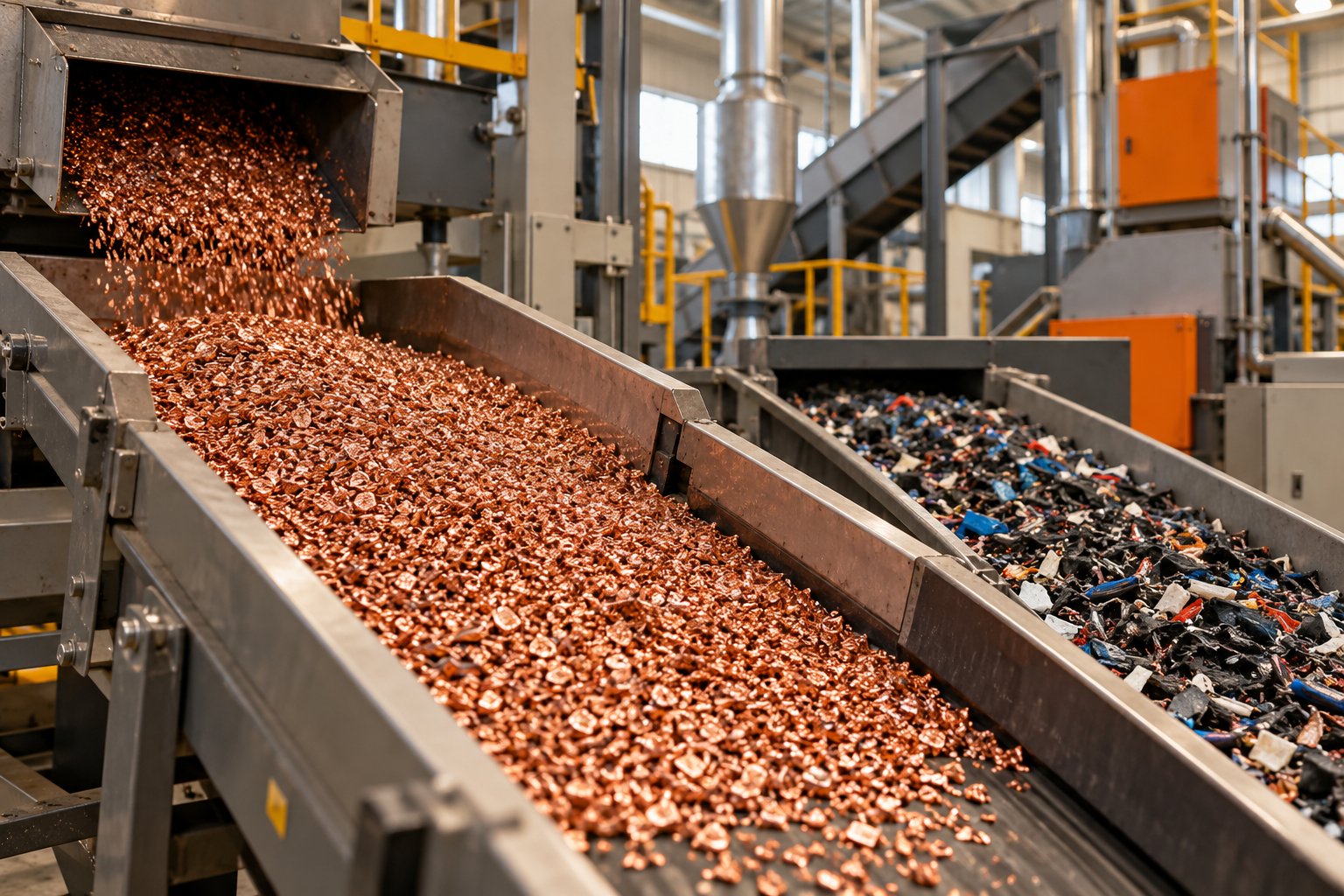
Copper Cable
Copper cable is an electrical conductor made of copper, wrapped in insulation and sometimes additional layers, used to carry current or signals. The construction varies by application: building wire, power cable, communication cable, and magnet wire each use different conductor forms and insulation materials. Those differences determine how much recoverable copper the cable contains and how easily that copper can be separated from the jacket.
Key takeaways
- Copper cable always contains a conductor and insulation; the conductor carries current, the insulation contains it and protects against contact and environmental exposure.
- Building wire, power cable, communication cable, and magnet wire are four main families, each with distinct conductor and insulation configurations.
- Recovery value depends on copper content, insulation type, and how cleanly the two can be separated.
- Mechanical separation — shredding, granulating, air separation, and vibration tabling — produces clean metal granules suitable for smelting.
What is copper cable?
Copper cable is a cable in which copper is the conductive element. Copper is chosen because it has low electrical resistivity, good ductility, and reliable performance at connections. A cable typically consists of:
- Conductor: one or more copper wires, either solid or stranded, that carry current.
- Insulation: a dielectric layer — PVC, XLPE, rubber, enamel, or other materials — that prevents current from leaving the conductor.
- Optional layers: shielding, bedding, armouring, or an outer sheath for mechanical or environmental protection.
The term covers a wide range. A single-core building wire and a multi-core armoured power cable are both copper cables, but they look and behave very differently at end of life.
Main types of copper cable
Building wire
Building wire is used for fixed wiring inside structures — lighting circuits, socket outlets, and distribution boards. It is usually solid or stranded copper with thermoplastic insulation (commonly PVC), supplied in single cores or small multi-core configurations. Insulation thickness is modest because the cable operates in dry, protected environments.
Power cable
Power cable carries higher currents between transformers, switchgear, motors, and distribution points. Conductors are stranded copper, often larger in cross-section, with thicker insulation (PVC, XLPE, or rubber) and frequently additional layers such as bedding, armouring, and an outer sheath. Some power cables use aluminium conductors, so not every power cable is a copper cable.
Communication cable
Communication cable carries signals rather than significant power. Twisted-pair and similar constructions use smaller copper conductors, often 0.4–0.6 mm, with foam or solid plastic insulation and sometimes foil or braided shielding. Conductor cross-section is small, but the number of pairs can be high.
Magnet wire (enamelled wire)
Magnet wire is used in motor windings, transformers, inductors, and coils. The conductor is usually solid copper, and the insulation is a thin enamel coating rather than a thick plastic jacket. This construction allows tight winding but makes the insulation difficult to remove by hand.
Conductor vs insulation
The conductor is the copper itself — the part that carries current and the part with recoverable metal value. The insulation is everything around it: plastic, rubber, enamel, tape, or sheath. Insulation protects the conductor, but it also represents weight and volume that must be separated before the copper can be sold or smelted.
Two cables with the same overall diameter can contain very different amounts of copper. A thick power cable with heavy armouring may have a low copper-to-insulation ratio, while a compact building wire with thin insulation may have a high one. Recovery economics start with that ratio.
Common uses
| Type | Typical conductor | Typical insulation | Common uses |
|---|---|---|---|
| Building wire | Solid or stranded copper | PVC or thermoplastic | Lighting, sockets, panel wiring |
| Power cable | Stranded copper (sometimes aluminium) | XLPE, PVC, rubber, with optional armouring | Distribution, motors, industrial feeders |
| Communication cable | Small stranded or solid copper | Foam or solid plastic, shielding | Telecom, data, control signals |
| Magnet wire | Solid copper | Thin enamel coating | Motors, transformers, coils |
Why different cables carry different recovery value
Recovery value is not a single number. It follows from three practical factors:
- Copper content by weight. Cables with large conductors and thin insulation yield more copper per tonne of input. Communication cable with many small pairs and magnet wire with a high enamel-to-copper ratio yield less.
- Insulation type and adhesion. Loose PVC jackets separate easily. Enamel on magnet wire and bonded or heavily filled insulations are harder to strip cleanly.
- Cleanliness of the separated copper. Buyers of recovered copper value clean granules. Copper mixed with plastic dust, foil, or rubber may need further processing or may command a lower grade.
Because of these factors, a recycler cannot treat all copper cable as one material. The same machine setup that works well for one cable type may need adjustment for another.
How recovery works
Mechanical cable recycling separates copper or aluminium conductor from plastic and rubber insulation. A typical line includes a twin-shaft shredder to reduce cable size, a granulator to liberate conductor from insulation, air separation to remove light plastics, and a vibration table to separate remaining heavy fractions. The output is clean metal granules intended for smelting.
The TG-CableLine 100 Cable and Wire Recycling Line uses this configuration — twin-shaft shredder, granulator, air separation, and vibration table — to process copper and aluminium cable into separated metal granules. If you are evaluating recovery equipment for a specific mix of building wire, power cable, communication cable, or magnet wire, the TG-CableLine 100 page describes the process flow and equipment sequence.
Note: Recovery results depend on the cable mix, insulation type, and how the line is configured. For a specific cable stream, confirm the expected separation and output with the equipment supplier.
FAQ
Is all copper cable the same for recycling?
No. Copper content, insulation material, and construction vary widely. Building wire, power cable, communication cable, and magnet wire behave differently in shredding and separation, and they yield different proportions of clean copper.
Can aluminium cable be processed the same way?
Mechanical separation lines can handle both copper and aluminium conductors. The same stages — shredding, granulating, air separation, and vibration tabling — apply, though settings may need adjustment for the material.
What affects the grade of recovered copper?
Purity matters. Copper granules free of plastic, rubber, and foil are generally more suitable for smelting than mixed output. Insulation type and separation efficiency are the main variables.
If you are assessing cable recycling equipment for a particular mix of building wire, power cable, communication cable, or magnet wire, share your cable types and target output so the line configuration can be matched to your material.