
Copper cable is used for carrying electrical power and signals in buildings, utility distribution networks, industrial electrical equipment, and vehicle and machinery harnesses. Those same four places are where scrap yards get their cable: demolition debris, replaced utility lines, decommissioned equipment, and end-of-life vehicles and machines. Recognizing which stream a piece of cable came from tells you a lot about its conductor, its insulation, and how much handling it needs before it becomes clean granulated metal.
What matters when sorting incoming cable
- Conductor: bare bright, tinned, stranded, or aluminum rather than copper.
- Insulation: thermoplastic, rubber, or mixed jackets, and whether it is bonded to the conductor.
- Contamination: steel armor, lead sheathing, connectors, tape, and filler that lower recovery value.
- Condition: short cut-offs versus long continuous lengths, which affects how the material feeds a shredder.
What this guide covers
- Building demolition and renovation cable
- Power infrastructure and utility cable
- Electrical equipment and control cable
- Vehicle and machinery harness cable
- Sorting and processing notes
Building demolition and renovation cable
Most cable that arrives with a demolition or strip-out load is building wire and small power cable. It was installed to carry branch circuits, lighting, and communication signals, so it is usually lighter and more varied than utility cable.
Fixtures and fitting types are the dominant conductor in older housing and commercial block wiring: a single solid or coarse-stranded copper core in a plastic or rubber jacket. Larger service and feeder cable in the same buildings carries the stranded conductor configuration, often with a tough thermoplastic jacket, sometimes with a bare ground conductor running alongside.
Communication and low-voltage cable sits in the same stream and is easy to mis-sort because it is thin and arrives in bundles.
- Twisted-pair and telephone cable: solid copper conductors, thin plastic insulation, often a foil or braided shield.
- Coaxial cable: a copper center conductor, a metallic shield, and a plastic outer jacket.
- Fire alarm and signal cable: multiple small conductors, sometimes tinned, with a jacket that may be bonded tightly to the core.
For a yard, the practical sorting decision here is whether you are looking at power cable or communication cable. Power cable gives heavier copper per meter; communication cable is thinner and usually needs the jacketing and shielding stripped before it grades cleanly.
Power infrastructure and utility cable
Utility and industrial power cable is the heaviest material in the copper scrap stream. It comes from replaced distribution lines, substation work, and heavy industrial feeds. Its conductors are almost always stranded copper for flexibility, and the insulation is thicker because it was designed to withstand outdoor and underground service.
The insulation system is where the sorting risk sits. Utility cable often uses layered construction: a conductor shield, the main insulation, and an outer jacket, sometimes with metallic components such as armor or sheathing built in. Those layers can be tightly bonded, which makes clean separation harder than with simple building wire.
Conductor notes for this stream:
- Stranded copper, frequently with a large cross-section, is the common configuration.
- Tinned or coated strands appear on some industrial cable and can affect how the material grades.
- Aluminum conductor cable also appears in this stream. It is not copper scrap, and it must be routed separately.
Because lengths are long and jacket layers are thick, this is the cable type that most rewards a purpose-built line rather than hand stripping. See the TG-CableLine 100 Cable and Wire Recycling Line for a configuration that shreds, granulates, and separates this material with air separation and a vibration table.
Electrical equipment and control cable
When a plant replaces a panel, a motor, a transformer, or a control cabinet, the cable that comes out with it is a mixed bag. It includes flexible cord, panel wire, and multi-conductor control cable installed to carry power and logic signals inside equipment.
The conductors here are finer than building wire and usually stranded, because equipment cable has to tolerate movement, tight bends, and vibration. Insulation is commonly flexible plastic or rubber, and multi-conductor cable carries several small cores inside one outer jacket, sometimes with a filler and a shield.
Two sorting points are worth flagging:
- Fine-strand cable produces more surface area and more insulation per unit of metal, so accurate separation matters for recovery purity.
- Shielded and armored equipment cable carries extra metallic components that are not the conductor and should not be counted as copper content.
Most equipment cable is short cut-offs and coils rather than long runs. That actually helps in a granulation-based line, because the material feeds more uniformly than long, bulky utility cable.
Vehicle and machinery harness cable
Auto and machinery harness is the smallest-gauge cable a yard is likely to see in volume. It comes from end-of-life vehicles, dismantled machinery, and parts inventories. The cable was designed for low-voltage circuits with limited current, so the conductors are fine and the insulation is thin.
Conductor and insulation notes:
- Fine stranded copper is standard, and some conductors are tinned for corrosion resistance.
- Insulation is thermoplastic, usually thin-walled, and often colour-coded rather than clearly marked.
- Harness comes bundled with connectors, tape, corrugated loom, and sometimes a steel or plastic frame, all of which reduce clean copper content until removed.
Harness is the material where manual stripping is least economical. The copper-to-insulation ratio is low, so the value is in mechanical separation rather than hand work. It also blends well with other fine-wire streams when feeding a shredder-and-granulator line, because it does not require pre-cutting to length.
Sorting and processing notes across all four streams
Sorting starts with a single question: where did this cable come from? That answer predicts the conductor configuration and the insulation type well enough to route the material before it reaches the processing line.
| Source stream | Typical conductor | Typical insulation | Main sorting issue |
|---|---|---|---|
| Building demolition | Solid or coarse-stranded copper | Plastic or rubber jacket | Communication cable mixed with power cable |
| Power infrastructure | Heavy stranded copper or aluminum | Layered, thick jacket, sometimes armored | Bonded layers and non-conductor metal |
| Electrical equipment | Fine stranded copper | Flexible plastic or rubber | Shields, fillers, and high insulation share |
| Vehicles and machinery | Fine stranded, sometimes tinned | Thin thermoplastic | Connectors, tape, and loom in the bundle |
Practical steps before the line
- Separate aluminum-conductor cable from copper cable at the gate; do not let it enter the copper stream.
- Remove steel armor, lead sheathing, and heavy connectors where they are easy to access, and keep them in their own containers.
- Keep long utility lengths and short mixed cut-offs in separate piles so they can be fed at different rates.
- Do not judge recovery from appearance alone. Run a representative sample through your process and weigh the metal output.
Why an integrated line suits mixed cable
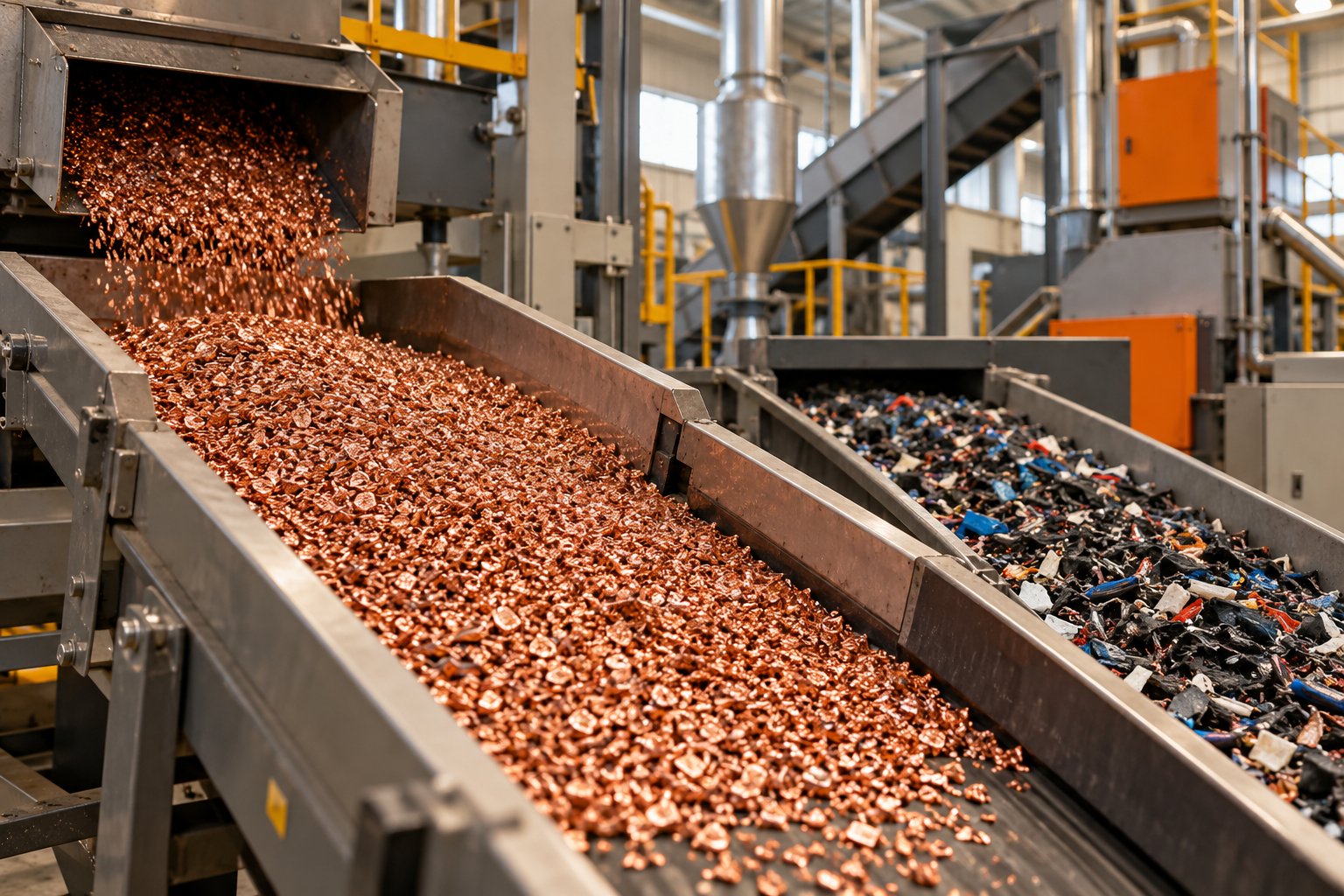
Mixed incoming cable is the normal case for most yards, not the exception. A line built around a twin-shaft shredder, a granulator, air separation, and a vibration table handles that mix without pre-sorting every conductor size: the shredder reduces long runs and bundles, the granulator liberates the conductor, and the separation stages split copper or aluminum granules from plastic and rubber insulation for smelting.
Tian Gong has manufactured metal shredders, crushers, and integrated scrap processing lines since 2008, with equipment that is CE-marked and produced in an ISO 9001 facility. The TG-CableLine 100 is covered by a 12-month warranty. Exact throughput for your material mix depends on cable type, so it is worth testing a sample before committing to a configuration.
Answering “what is copper cable used for” from the scale house
Copper cable is used wherever power or signal has to move: through buildings, along utility routes, inside electrical equipment, and through vehicles and machines. For a recycler, the useful version of that question is narrower — which of those four streams is this load from, and what does that tell me about the copper inside it. Sort by stream, check the conductor and insulation, and let the separation equipment do the work that hand stripping cannot.
Cable appearance varies by manufacturer and installation age. If you are unsure how a load will grade or how it will run on a line, request a material test with a representative sample rather than estimating from the outside.